
One-Piece vs Two-Piece Silicone Molds: Complete Comparison
Choosing between one-piece and two-piece silicone molds is one of the most important decisions in mold procurement. Each type has distinct advantages and l
 Kyler Yang · Founder4 min read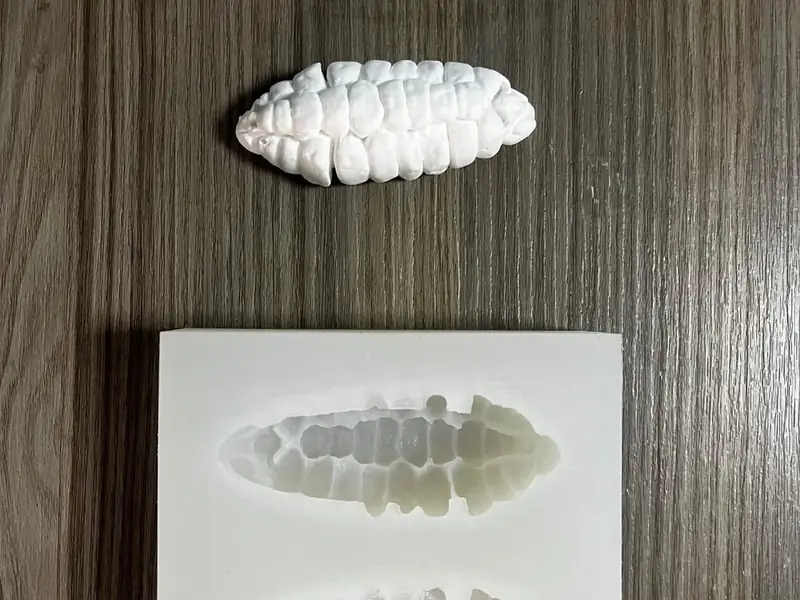
Introduction
Choosing between one-piece and two-piece silicone molds is one of the most important decisions in mold procurement. Each type has distinct advantages and limitations. This guide helps you select the right architecture for your production needs.
One-Piece Molds
Definition
One-piece molds (also called open molds or single-cavity molds) have cavities that are open on one side. They function like trays with individual compartments.
Structure
`` ┌─────────────────────────────┐ │ ┌───┐ ┌───┐ ┌───┐ │ │ │ │ │ │ │ │ ... │ │ └───┘ └───┘ └───┘ │ │ │ └─────────────────────────────┘ ↑ Open on top ``
Best Applications
| Product Type | Why One-Piece Works |
|---|---|
| Gummy bears | Flat bottom, open top |
| Chocolate squares | Simple geometry |
| Hard candy | Easy demolding |
| Flood-and-scrape products | Designed for this method |
| Flat-bottomed items | No underside needed |
Advantages
| Advantage | Explanation |
|---|---|
| Lower cost | Simpler design, less material |
| Faster production | Single-step process |
| Easier cleaning | Open cavities accessible |
| Flood-and-scrape compatible | Industry standard for high volume |
| Simpler design | Fewer alignment features needed |
| Better for flat products | No top/bottom separation issues |
Limitations
| Limitation | Explanation |
|---|---|
| Flat bottoms only | Cannot create fully enclosed 3D shapes |
| Limited geometry | No undercuts or complex 3D forms |
| Product orientation | Products must release from top |
Typical Specifications
| Specification | Range |
|---|---|
| Durometer | 20A-30A |
| Cavity count | 50-600 |
| Tray size | 30×40cm to 60×80cm |
| Production method | Hand pour, flood-and-scrape, automatic depositor |
Two-Piece Molds
Definition
Two-piece molds consist of two interlocking halves that form a fully enclosed cavity when closed. They create 3D shapes with no open sides.
Structure
``` Top Half: ┌───────────────┐ │ ┌─────┐ │ │ │ │ │ │ └─────┘ │ └───────────────┘
Bottom Half: ┌───────────────┐ │ ┌─────┐ │ │ │ │ │ │ └─────┘ │ └───────────────┘
When Closed: ┌───────────────┐ │ ┌─────┐ │ │ │ ● │ │ ← Enclosed 3D cavity │ └─────┘ │ └───────────────┘ ```
Best Applications
| Product Type | Why Two-Piece Works |
|---|---|
| 3D character gummies | Full enclosure needed |
| Complex shapes | Undercuts and details |
| Filled chocolates | Enclosed cavity for filling |
| Decorative pieces | All-around detail |
| Non-flat products | Complete 3D geometry |
Advantages
| Advantage | Explanation |
|---|---|
| 3D shapes | Create fully enclosed products |
| Undercut capability | Complex geometries possible |
| All-around detail | Details on all surfaces |
| Filled products | Can create hollow or layered products |
| No flat bottom | Products can be shaped on all sides |
Limitations
| Limitation | Explanation |
|---|---|
| Higher cost | More material, complex design |
| Slower production | Two-step process (close, fill, open, remove) |
| Alignment required | Pins and alignment features needed |
| Harder cleaning | Sealed cavities harder to access |
| More complex | Higher skill required for operation |
Typical Specifications
| Specification | Range |
|---|---|
| Durometer | 15A-25A |
| Cavity count | 20-200 (per pair) |
| Tray size | Custom |
| Production method | Manual pour, automated injection |
Side-by-Side Comparison
| Feature | One-Piece | Two-Piece |
|---|---|---|
| Cost | Lower | Higher (2x-3x) |
| Production speed | Faster | Slower |
| Shape complexity | Simple (flat bottom) | Complex (3D) |
| Undercuts | Not possible | Possible |
| Detail on all sides | No | Yes |
| Flood-and-scrape | Compatible | Not compatible |
| Cleaning | Easier | Harder |
| Maintenance | Simpler | More complex |
| Best for | High-volume, simple shapes | Low-volume, complex shapes |
| Operator skill | Lower | Higher |
Decision Matrix
When to Choose One-Piece
| Your Situation | Recommendation |
|---|---|
| Producing gummy bears or simple shapes | One-piece ✓ |
| Using flood-and-scrape method | One-piece ✓ |
| High-volume production (>5,000/day) | One-piece ✓ |
| Limited budget | One-piece ✓ |
| Manual or semi-automatic production | One-piece ✓ |
| Need flat-bottomed products | One-piece ✓ |
When to Choose Two-Piece
| Your Situation | Recommendation |
|---|---|
| Producing 3D character shapes | Two-piece ✓ |
| Products need undercuts | Two-piece ✓ |
| All-around detail required | Two-piece ✓ |
| Low-volume, high-value products | Two-piece ✓ |
| Filled or layered products | Two-piece ✓ |
| Custom decorative shapes | Two-piece ✓ |
Hybrid Options
One-Piece with Removable Inserts
Some manufacturers offer hybrid designs:
- One-piece base with interchangeable inserts
- Allows for different shapes from same tray base
- Reduces tooling cost for multiple products
Two-Piece with Open Top Option
Some two-piece molds can be used as:
- Closed — for full 3D shapes
- Open — for flat-bottomed variants
- Provides flexibility for product line expansion
Cost Comparison
Typical Pricing
| Mold Type | Simple | Moderate | Complex |
|---|---|---|---|
| One-piece (100 cavities) | $400 - $800 | $800 - $1,500 | $1,500 - $2,500 |
| Two-piece (50 cavities) | $800 - $1,500 | $1,500 - $3,000 | $3,000 - $5,000 |
Cost Per Piece Analysis
| Factor | One-Piece | Two-Piece |
|---|---|---|
| Mold cost per piece | Lower | Higher |
| Labor cost per piece | Lower | Higher |
| Cycle time per piece | Faster | Slower |
| Defect rate | Lower | Higher (alignment issues) |
| Total cost per piece | Lower | Higher |
Production Efficiency
One-Piece Production Flow
`` Load mold → Flood deposit → Scrape → Cool → Flip → Demold → Collect ``
Cycle time: 5-15 seconds (deposition) + cooling time
Two-Piece Production Flow
`` Open mold → Place bottom half → Deposit → Close top half → Cool → Open → Remove → Clean ``
Cycle time: 15-30 seconds (deposition + closing) + cooling time
Throughput Comparison
| Metric | One-Piece | Two-Piece |
|---|---|---|
| Cycles per hour | 200-400 | 80-150 |
| Pieces per hour (200 cavities) | 40,000-80,000 | 16,000-30,000 |
| Operator attention | Minimal | Higher |
FAQ
Q: Can I use a one-piece mold for 3D shapes? A: No. One-piece molds can only create products with a flat bottom. For 3D shapes, you need a two-piece mold.
Q: Are two-piece molds worth the extra cost? A: Yes, if you need 3D shapes or complex geometry. The higher cost is justified by the design capability.
Q: Which is better for high-volume production? A: One-piece molds with flood-and-scrape are the industry standard for high-volume production due to speed and lower cost.
Q: Can I convert a one-piece mold to two-piece? A: No. The mold architecture is determined during design. Plan your needs before ordering.
Q: What durometer should I choose? A: One-piece: 20A-30A. Two-piece: 15A-25A (softer for complex shape release).
Conclusion
One-piece molds excel in high-volume, simple-shape production. Two-piece molds enable complex 3D geometry at the cost of speed and complexity. Choose based on your product requirements, production volume, and budget.
For expert guidance on mold architecture selection, contact our engineering team.
*Published: 2026-08-12 | Category: Mold Types | Read Time: 8 minutes*
Ready to order custom silicone molds?
Free quote for OEM/ODM projects. MOQ 20 · Prototype 3-7 days · FDA/LFGB available.