
One-Piece vs. Two-Piece Silicone Molds: Which Architecture Is Right for Your Production?
The architecture of your silicone mold — whether one-piece (open) or two-piece (split) — determines what products you can make, how efficiently you can pro
 Kyler Yang · Founder5 min read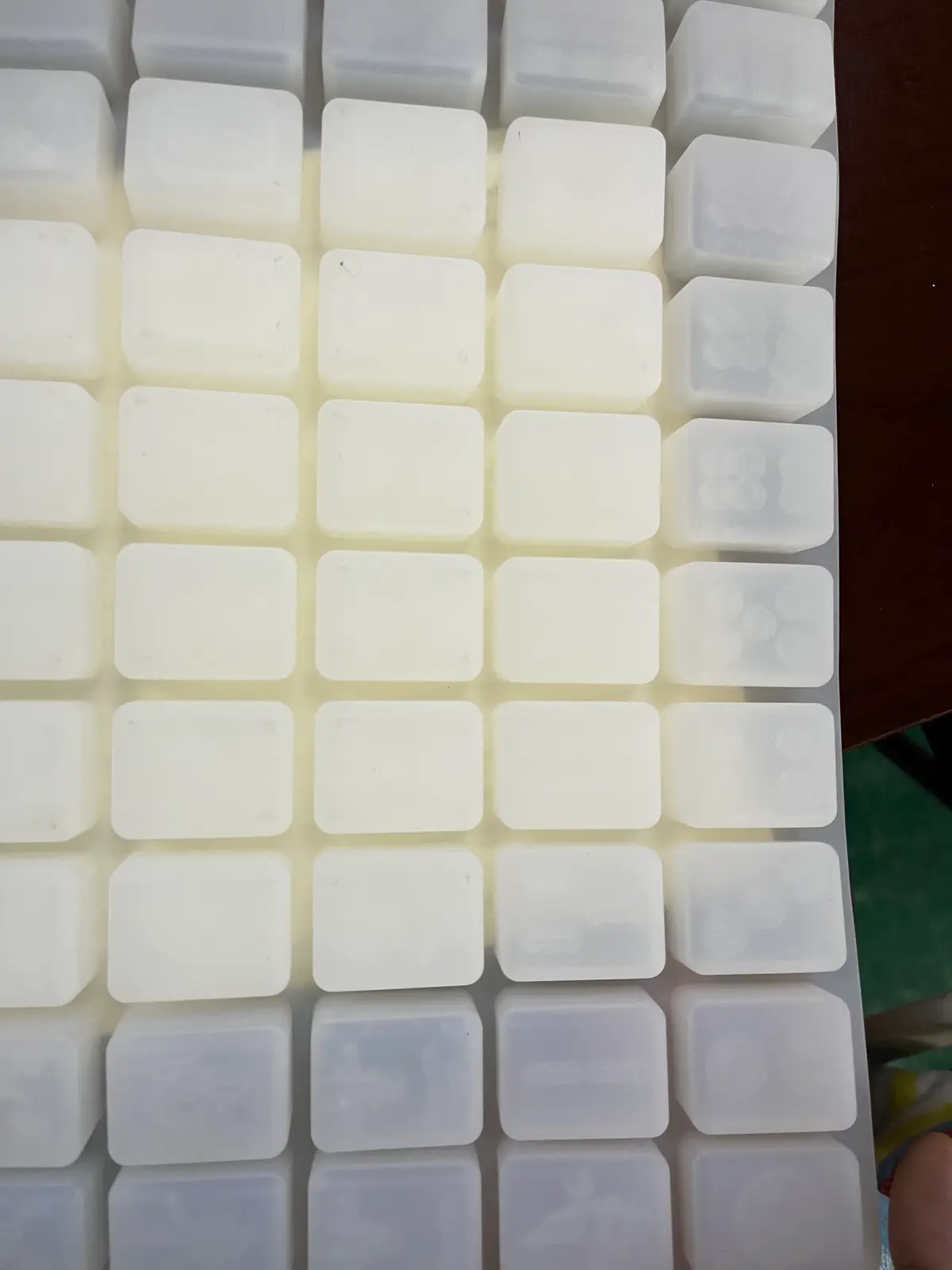
Understanding Mold Architecture
The architecture of your silicone mold — whether one-piece (open) or two-piece (split) — determines what products you can make, how efficiently you can produce them, and what level of detail you can achieve. This guide helps you choose the right architecture for your production needs.
One-Piece (Open) Molds
How They Work
One-piece molds consist of a single block of silicone with cavities open to the top. The product is poured into the open cavities, set, and then removed from the same side — similar to an ice cube tray.
Best Applications
| Application | Why It Works |
|---|---|
| Flat-bottomed gummies | No undercuts; clean release from open cavity |
| High-cavity-count trays | Open design allows maximum cavity density |
| Flood-and-scrape production | Cavities accessible for simultaneous filling |
| Simple geometric shapes | Squares, rectangles, circles, bears |
| Hand-pour operations | Easy access for manual filling |
Advantages
| Benefit | Description |
|---|---|
| Faster production | Higher cavity count means more pieces per pour |
| Lower cost | Simpler design, faster manufacturing |
| No parting line | Product has a clean bottom surface |
| Easier to use | No assembly/disassembly required |
| Better for depositors | Open cavities ideal for flood-and-scrape |
Limitations
| Limitation | Impact |
|---|---|
| Flat bottom required | Cannot produce 3D shapes with undercuts |
| Limited detail on bottom | Bottom surface is featureless |
| Depth constraints | Deep cavities make demolding difficult |
| No enclosed 3D replication | Cannot capture detail on all surfaces |
Two-Piece (Split) Molds
How They Work
Two-piece molds consist of two interlocking halves that form a fully enclosed 3D cavity. The product is poured into the closed cavity, and the two halves are separated to remove the product — similar to a clam shell.
Best Applications
| Application | Why It Works |
|---|---|
| Complex 3D shapes | Characters, letters, spheres, intricate designs |
| Full-surface detail | Logo and texture on all sides of the product |
| Undercut geometries | Features that extend below the cavity opening |
| State regulatory symbols | Precise reproduction of multi-angle symbols |
| Premium/novelty products | Stand-out shapes that require 3D detail |
Advantages
| Benefit | Description |
|---|---|
| True 3D replication | Captures detail on all surfaces |
| Complex geometries | Can reproduce any shape, including undercuts |
| Premium product quality | No flat bottom — fully detailed product |
| Detail fidelity | Superior reproduction of fine features |
| Design flexibility | Unlimited shape possibilities |
Key Engineering Features
Registration System: Alignment pins and corresponding holes ensure the two halves always close in the exact same position. This prevents:
- Misaligned seams on the product
- Flash (excess material at the parting line)
- Cavity volume variation
Lock-and-Key Geometry: For asymmetric molds, unique alignment shapes prevent incorrect assembly. This is critical for:
- Products with orientation-specific designs
- Molds that could be assembled in multiple ways
- Ensuring consistent product quality
Beveled Pry Edges: Chamfered edges at the parting line allow clean separation without damaging cavity surfaces. This:
- Reduces operator fatigue
- Prevents edge damage during separation
- Extends mold lifespan
Limitations
| Limitation | Impact |
|---|---|
| Lower cavity count | Mold half thickness reduces available cavity space |
| Higher cost | More complex design and manufacturing |
| Parting line visible | Product has a seam where halves meet |
| Assembly required | Must align and close halves before each pour |
| Slower production | Additional handling time for assembly/disassembly |
Comparison Matrix
| Factor | One-Piece (Open) | Two-Piece (Split) |
|---|---|---|
| Cavity count per tray | 48-144 | 12-48 |
| Product detail | Top surface only | All surfaces |
| Undercut capability | No | Yes |
| Manufacturing cost | Lower | Higher |
| Production speed | Faster | Slower |
| Operator skill required | Lower | Higher |
| Best for | High-volume, simple shapes | Premium, complex shapes |
| Parting line | None | Visible (strategically placed) |
| Depositor compatibility | Excellent | Good (with proper design) |
| Regulatory symbol reproduction | Limited | Excellent |
Decision Framework: Which Architecture Should You Choose?
Choose One-Piece (Open) Molds When:
1. Your product has a flat bottom — Gummy bears, squares, bars, lollipops 2. Production volume is the priority — You need maximum output per pour 3. You use automatic depositors — Flood-and-scrape requires open cavities 4. Budget is a constraint — One-piece molds are more cost-effective 5. Operator simplicity matters — No assembly required, faster cycle times
Choose Two-Piece (Split) Molds When:
1. Your product is fully 3D — Characters, letters, spheres, custom shapes 2. Detail on all surfaces is critical — Logo embossing, textured surfaces 3. You produce regulatory symbols — Multi-angle precision required 4. Product differentiation is a priority — Unique shapes that stand out 5. You're producing premium products — Willing to trade speed for quality
Hybrid Approach: Use Both
Many successful producers use a combination:
- One-piece molds for standard, high-volume products
- Two-piece molds for specialty, premium, or regulatory products
This approach optimizes both production efficiency and product differentiation.
Real-World Examples
Example 1: Standard Gummy Bear Production
- Product: 2g gummy bears, 10,000 pieces per shift
- Recommended: One-piece mold, 96 cavities, 20A durometer
- Rationale: High volume, simple shape, flat bottom, depositor compatible
Example 2: CBD-Infused Gummy with State Symbol
- Product: 10mg CBD gummy with Colorado hexagon gem
- Recommended: Two-piece mold, 24 cavities, 20A durometer
- Rationale: Regulatory symbol requires 3D detail, dosing accuracy critical
Example 3: Premium Chocolate Gummy
- Product: 5g chocolate-coated gummy with custom logo
- Recommended: Two-piece mold, 12 cavities, 25A durometer
- Rationale: Logo on all surfaces, chocolate requires firmer durometer
Example 4: Large-Format Protein Gummy
- Product: 15g protein gummy, flat bottom, simple shape
- Recommended: One-piece mold, 24 cavities, 25A durometer
- Rationale: Large cavity size, simple geometry, high structural rigidity needed
FAQ
Q: Can I convert a one-piece mold to two-piece? A: No, the architecture is determined during the mold design and manufacturing process. If you need two-piece capabilities, you'll need to commission new molds.
Q: Do two-piece molds take longer to produce? A: Yes, two-piece molds require additional engineering for registration features and parting line optimization. Lead time is typically 20-30% longer than one-piece molds.
Q: Will the parting line affect my product appearance? A: Our engineering team strategically places parting lines to minimize visibility. For most products, the parting line is positioned on a non-critical surface area.
Q: Can I use two-piece molds with automatic depositors? A: Yes, but the mold must be specifically designed for depositor compatibility. The parting line must be perfectly flush, and registration features must maintain alignment under depositor pressure.
*Published: 2026-08-12 | Category: Production Engineering | Read Time: 9 minutes*
Ready to order custom silicone molds?
Free quote for OEM/ODM projects. MOQ 20 · Prototype 3-7 days · FDA/LFGB available.