
Tin-Cure RTV Odor Is Condensation Leftover | RUUIPON
Tin RTV smells from condensation leftover, not new-platinum shop odor. Why it stays, why we skip tin on chocolate, and the RFQ lines. Typical shop values.
 Kyler Yang · Founder9 min read
Condensation-cure (tin) RTV smells because the network throws off a small leftover as it crosslinks — usually an alcohol note, sometimes a vinegar-sour acetic note depending on the tin system. That odor lives in the bulk, not only on a dirty face. A wash will not delete it the way a short rest deletes faint platinum shop volatiles. If you can still smell the well after a clean, dry overnight, you are smelling chemistry, not "new rubber." For chocolate, gummy, ice, baking, or popsicle cavities we will not spec tin. We quote platinum, mix 1:1 or 10:1 by weight, and a wash-and-rest before first food dump.
On this site the path is photos, sketch, or CAD, then a 3D-printed pattern, often a temporary silicone flip, a resin production mother, then batch RTV. The mother is not the pattern. Free DFM. HTV/HCR compression mold tooling is also quoted on RUUIPON.
Does not apply when the smell is last week's pectin film, dishwasher detergent, or a solvent wipe on a resin well — those are use-soil problems, not condensation leftover. It also does not apply to HCR peroxide post-cure odor on a *part*, or to an inhibited platinum face that is still tacky (that skin is scrap). Don't read this as an FDA-approved-factory claim; 21 CFR 177.2600 is extraction of the finished article.
Condensation leftover versus platinum shop volatiles
Tin RTV is condensation-cure. The catalyst path leaves a small molecule behind. You notice it most on a freshly demolded block, in a closed tote, and again months later if the tote never aired. Platinum (addition-cure) has no condensation by-product of that kind. A new platinum tray can smell like the shop for a day or two; that note fades after wash, cavity-up dry, and rest. Tin's sour note often does not.
Confirm on the bench:
- Jacket back and cavity face smell the same → bulk leftover, not a dirty well.
- Unused spare from the same pour smells like the used well → not food film.
- Face is dry, not tacky → not inhibition.
- A platinum coupon poured the same week is faint after rest; the tin coupon is still sour.
We will not perfume a tin food tray to hide this. We will not oven-bake a food cavity to "drive it off." Heat warps a 20A–30A tray and does not rewrite the chemistry.
Related smell sorting for mixed causes (film, dishwasher, solvent) lives on a different page. This page is the tin leftover only.
Why tin keeps talking in storage
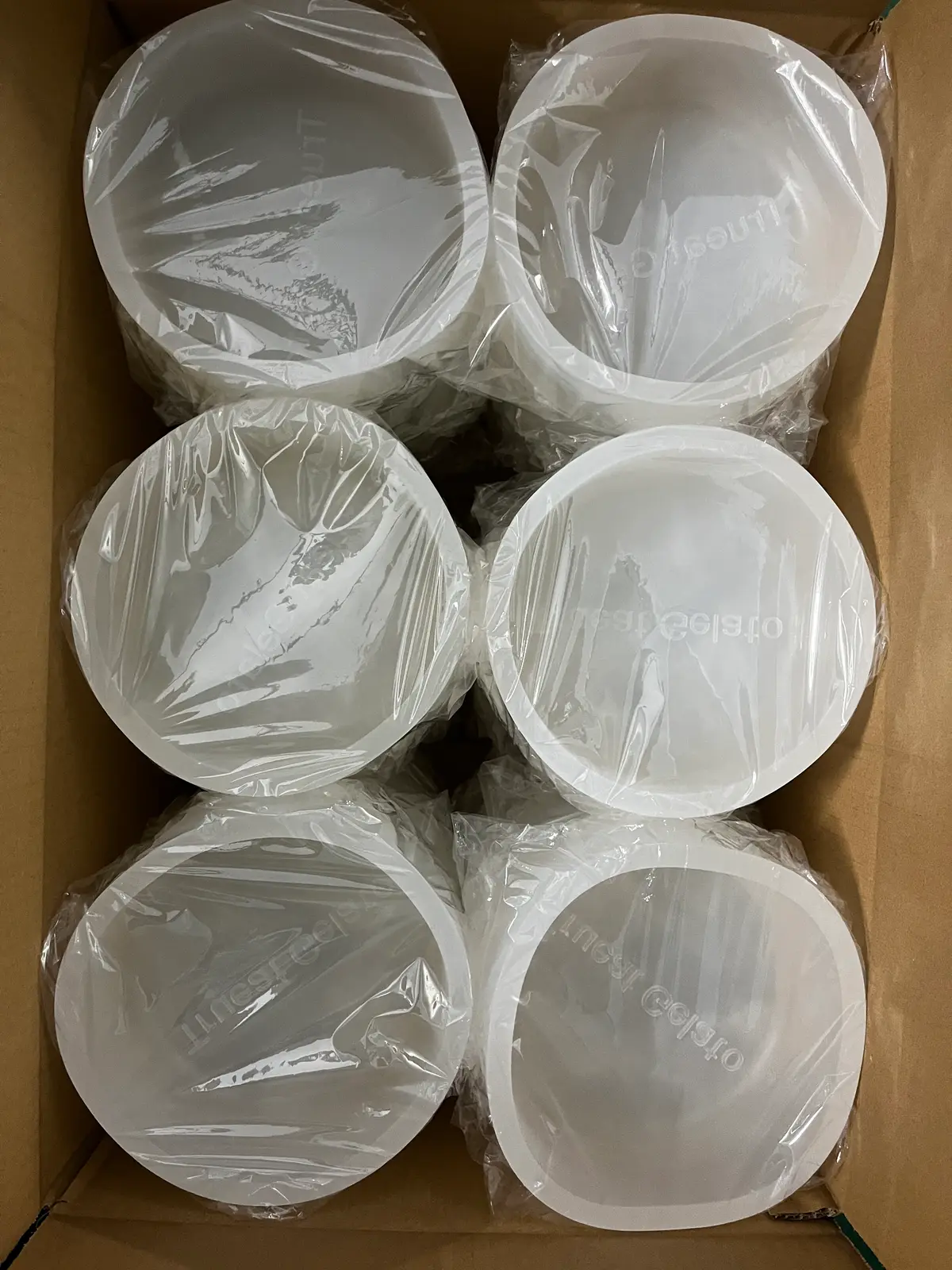
Tin also keeps moving dimensionally. Linear shrink is not the platinum 0.1–0.3% band that holds after a full cure. Keys that fitted in March can walk by November. The leftover odor is a useful warning that you are on that clock. A closed polyethylene bag concentrates the note; opening the bag "to let it breathe" does not convert the tool to platinum.
Craft dumps (PU, plaster, a decorative candle you will never plate food on) can still be a named tin conversation when the master is dirty or the buyer already lives in a tin kit. Write tin on the RFQ. Do not later slide that skin onto couverture and forward a craft TDS as a US retail pack. We recast food in platinum. CAD compensation from the tin pour does not transfer.
ISO 3302-1 M2 is a drawing class on the dump, not a smell spec. "Unscented food-grade" is not a lab method.
Food cavities: no tin, no grease, no odor hack
Chocolate and gummy wells take platinum. We will not spec tin because leftover + ongoing shrink fights the document pack you actually need. 177.2600 is an article extraction, not a factory stamp. LFGB / BfR is a separate European pack. A gum-supplier letter for a tin hobby kit is formulation evidence, not a tray extraction.
Do not oil, grease, or powder a food well to "seal the smell in." Food cavities stay dry. Release, if any, is a named food-contact conversation on a different SKU — not a pantry spray.
If you already own tin craft trays, keep them in the craft cabinet. A resin well is retired from food even if you later wish it weren't.
- Face tacky? - yes -> Inhibition or off-ratio — scrap food skin
- Face tacky? - no dry face -> Unused spare smells the same?
- Unused spare smells the same? - no only used wells -> Film or wash soil — not this page
- Unused spare smells the same? - yes bulk odor -> Named platinum or tin?
- Named platinum or tin? - tin or unknown cheap kit -> Craft only or recast platinum for food
- Named platinum or tin? - platinum faint fading -> Wash dry rest; post-cure if RFQ asks
- Craft only or recast platinum for food -> Do not perfume / bake / grease
The photo that would prove the split: two coupons from the same week, one platinum and one tin, labeled, bagged overnight, then opened next to a clean unused food tray. Smell cannot be photographed; the labels and the dry faces can.
Typical shop values
Reference values only. Confirm material-specific limits against the supplier’s technical data and agree project acceptance criteria before production.
| Item | Typical shop value | Why odor cares |
|---|---|---|
| Food cavity rubber | Platinum RTV, mix 1:1 or 10:1 by weight | Tin leftover is why we will not spec tin on chocolate |
| Platinum shrink after full cure | about 0.1–0.3% linear | Size holds; odor fades with wash/rest |
| Tin (craft, named on PO) | condensation-cure, kit-dependent | Bulk odor + ongoing shrink in storage |
| Food well | no grease, no tin, no pantry deodorizer | Film is a new article you did not extract |
| Post-cure | quoted when odor-at-receipt is a CTQ on platinum | Not a kitchen oven; not a tin rescue |
| Prototype | 3–7 business days after CAD lock | Includes wash guidance for first food dump |
| Production MOQ | 20 pieces per design | Don't multiply a tin sample into a food pack |
| Simple 3D | USD $50 when that CAD scope applies | Odor is chemistry; CAD fee only if geometry is still open |
Worked example (anonymized)
A 12-cavity chocolate bar, buyer forwarded a tin-kit TDS that said "low odor food." Unused spare smelled sour in the bulk after a 48 h rest; face was fully dry. We refused the tin line, quoted platinum ~25A open-back, $50 CAD only because the STEP had no fill line, locked CAD, poured in the 3–7 business day window, wash and rest before first dump, 177.2600 path named on the compound. The craft resin twin of the same bar, sold with no food claim, could have stayed a tin conversation. The chocolate SKU could not. Tooling charge is not unrestricted ownership of a recast if you later change chemistry without telling us.
One procurement mix-up
"FDA silicone" on a tin drum is not 21 CFR 177.2600 on *this* tray. Buyers paste a one-page smile sheet and ask us to match Shore in food tin. We will not. Name platinum vs tin in writing. Name US retail, EU, or craft-only. A trader's "no smell" photo is not a document.
Stay on this page / skip this page
Stay when you need to tell tin condensation leftover (alcohol or acetic note) from platinum shop volatiles, and why we skip tin on chocolate.
Skip if the smell is last week's pectin film, detergent, or a solvent wipe. Skip HCR peroxide post-cure odor on a finished part - a different RFQ - ask us. Skip baking a food tray to chase tin leftover.
We will not quote tin-cure rubber for chocolate, gummy, ice, baking, or popsicle cavities. We will not quote baking, sunning, or vinegar-soaking a food tray to chase tin leftover. We will not grease a food well to trap odor. We will not use a platinum extraction PDF to bless a tin recast you poured in-house.
Related: platinum vs tin, humidity and tin-cure, contact.
What to ask when you're buying
- Platinum or tin, in writing, for this SKU — and is the dump food or craft?
- If odor-at-receipt is a CTQ, will a platinum post-cure be quoted?
- Storage: away from latex, sulfur bands, and a closed hot tote?
- Who owns the master if we recast tin → platinum?
- Article tests (177.2600 / LFGB) vs a kit TDS?
RFQ copy-pack
Send to [email protected] · +86 135 3006 2969 · Xinhe Blvd, Shajing, Bao'an.
RUUIPON tin-odor / chemistry RFQ Dump: chocolate / gummy / ice / craft resin / other Rubber if known: platinum / tin / unknown kit Smell after clean dry rest: gone / sour bulk / film only Face tacky? yes / no Unused spare smells the same? yes / no Want platinum recast? yes / no Docs: 177.2600 / LFGB / craft none Qty: witness / MOQ 20 CAD: locked / $50 3D if geometry open
Matched next step: send spare-vs-used notes and the dump family. We recast food to platinum. We will not bake or perfume a tin well into a chocolate tool. Prototype 3–7 business days after CAD lock. MOQ 20 per design.
Related: platinum vs tin for food molds, food-grade silicone molds, food-grade buyer spec, contact.
FAQ
If I air a tin mold for two weeks, does the leftover become platinum-safe? No. Air may drop the peak note. The chemistry is still condensation-cure, still on a shrink clock, still off our food RFQ.
Can I mix a few grams of platinum into tin to "upgrade" odor? Don't. Off-ratio leftovers stay tacky and can inhibit the platinum. Recast the skin in one named family.
Does a dishwasher cycle strip tin odor from a chocolate well? It strips neither the leftover nor the document problem. Dishwasher film can add a second smell. Food wells we quote stay platinum and follow the wash you name.
Is the sour note proof the tin is still curing? It is proof you are on condensation chemistry. Full-cure demold time and leftover odor are different clocks. Don't dump chocolate into a well that is still shrinking.
If the tin sample is already paid, do I still owe MOQ 20 in tin? Don't multiply a chemistry we will not spec for food. Approve a platinum witness, then MOQ 20. $50 3D only when CAD is still open.
Custom silicone development · DFM & prototype support
CAD, drawing, photos or sample details