
Demold Deep-Draw RTV Jackets Without Air Damage
Deep-draw LSR boots vacuum-lock on the core. RTV gloves invert on purpose. Peel with draft and a jacket — a shop hose splits 10A rubber.
 Kyler Yang · Founder10 min read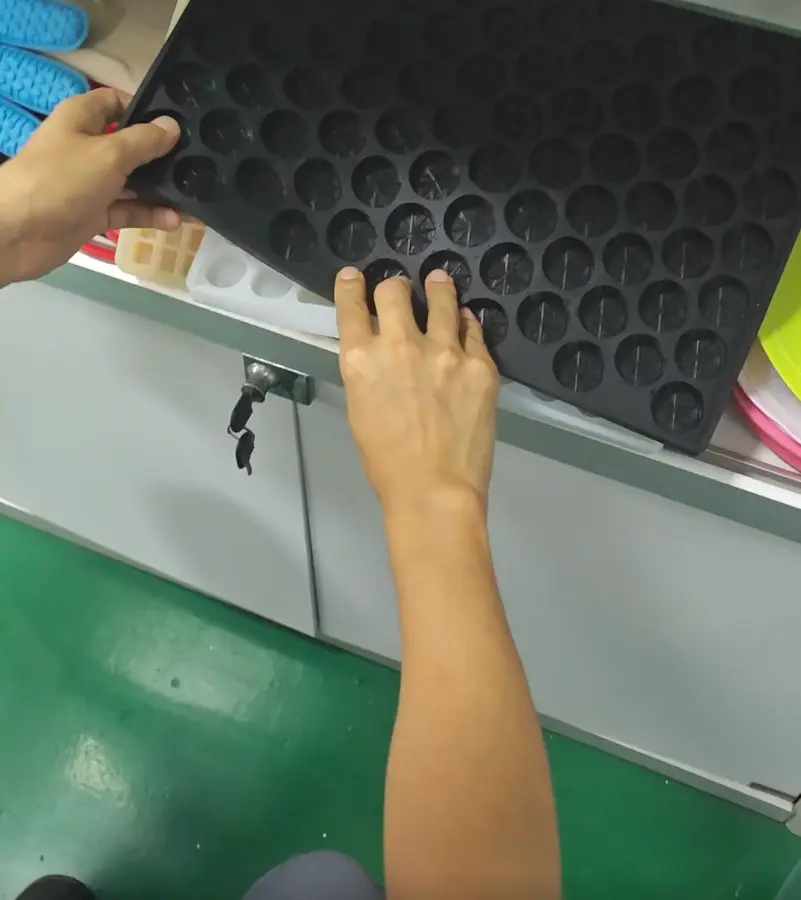
A deep-draw silicone part (boot, bellows, cup, sheath) leaves the core like a suction cup. The usual factory answer is compressed air. The usual defect is a rolled sealing lip, a stretch mark, a contamination event, or a part that inverts and never sits right again.
On this site the deep draw is often the master, and the thing you are saving is the RTV jacket. RTV glove molds invert on purpose. Compressed air between jacket and part is how you split a 10A mold. Use air between jacket and *master* only if the jacket can take it — timed, through a designed path, not a hose in an operator’s hand.
Process split: LSR in steel is the high-volume part problem. HCR compression boots are often pulled by hand over a mandrel. RTV gloves peel. Do not copy the glove-mold peel onto a 16-cavity LIM cell, and do not copy a LIM air blast onto a 12A chocolate jacket.
Why the part — or the jacket — will not drop
Three locks, often stacked:
- Vacuum lock. Mirror ID, little draft, closed end. Atmospheric pressure holds the cup on the core (or the jacket on the master).
- Friction. 0° walls, texture (VDI or MT grain as micro-barbs), self-bonding grade tack. Platinum RTV against a glossy master is a sucker.
- Mechanical undercut. A sealing barb or bellows convolution that must stretch. Soft high-elongation RTV can come off if a human rolls it. Cycle clocks and robots cannot roll. A glove is allowed to invert; a production LIM boot usually is not.
Damage starts when the release energy is dumped into a small lip: air that inflates the closed end and then escapes under the seal in a jet, or a gripper that pulls one ear. If you ignore the lock type, the defect is “we added more air” until the lip blossoms — or the jacket tears at a logo.
Break the lock in the tool, not in the hose
DFM that reduces the need for violent air:
- Draft on the core / master, even 0.5–1° on a deep draw, is a lot of opening. Zero draft is an elongation bet (see the draft article in this cluster). RTV can peel at 0° on shallow walls; a deep 0° mirror master still vacuum-locks the jacket.
- Finish: a controlled matte or very light blast can break vacuum without printing a cosmetic grain. Mirror looks premium and holds like a sucker. Texture deep enough to be VDI 30+ on a 0.6 mm wall is a perforation and a barb — of the LSR part, or of the RTV skin.
- Stripper ring or plate (LIM) that pushes on a designed shoulder, not on the sealing lip. Mother mold open first (RTV) so you peel the skin, not yank the whole floppy cup.
- Collapsible or split cores when convolutions are honest undercuts. Two-part jackets when the peel would tear.
- A tiny vent or hole in the product, if allowed, so a perfect cup cannot form. Many boots cannot have it. Ask. On a master, a tiny air channel in the *box* is a process hole, not a product hole.
Gate vestige on the closed end becomes a tear start when air balloons that end. Put the LIM gate where stretch is low. Put the RTV pour gate where the jacket is thick.
HCR compression deep draws add a second damage mode: the operator who “pops” the part with a screwdriver at the closed end. That nick is a tear start. If the mandrel will not release with taper and a straight pull, fix the mandrel. A pry bar is not a demold spec. Neither is a screwdriver under an RTV key.
If you still need air, make it a circuit
Core air that does not damage:
- Internal passages that open *behind* the closed end so the part (or jacket) balloons uniformly, then the lip walks off a lead-in, not a square shoulder.
- Timed, filtered, dry air as a process parameter (pressure, duration, start relative to open). Shop air with water and rust is a dirty blast.
- Pressure low enough that the part does not invert unless inversion is the RTV glove plan. A thin bellows will turn inside out at a pressure a thick boot ignores. Find the pressure on the real article.
- No aim at the lip from outside. External air knives fold edges and throw flash onto the next nest.
- Medical / food: air is a contamination control problem (ISO 13485, food-contact discipline next to FDA 21 CFR 177.2600 grades). Filter, dedicated circuit, no operator blow-off as a standard.
Sometimes the honest answer is more cure so the lip has tear strength, or less polish, not more bar. Green rubber plus air is a balloon animal. An under-cured RTV face plus air is a split jacket.
HCR mandrels: a slight taper, a good finish, and a pull along the axis. Air between mandrel and part can help; blasting the OD to “pop” it will stretch a thin wall out of spec.
Cell and inspection
Robots should grip a designed rim after the stripper or core air has broken the lock. Vacuum cups on a deep-draw OD will collapse the draw. On RTV, hands peel after the mother is off; cameras catch inversion; they do not un-invert a medical lip you will ship.
First-article checks for air damage: lip roll, witness rings, localized gloss from stretch, contamination, and dimensional neck-down on the wall (a cousin of core shift, but from strip). Put them in the visual standard. If you only CMM the OD at the mouth, you will miss a creased bellows — or a stretched logo on a jacket.
RUUIPON Mold Structure Decision: Deep draw the jacket must peel? If it cannot peel safely → two-part / plug / core. Soft 10A–20A? → mother mold, open the jacket first. Large wet dump? → same mother, or the tray sags when you peel.
Common mix-up: glove peel as the LIM spec
A lot of RFQs film a technician inverting a platinum glove and then ban air on a 16-cavity steel tool. In the shop that usually means a robot, a hose, and a rolled lip.
What to ask when you're buying
- Object: LSR boot, HCR mandrel pull, or RTV jacket off a deep master?
- Draft on the core/master, finish intent, undercuts?
- Stripper shoulder allowed (LIM)? Mother opens first (RTV)?
- Air policy: none, core circuit only, or not on this part?
- If the lip is a seal (or a logo on a jacket), are air marks a fail?
Worked example
You're pulling a 90 mm deep chocolate mascot jacket, 12A platinum, 10-cavity, about 4,000 dumps. 1° master draft, light matte in the deep well, mother off first, peel — no shop hose between jacket and dump. A 0.5 mm air pulse between jacket and *master* only if a trial shows no tear. If the SKU is a 16-cavity LSR boot, budget a stripper shoulder and a filtered core circuit on the parts OEM.
We would not recommend a hose in an operator’s hand as the demold spec
We would not recommend blasting air between a 10A jacket and the dump, zero-draft mirror cores with a ban on air, or operator blow-off on food/medical as a standard. We would not pry a closed end with a screwdriver.
- Lock type? - Vacuum / polish -> Draft + break the mirror
- Lock type? - Undercut -> Split core or two-part jacket
- Draft + break the mirror -> LIM or RTV?
- LIM or RTV? - LSR steel -> Stripper / timed core air
- LIM or RTV? - RTV glove -> Mother off, peel; air only vs master
- Deep draw will not release - Shop hose at the lip -> Rolled lip / split jacket
Typical shop values
Reference values only. Confirm material-specific limits against the supplier’s technical data and agree project acceptance criteria before production.
| Item | Typical shop value | | --- | --- | | Core draft that helps a deep draw | About 0.5–1° is already a lot of opening | | RTV cavity Shore | 10A–20A gloves invert; they also tear | | Platinum mix | 1:1 or 10:1; through-cure before a peel | | Platinum shrink | About 0.1–0.3% | | ISO 3302-1 | M2 common; stretch marks are visual, not a class | | Loaded-tray sag if you peel a floppy jacket | About 0.5–1.5 mm edge |
Copy this into a deep-draw release RFQ
- Deep-draw geometry, draft on the core/master, finish intent
- Whether a stripper shoulder is allowed; undercuts; grade/durometer
- Robotic versus hand; mother-first peel on RTV
- Air policy: none, core circuit only, jacket-vs-master only, or not on this part
- If the lip is a seal (or a logo), air marks are a fail
Send the section through the deep well. We'll put draft on the master and keep the hose off the 10A face. Custom RTV molds.
Related: draft vs texture, core shift, 3-part splits.
FAQ
Can I demold a deep-draw LSR boot with no air at all? Often yes if you have draft, a finish that is not a vacuum lock, and a stripper on a shoulder. Zero-draft mirror cores usually need some assist. Design the steel so air is optional. Do not design a sucker and then ban air in a note.
What air pressure is safe for a sealing lip — or a 12A jacket? There is no universal bar number. Thin, soft lips invert at pressures thick boots ignore. Instrument a core circuit, raise pressure until the article frees without roll, and lock that as a parameter. An external hose has no safe number because the jet is not controlled. RTV jackets: trial vs the master, never vs the dump.
Why does air assist leave a cloudy ring on clear LSR? Stretch: the rubber yielded locally where the balloon peeled. Finish, draft, and a slower peel (stripper) reduce it; more pressure makes a sharper ring. Clear medical and optical parts should treat that ring as a defect. RTV jackets show a similar gloss ring on a stretched logo.
Is operator blow-off acceptable on food-grade or medical deep draws? As a documented, filtered process, core air can be validated. As a person with a gun, it is a contamination and a geometry lottery. ISO 13485 and food-contact programs should not rely on random shop air at the lip.
Will more draft make robotic deep-draw ejection slower? Draft usually makes it faster and kinder: less air, less stretch, less miss-pick. The CAD volume change is the cost. A 1° core draft on a deep boot is often cheaper than a cell that fights inversion every twentieth shot. Same 1° on a deep RTV master is cheaper than a recast.
Custom silicone development · DFM & prototype support
CAD, drawing, photos or sample details