
How to Improve RTV Silicone Mold Release Without Guesswork
Improve RTV release by fixing master pull, peel, and jacket first. Spray is last. LSR and HCR stick for different reasons on a different parts quote.
 Kyler Yang · Founder11 min read
If you're trying to improve release on a custom RTV silicone mold, diagnose why the master sticks in the cavity, or why the dump sticks in the pocket, then change draft on the master, finish, vacuum, chemistry, or split. Buying another can of spray is the last step, and on food-contact files it can be a forbidden step. Platinum RTV sticks for reasons that aren't LSR hot-steel reasons and aren't HCR flash-land reasons. Those *part* tools are a different finished-part quote. If you mix those, you'll polish a master you should have drafted, or you'll contaminate a platinum pour with a tin-cure leftover.
This is a diagnostic order for RTV. It doesn't invent a cycle life. It doesn't recommend a secret coating brand as a miracle.
Diagnose stick before you buy spray
Ask what is sticking, and in which process.
- RTV mold-making (this site): master won't pull (inhibition, no release on the master, mechanical lock), or later castings stick in the RTV cavity because the pour was undercured, the jacket walked, or the casting resin attacks the mold.
- LSR in steel/aluminum: part vacuum-locks on polish, undercured lip on a cold corner, insufficient draft, texture grain acting as hooks, contamination/inhibition at the surface. Different RFQ.
- HCR compression: part torn at a barb, operator pry because of zero draft, sticky peroxide residual before post-cure, overpacked charge that won't let the land breathe. Different RFQ.
Spray that "works" on one of these can ruin another. A mold-release aerosol that contaminates a platinum RTV food mold will look like a cure problem two weeks later — and may blow the FDA 21 CFR 177.2600 or LFGB story.
Map the face. A dump that sticks only at a logo well is polish and vacuum on the master. A dump that sticks on every vertical wall is draft or a missing split. A dump that sticks on one cavity of sixteen is jacket registration or pour head, not "silicone." A master that won't leave RTV after a platinum pour is often inhibition. The map decides the fix. A generic spray doesn't.
Draft, polish, and vacuum as one system
On RTV, the silicone peels. Draft on the *mold* can be low. Draft on the master still helps you pull the master once, and it helps the dump leave the pocket. Mechanical locks (windows, through-holes without cores, negative-draft letters) aren't a polish problem. Split the mold or add a core.
Soft 10A–20A skins tear on barbs even though they stretch. Don't use elongation as a waiver. A glossy logo well on the master is a vacuum cup for chocolate or resin. A vapor blast that breaks the gloss without adding a deep grain often releases better than another half-degree of draft. Deep grain without extra draft is a field of undercuts. The dump drags and the texture looks smeared.
Air blast and ejector design belong on metal *part* tools. A random operator screwdriver isn't an ejector on RTV either. It tears the lip, which then sticks more. If a pocket is a known sticker, that cavity isn't qualified. For RTV, the last resort is a split jacket, not more oil.
On rigid LSR/HCR tools, 0.5–2° on vertical faces is the conversation starter; texture (VDI 3400 / MT 11000) wants more. Zero draft is an elongation bet. Don't copy RTV peel rules onto that steel.
Chemistry: platinum inhibition isn't the same as tack
Platinum RTV (and platinum LSR) can remain tacky when inhibited: sulfur, some amines, some tin residues, some dirty SLA resins, some latex gloves. The fix is clean substrates, compatible masters, barrier coats, and not running a tin RTV bench into the platinum pour. More spray won't cure inhibition.
Tin-cure RTV has its own surface and shrinkage story. Don't "fix" a tin mold's stick by painting it with a platinum system. Tin keeps moving; a mark that stuck last month may also have drifted — that's chemistry plus time, not a missing aerosol.
Peroxide HCR can feel greasy or tacky before a specified post-cure. Oven first, spray second. That's the parts file.
Wrong Shore A feels like stick: a 10A membrane on a deep polish won't behave like a 70A bumper on a blast. Changing grade to chase release without changing draft or split is a compound lottery. Raising Shore A first is the wrong fix for a missing jacket; sag of about 0.5–1.5 mm at the edge makes outer-row dumps grab.
Release agents that contaminate the next process
Food-contact (FDA 21 CFR 177.2600, LFGB) files don't automatically allow an unlabeled aerosol. If a release is needed on the *master* (so the RTV pulls) or in the *cavity* (so the dump leaves), it must be compatible with the file and with any later bonding or printing. Many "temporary" sprays become permanent contamination for paint and for overmold primers — and for a platinum kit.
Internal lubricants in some LSR grades exist to reduce friction in the *article*, not to replace draft. They can affect printing and bonding. Specify them as a grade choice on a parts RFQ, not as a shop-floor surprise on this tray.
Coatings on steel (nickel and others) are trials on *part* tools. They can help. They can also mask a bad shut-off until they wear. Treat coating as a process experiment with a control cavity, not as a religion, and not as a substitute for a split on RTV.
Ejection, peel, and operator pry as last resorts
Design the peel: split, core, jacket clamp, a peel tab, a consistent dump temperature. Multi-cavity automation only works if every pocket strips like cavity 1.
Pry is a defect generator. It stretches lips, marks cosmetic faces, and tears letter roots. If the SOP includes a screwdriver, the tool isn't released.
For RTV, the last resort is a split jacket, not more oil. For HCR, it's a pick or a split, or a geometry change. For LSR, it's draft plus finish plus heat uniformity, then a qualified air blast. Those last two live on the parts OEM.
Undercuts that were sold as "silicone will stretch" are a common last chapter. If the strip tears a 10A bead, the undercut was a design miss. Split the tool, add a pick, or change the article. Release agent won't rebuild a lip.
China or local, the same order applies: diagnose process, fix geometry and finish, fix chemistry, then consider a named, file-compatible release. Shops that start with spray are hiding a DFM miss. Ask for the stick map (which face, which cavity) before you approve another can.
ISO 3302-1 might class a lip thickness on a drawing. It doesn't fix stick. It's a drawing class, not a release spec.
Common mix-up: one spray for master pull, dump peel, and LIM strip
A lot of RFQs treat "add release" as a line that covers every silicone job. In the shop that usually means a food-contact platinum cavity got an unlabeled aerosol, or a LIM cell inherited tin residue. Name what is sticking. Name the process.
What to ask when you're buying
- What's sticking: master in RTV, dump in the pocket, or a *part* in steel?
- Stick map: which face, which cavity?
- Platinum or tin; SLA barrier coat yes/no?
- Split / core / jacket in the design, or are we betting on peel?
- Any aerosol allowed on this food-contact file?
Worked example: logo well vacuum on an 8-cavity bar
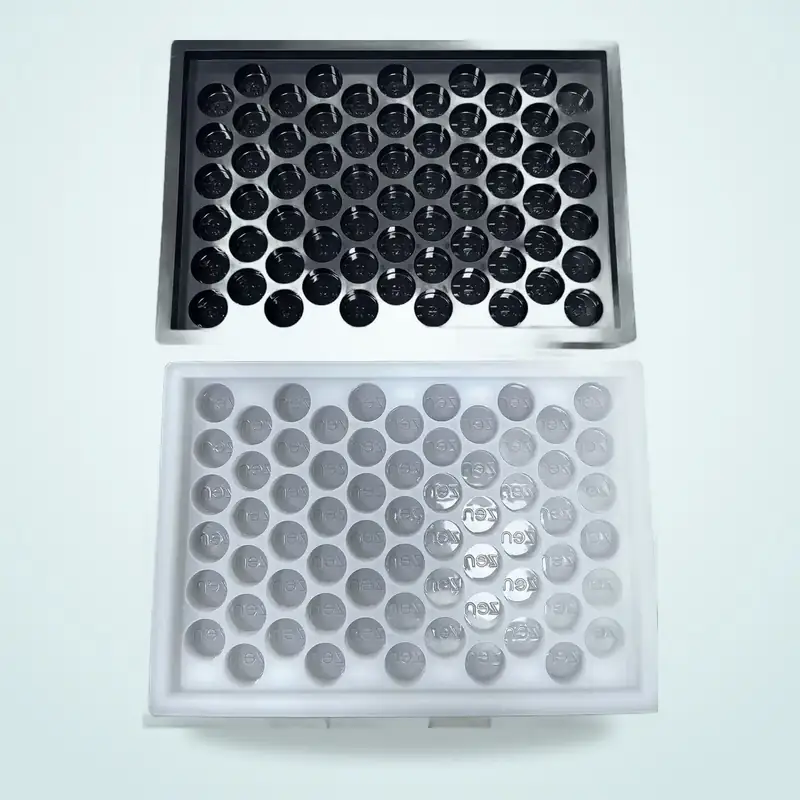
A confectionery line had an 8-cavity bar, 120 x 60 x 12 mm, 10A–20A platinum, about 500 pours a month. Chocolate stuck only in a mirror-smooth 0.4 mm logo well on the outer row. The map was gloss plus 0.5–1.5 mm jacket sag, not "bad silicone." Fix: blast the well, keep serif draft, flatten the jacket. More spray would have contaminated the food-contact path. A parallel LSR "air eject" quote was a different object.
When this diagnostic does not apply
If the article is a vulcanized LSR or HCR *part*, don't run this RTV peel order on a hot tool. Quote the parts OEM — different HTV product RFQ or LSR-tool RFQ (ask us). A one-off tin art mold on a dirty master can use a named master release and a short life. Geometry can override quantity: a negative-draft letter at 80 pours still needs the split off the face; spray won't replace it.
Related reading: design guide, common design mistakes, how molds are made, custom RTV molds.
Release pack to copy onto the RFQ
Copy this. A spray line without these items isn't a strip method.
- Process: platinum or tin RTV (not LSR/HCR part strip)
- Stick map: master pull vs dump peel; which face
- Split / core / jacket; peel direction
- Master finish: gloss vs blast at logo wells
- Named, file-compatible release only if geometry is already right
- Ban unlabeled aerosols on food-contact lots
Send the STEP, a photo of the stuck face, and the dump material. We'll mark whether the fix is draft, split, jacket, inhibition, or a named release — before anyone buys a can.
We would not recommend starting with spray
We would not recommend raising Shore A first to "make it release." We would not put an unlabeled aerosol on a food-contact platinum cavity. We would not copy RTV peel onto an LSR shut-off, or LIM air-eject onto a chocolate tray. We would not skip the jacket and then blame stick for outer-row sag.
RUUIPON Mold Structure Decision: diagnose the stick map, then geometry. Flat back? open-back. Deep undercuts that won't peel? two-part / plug / core — spray won't rebuild a lip. Soft 10A–20A or wet dump? mother mold so the sheet doesn't grab at the edge.
- Master in RTV or dump in pocket? - master -> Inhibition or mechanical lock?
- Inhibition or mechanical lock? - inhibition -> Barrier coat; clean SLA; no tin nearby
- Inhibition or mechanical lock? - lock -> Split or core
- Master in RTV or dump in pocket? - dump -> Draft finish jacket?
- Draft finish jacket? - gloss well -> Blast plus micro-draft
- Draft finish jacket? - sagging sheet -> Mother mold
- What is sticking? -> LSR or HCR part in steel?
- LSR or HCR part in steel? - yes -> Stop: different part RFQ
Typical shop values
Reference values only. Confirm material-specific limits against the supplier’s technical data and agree project acceptance criteria before production.
| Item | Typical shop value | | --- | --- | | Mix | Platinum 1:1 or 10:1; vacuum degas | | Cavity Shore | 10A–20A skin with jacket | | Platinum shrink | About 0.1–0.3% after full cure; tin keeps moving | | Loaded-tray edge sag without a jacket | About 0.5–1.5 mm — outer-row dumps grab | | Master release | Named, file-compatible; last step after geometry | | 8-cavity 120 x 60 x 12 mm bar | About 500 pours/month is a common food-mold band |
FAQ
Why does my dump stick only on the polished logo well? Soft rubber plus gloss makes a vacuum. Blast the well, add micro-draft on the letters, or flatten the jacket. More spray will also contaminate if you later print, bond, or claim food-contact.
Can I use the same release spray on RTV molds and LSR tools? Don't assume so. Chemistries and files differ. Tin residues can inhibit platinum LSR and platinum RTV. Food-contact lots may forbid the aerosol entirely.
Will more draft always fix RTV stick? Draft on the master helps. If the stick is a barb, a zero-radius serif, a missing split, or a sagging jacket, draft alone won't save the lip. Look at undercut and mother mold next.
Is a sticky first-article a sign of wrong shrink? Not usually. Shrink is a size miss. Stick is draft, finish, cure, inhibition, or a missing jacket. You can have both. Measure after you can demold without pry, or you'll measure a stretched dump.
How do I write release into an RFQ without sounding like I want a miracle coating? Require a peel direction, split/core notes, master-finish callout, and a ban on unlabeled sprays for file-sensitive lots. Ask the shop to name their strip method (peel, split, pick) for this RTV process.
Custom silicone development · DFM & prototype support
CAD, drawing, photos or sample details