
Clear RTV Molds for Casting Optics, Not LSR Lenses
A clear platinum RTV mold copies the master into resin. Glass-like LSR lenses are a different quote. Control dust, bubbles, polish, and inhibition.
 Kyler Yang · Founder8 min read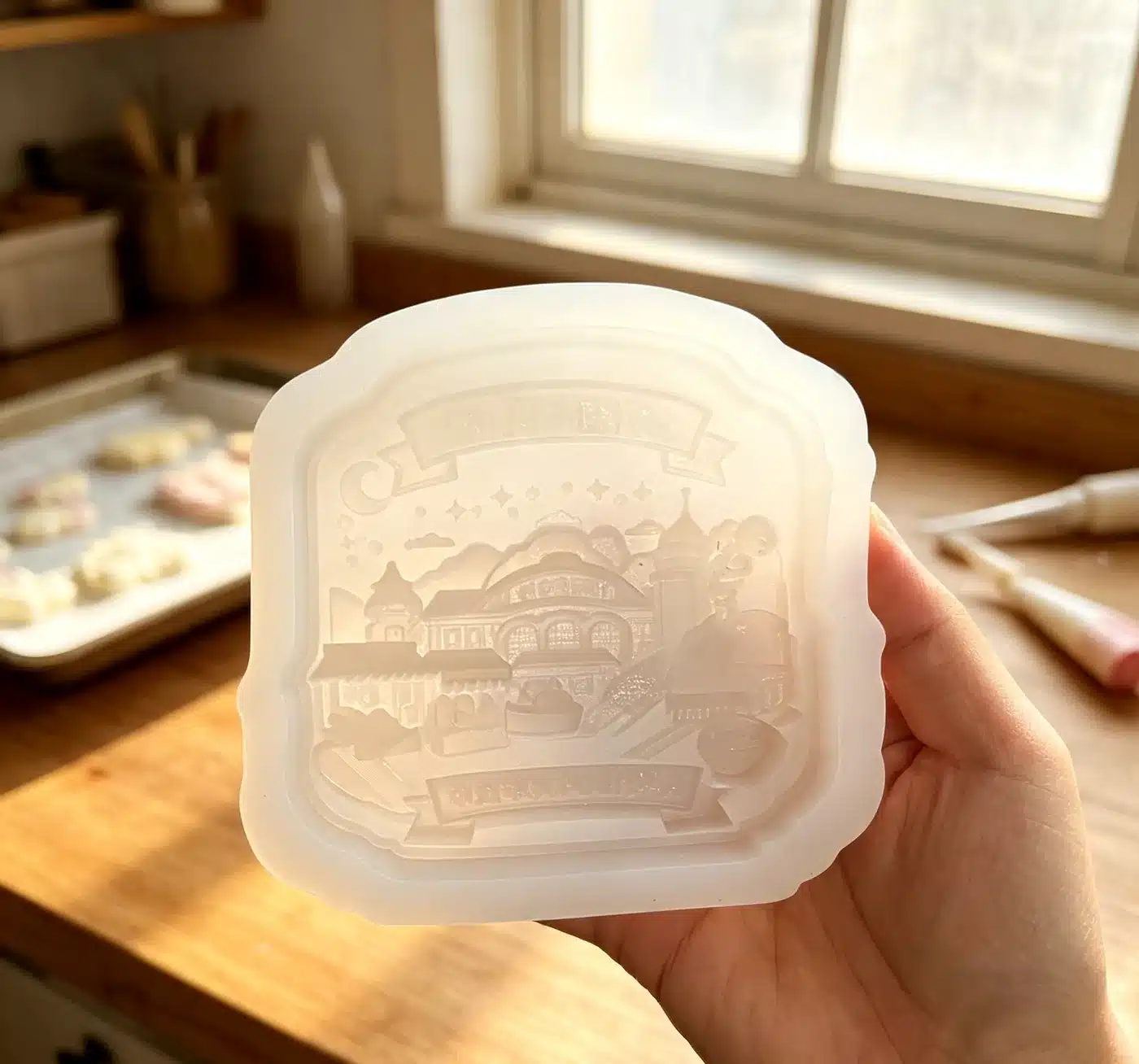
Glass-like clarity fails from haze, particles, and fogging, not from “the silicone was not clear enough on the TDS.” If you're buying a custom RTV mold for a lens, light-guide, or clear resin prototype, the cavity is platinum RTV poured against a polished master. That mold copies every scratch, every dust speck, and every bubble into the casting. It is not optical-grade LSR injection of a production lens in steel.
Optical LSR (low-yellowing, often low-volatility, usually post-cured) is a part compound for TIR optics and LED overmolds — a different RFQ, cold-runner, never a LIM hot tool. Poured craft RTV that looks water-clear in a cup is also not a production optic. Pick the object first: a clear cavity you cast into, or a clear article that ships as silicone.
The master surface is the optical surface
RTV does not get a secondary polish like a glass blank. The master finish is the cavity finish, and the cavity finish is the casting finish.
SPI-style diamond buff on a metal or high-quality resin master is the usual conversation for high-clarity faces. Layer lines on an undercured SLA print are a designed diffuser, wanted or not. Parting lines, keys, and pour gates on a clear aperture are refractive errors. Put them on a flange, a gate well you trim, or a non-optical wall.
Draft still helps. Soft 10A–20A platinum can strip with little draft, but rubbing a polished master dulls it and prints haze into later pours. A small draft on non-critical sides protects the polish. Vacuum degas of mixed RTV until the foam collapses is not optional on an optic mold: a trapped bubble in a TIR is a reject.
Common mix-up: clear mold versus clear LSR lens
A lighting engineer sends a STEP of a 12 mm TIR and asks for “optically clear LSR molds.” Two honest quotes:
- RTV route: CNC or fully post-cured, washed, barrier-coated master; clear platinum RTV glove or keyed split; rigid jacket; you cast urethane or epoxy stand-ins this week.
- Part route: optical platinum LSR in a polished steel tool, post-cure, haze method on the production thickness. That quote will not dump resin.
Both PDFs can say “clear silicone mold.” Ask which object ships.
What to ask when you're buying
- Is the silicone the cavity I'll cast into, or the optic that ships?
- Master process (CNC, diamond-buff metal, SLA) and who keeps it?
- Where may the split, keys, and pour gate sit relative to the aperture?
- Casting resin, refractive-index target, and whether bubbles are allowed in a gate well only?
- Jacket: Shore 10A–20A clear skin still slumps without a mother mold.
Worked example: 2-cavity 18 mm TIR stand-in, 40 pours
A lighting startup needed forty urethane TIRs, 18 mm, clear aperture on the front face, to check a heat-sink nest. The RTV job was a CNC master with the optical face buffed, a clear platinum 20A–30A skin (a bit firmer than a gummy tray so the optic doesn't sag), keyed split on the flange, pour gate on the rim, vacuum degas, rigid jacket. ISO 3302-1 M2 on the flange; the aperture was a visual/haze check, not a rubber class.
A second vendor quoted optical LSR, SPI A-2 steel, and a cold-runner. Right process for 50,000 lenses. Wrong asset for forty stand-ins.
Dust, inhibition, and post-cure on a clear cavity
One particle in a 3 mm lens is a dark spec. Cover the pour, no cardboard at the bench, gloves that do not shed.
Moisture and inhibition still apply. An undercured platinum face is sticky and hazy. Sulfur, amines, and tin-contaminated handling gear kill the face the same way they kill any mold rubber. Keep optical RTV on dedicated cups.
Low-molecular-weight cyclics can later fog a sealed luminaire if the casting or a production LSR lens sits hot. That's a low-volatility grade plus bake on the article. Baking a tin RTV mold like an LSR lens will shrink the cavity and still not give you optical LSR.
Phenyl-containing optical grades can raise refractive index; dimethyl sits near usual PDMS. If the optic is the casting, match the resin to the optical file. The mold rubber's index is not the lens index.
Geometry that refuses to look like glass
- Sink in thick bosses attached to a thin lens: decouple mechanical bosses from the optical body on the master.
- Weld / knit in the aperture: two pour paths can put a seam on axis. One gate plus overflow on a non-optical rim is cleaner.
- Soft grades on large lenses: a 10A optic sag under its own weight. Harder clear RTV, or a jacket that holds the prescription.
- Layer lines and sealer blush on printed masters print as texture.
Shop-floor “looks water-clear” is not a spec. Write transmittance/haze language on the casting thickness if you need it, and a particle map on the aperture.
When this article is the wrong quote
Production LSR lenses that need repeatable prescription, low fogging, and a polished steel path belong on a parts OEM. Food-grade clear chocolate molds are a different clarity job (you want a clean dump, not a TIR). Geometry can override: a one-off museum replica still wants clear RTV even at one pour.
Related reading: custom RTV silicone molds, how we make the mold, custom mold design, what tooling means.
What to send for an RTV mold quote
- Object: clear platinum RTV cavity for resin/urethane (not optical LSR parts)
- Master: process, polish, who keeps it
- Aperture vs flange; where gates and keys may sit
- Casting resin, qty, whether fogging in a sealed lamp matters
- Shore, jacket, split
- Acceptance: visual particle map, optional haze method on the casting
Send the optic STEP, which face is the aperture, and the resin you'll cast. We'll place the split off-axis and say when you actually needed steel LSR.
We would not recommend pouring a 30 mm clear brick in one UV or open-cup shot
We would not recommend a one-piece glove if the TIR has a locked wrap. We would not raise Shore A first to “get clearer.” We would not prototype optics in gasket-grade translucent RTV and expect the production LSR index to match. We would not skip vacuum degas on a clear aperture.
RUUIPON Mold Structure Decision: flat back? open-back. Locked wrap or deep undercut that cannot peel? two-part / core. Soft clear skin or large wet resin? mother mold.
- Silicone is the cavity? - yes -> Clear platinum RTV vs polished master
- Silicone is the cavity? - no, silicone is the lens -> Different RFQ: optical LSR in steel
- Clear platinum RTV vs polished master -> Aperture can take a split?
- Aperture can take a split? - no -> Split / gate on flange
- Aperture can take a split? - yes -> Still keep keys off the optic
- Clear platinum RTV vs polished master -> Vacuum degas + jacket
Typical shop values: clear RTV optic mold
| Item | Typical shop value | | --- | --- | | Cavity Shore | 20A–30A clear platinum when the optic must hold shape; 10A–20A needs a stiff jacket | | Mix | Platinum 1:1 or 10:1; vacuum degas until foam collapses | | Linear shrink | ~0.1–0.3% platinum | | Master finish | Buffed metal or fully post-cured, washed, barrier-coated print | | Gate / split | Off the clear aperture | | ISO 3302-1 | M2 common on flanges; aperture is optical, not a rubber class |
Reference values only. Confirm material-specific limits against the supplier’s technical data and agree project acceptance criteria before production.
FAQ
Can I pour optically clear platinum RTV instead of injecting optical LSR? For a one-off or short resin stand-in, yes — that's this product. Production lenses that need repeatable prescription, low fogging, and a polished steel path are LSR injection jobs. Poured RTV picks up bubbles, cup dust, and a different volatile profile.
Why does a clear casting haze after a few weeks in a hot lamp? Low-molecular-weight siloxanes left the article (or the wrong resin) and condensed on a cooler face, or post-cure was skipped on a production LSR lens. Specify fogging and a bake on the part that sits in the lamp, not only as-poured mold clarity.
Is a shiny SLA master enough for a TIR cavity? Usually not. Layer lines, sealer blush, and undercured acrylate inhibition print into the optic. Full UV post-cure, wash, barrier coat, or switch to CNC/buffed metal. The steel or master finish copies.
Does a warm finish on the RTV block change the lens size enough to matter? Platinum RTV already sits near 0.1–0.3% shrink. A tin library tool keeps moving. If the casting is post-cured or the production path is LSR, those shrink bands are larger (~2–3% LSR). Don't cut the master for the wrong chemistry.
Will a general translucent mold rubber pass as optical if I polish the master? Unlikely for a lighting prescription. Translucent industrial RTV can still scatter, yellow, or print texture. Polish cannot fix the compound. For chocolate trays, “clear enough to inspect the dump” is a different, looser bar.
Custom silicone development · DFM & prototype support
CAD, drawing, photos or sample details