
Splitting Asymmetrical Masters for 3-Part RTV
A 3-part split is a parting-network, not a midplane. Pick faces that unhook undercuts, key the pieces, and keep the pour from fighting the split.
 Kyler Yang · Founder9 min read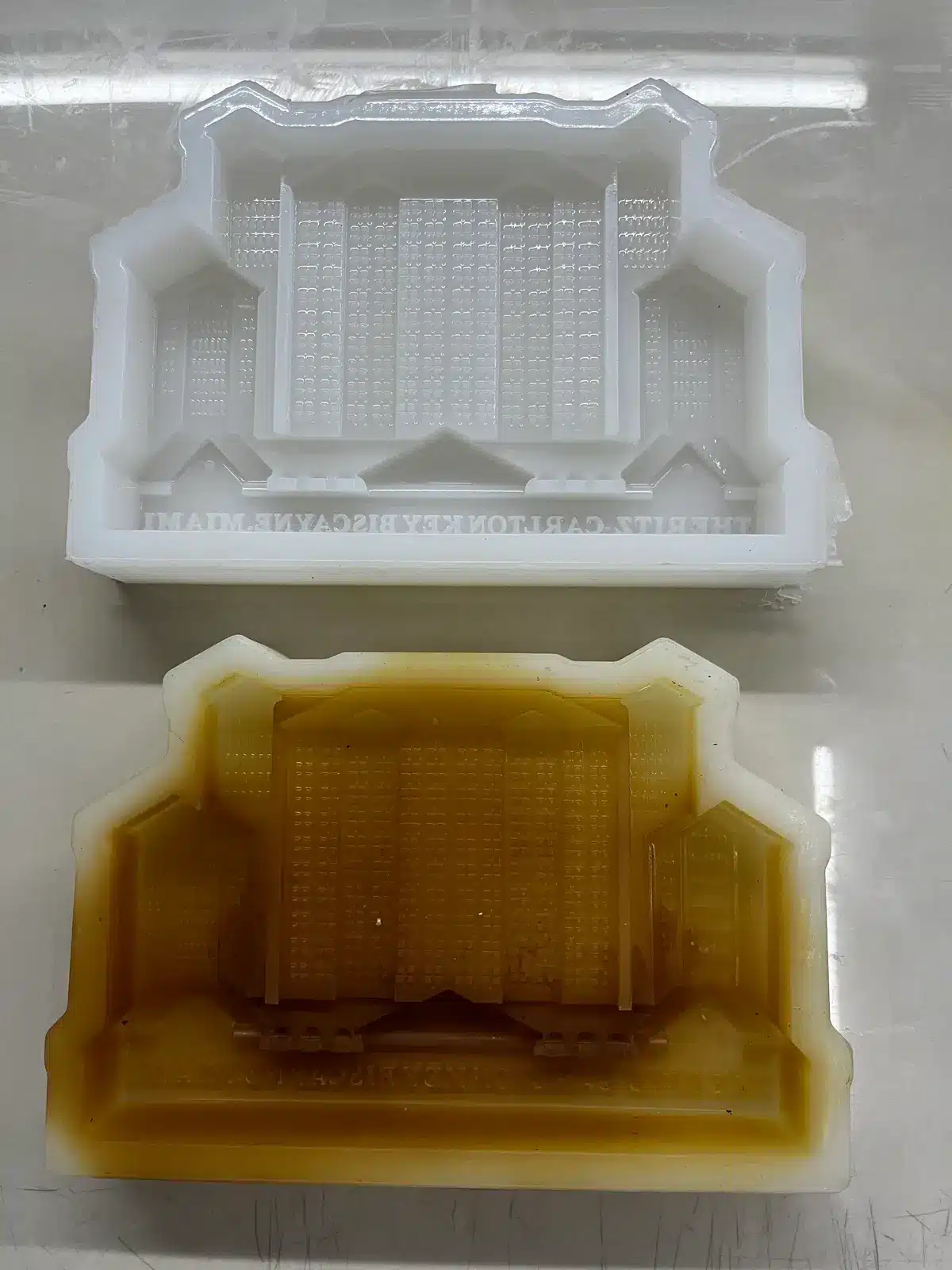
A symmetric bottle wants a midplane. An asymmetrical master (a sculpted housing, a medical grip, a figurine, a duct with one twisted branch) does not have that plane. Forcing a 2-part split puts an undercut on the wrong half and then everyone argues about “silicone stretches.”
A 3-part (sometimes 3-piece, 3-plate) silicone mold is a parting *network*: two splits that let three rigid or semi-rigid pieces leave in three directions, or two jacket pieces plus a core. The job is to choose those directions from the undercut map, not from the pretty view in the render.
This site starts with the RTV master split: platinum or tin jackets poured on a master, often with a mother mold. Three jacket pieces, or two jackets plus a core/mandrel. Production LSR/HCR steel where a third plate, a side core, or a split cavity does the same geometric job is a different quote — every extra split is a 0.005 mm-class land to maintain at 180 °C. If the program will go to steel, split the master on the production parting network so the prototype trains the right DFM.
Draw the undercut map before you draw the clay wall
On the CAD (or on a printed master), color faces by which way they can unhook:
- Direction A: main open (usually the largest projected area).
- Direction B: the second open (often 90° or 180° from A).
- Direction C: cores, lost plugs, or a third jacket for a local barb.
Asymmetry means A is not a plane of symmetry. The split can be a stepped, wrapped, or joggled surface. That is legal. A joggle that leaks is not.
Rules that keep you out of a 4-part accident:
- Every undercut needs a home. If a hook cannot unhook in A, B, or C, you need a fourth piece, a lost core, or a geometry change. “Silicone will stretch” is a local permission for shallow barbs in soft RTV, not a global waiver.
- Splits should sit on low-cosmetic, easy-to-flash-control faces. On a product, hide the witness in a radius or a texture break. On a master for RTV, the split prints on every casting.
- Avoid splits that run across a sealing lip or an optical window.
- Keep the three pieces loadable in one obvious order. If the only assembly sequence requires three hands and a prayer, the shop will mis-key it.
If you ignore a side hook on an otherwise 2-part body, the defect is a torn jacket on pull one, or a steel tool quote that suddenly includes a lifter you did not budget.
How RTV 3-part jackets are actually split
Shop practice, not sculpture class:
- Keys. Cones, sockets, or irregular jogs so the three pieces cannot assemble 180° wrong. Asymmetrical masters still need *more* keys, because there is no visual symmetry to save you.
- Stable walls. Each jacket needs thickness and a rigid mother (plaster, fiberglass, printed shell) if the piece is large. A floppy third piece is a flash machine.
- Pour / vent path that still fills after the split. Air traps at the new corners. Last-fill vents belong at those corners. Vacuum degas the mix.
- Registration to the core if there is a hollow. A 3-part OD with a wandering mandrel is a wall-thickness lottery (core shift’s RTV cousin).
- Tin versus platinum. Tin is more forgiving of inhibition from clays and some printed masters; platinum copies better and lives longer. Neither fixes a bad split. Sulfur clay against platinum is a sticky jacket, not a split problem.
Shims and clay walls that follow a spline on the master are how you build a non-planar split. Do it once on a signed CAD plane if this master will later become LSR steel. A romantic freehand split on the prototype is a change order on the production tool.
When the third part should be a core, not a jacket
Hollows and deep draws: two OD jackets plus a mandrel is a 3-part mold. Trying to split the OD into three jackets because the ID scared you is usually backwards. Pull the core along its axis; split the OD where the exterior undercuts live.
Lost cores (soluble, low-melt, 3D-printed breakaways) are a fourth strategy when no third rigid piece can leave. They are not 3-part molds. Do not write “3-part” on an RFQ that needs a lost core.
Steel / LSR analog
In injection, “3-part” often means a third plate, a stripper, or a side action. Asymmetrical products still need the same undercut map. Differences:
- LSR will flash the extra splits (0.005 mm class). Every new split is a land to maintain.
- Heat: three pieces at 180 °C must still meet. Alignment at operating temperature.
- Automation: the robot must see a consistent open. A 3-piece RTV peel does not teach a 3-plate LSR sequence unless you designed the production splits first.
If the program will go to steel, split the master on the production parting network. Prototype jackets that peel in impossible directions train no one.
RUUIPON Mold Structure Decision: Flat back? → open-back (not 3-part). Else deep undercuts + peel? If no → two-part / plug / core. Hollow? Mandrel is the third piece. Large wet casting? → mother mold so the third piece is not floppy.
Common mix-up: stretching a 2-part undercut instead of a third direction
A lot of RFQs treat elongation as a split strategy. In the shop that usually means a torn jacket on an asymmetrical hook.
What to ask when you're buying
- Proposed open directions A/B/C on the CAD?
- Faces that cannot carry a witness?
- Undercuts you refuse to change?
- Must the RTV split equal a future LSR split?
- Hollow: OD split + mandrel, or three OD jackets?
Worked example
You're molding a twisted 110 mm figurine, platinum RTV, 2-cavity, about 400 resin casts. Undercut map: main back, a 90° arm barb, mandrel for a hollow base. Keys on all three, resin mother, pour path to the new corners. Do not force a midplane. If year-two is steel LSR, freeze those same opens on the master now.
We would not recommend a 4-part accident because one hook had no home
We would not recommend “silicone will stretch” as the split, a freehand clay wall that will not grind in steel, or three OD jackets when the ID wanted a mandrel. We would not skip keys on an asymmetrical master.
- Undercut map A/B/C -> Every hook has a home?
- Every hook has a home? - No -> Fourth piece, lost core, or CAD change
- Every hook has a home? - Yes -> Hollow?
- Hollow? - Yes -> Two OD jackets + mandrel
- Hollow? - No -> Three keyed jackets
- Two OD jackets + mandrel -> Mother + pour/vent at new corners
- Three keyed jackets -> Mother + pour/vent at new corners
Typical shop values
Reference values only. Confirm material-specific limits against the supplier’s technical data and agree project acceptance criteria before production.
| Item | Typical shop value | | --- | --- | | RTV mix | Platinum 1:1 or 10:1; tin often 10:1; degas until the foam collapses | | Cavity Shore | 10A–20A with a rigid mother on large pieces | | Platinum shrink | About 0.1–0.3%; tin keeps moving | | LSR leak band (steel analog) | About 0.005 mm per extra split | | RTV skin wall | Often 8–15 mm | | ISO 3302-1 | M2 common on the dump; witness location is DFM |
Copy this into a 3-part split RFQ
- Process: 3-part RTV from master and/or steel with third action
- CAD with proposed open directions
- Faces that cannot carry a witness; undercuts you refuse to change
- Whether the RTV split must equal the LSR split
- Name it: OD split + mandrel vs three OD jackets
Send the undercut map. We'll key three leave directions, or tell you the hook needs CAD. Custom RTV molds.
Related: core shift / mandrels, what tooling means, mold engineering.
FAQ
When is a 3-part split better than stretching silicone off a 2-part undercut? When the undercut is deep, the rubber is hard, the wall is thin, or the jacket (or steel land) will tear or flash. Soft platinum RTV can peel shallow barbs in two parts. A twisted asymmetrical hook usually wants a third direction. Stretch is a local permission, not a split strategy.
Can the three parting surfaces be non-planar on an asymmetrical master? Yes, and they often must be. They still need keys, a pour path, and a way to clamp without a gap. A spline split that leaks is worse than an ugly planar jog that shuts. For later LSR steel, prefer splits a toolroom can grind.
Should I split the RTV prototype the same way as the future LSR tool? If the program is going to steel, yes, as far as the product allows. A glove-mold peel that no press can copy trains the wrong DFM. Use the extra RTV freedom only for features you have already agreed will change before production steel.
Where do 3-part RTV molds usually flash? At keys that do not seat, at joggles that were not rigid in the mother mold, and along a clay wall that moved. Asymmetry hides a 0.5 mm mismatch that a symmetric bottle would show. More keys, a rigid shell, and a written assembly order beat another clamp strap.
Is a two-jacket-plus-core mold counted as 3-part? Yes in the sense of three pieces and three leave directions. Name it that way on the RFQ (OD split + mandrel) so the shop does not bid three OD jackets and no core. The undercut map should show the ID leaving along the core axis.
Custom silicone development · DFM & prototype support
CAD, drawing, photos or sample details