
Cavity Layout on a Commercial Chocolate RTV Tray
"18 cavities sounds efficient" is how an outer row runs heavy and the logo starves. If you are locking a commercial chocolate RTV layout, this page is that map: finished grams, tray the operator can lift, spacing, loaded sag, and logo as production geometry. Start from piece weight and the bench, then pick cavity count.
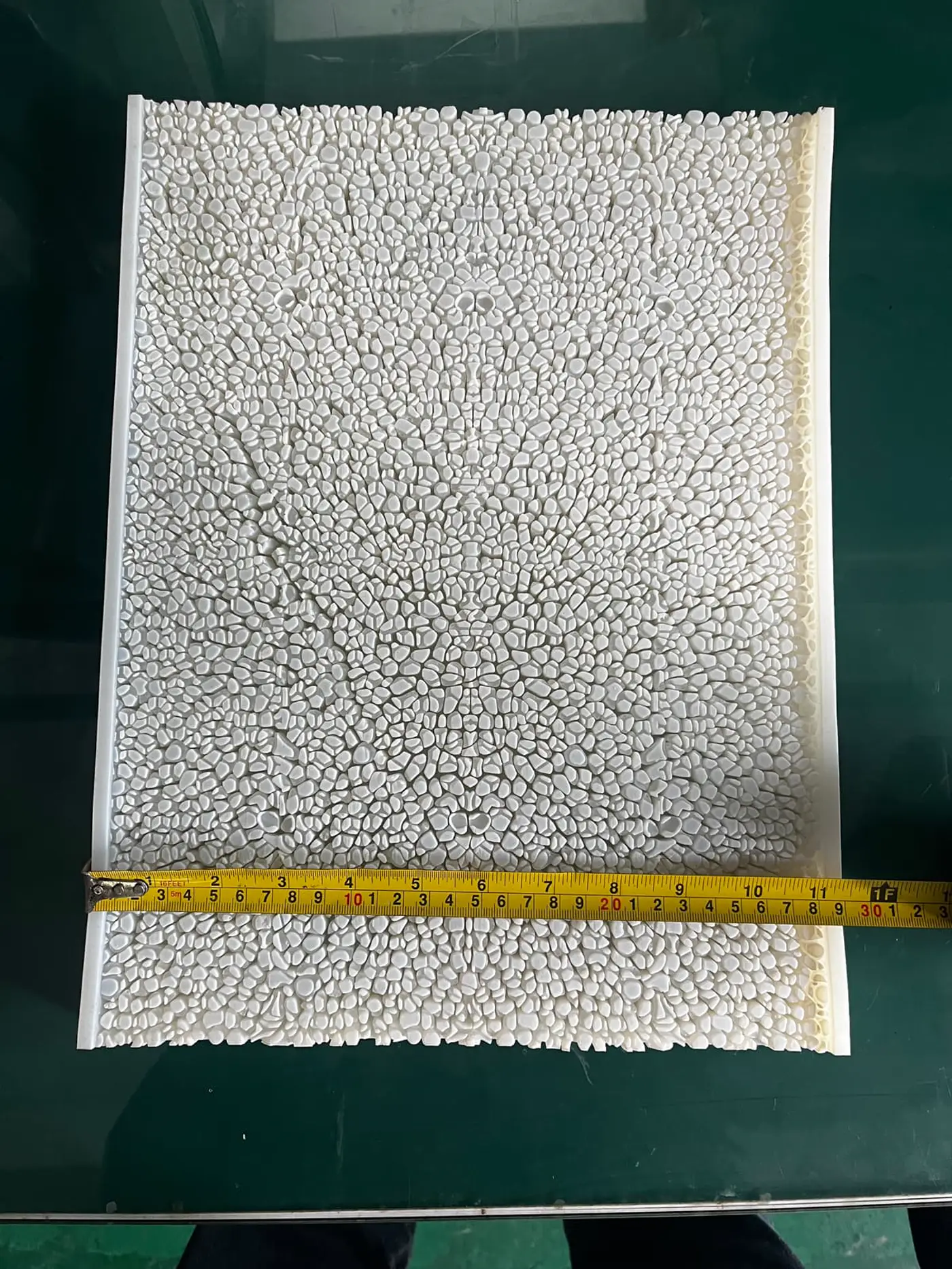
RUUIPON pours platinum food-contact chocolate trays in Bao'an, Shenzhen (Licheng Technology Industry Park, Xinhe Blvd, Shajing; USCC 91440300MA5FAXCN9W) since 2018. Simple 3D is USD 50 when that CAD scope applies. Prototype is 3-7 business days after CAD lock. Production is MOQ 20 pieces per design. The SKU lives on custom silicone chocolate molds.
Where this page sits
Buy the mold, Shore, and food-document path on custom silicone chocolate molds. Food-pack fields live on food-grade buyer spec. This page covers commercial cavity layout: grams, count, spacing, sag, logo.
Grams drive volume
For solid pieces, start from target grams, density, and geometry. Then pour and weigh. Inclusions, aeration, meniscus, hollow shells, and filled chocolates are different problems. CAD volume is the reference. The temper dump is the proof.
Count follows handling
More cavities raise pieces per pour and also tray size, filled mass, sag, demold time, cooling, reach, and carton. An 18-up 3 x 6 can beat a 24-up strip on a narrow bench. A 50-up sheet usually needs a rigid nest. Compare handling before output.
Typical shop values
Reference values only. Confirm material-specific limits against the supplier’s technical data and agree project acceptance criteria before production.
| Item | Typical shop value |
|---|---|
| Layout inputs | Finished grams, tray the operator can lift, logo / gloss |
| Cavity Shore | Often 10A-20A platinum; jacket / nest if loaded |
| Loaded-tray edge sag if unsupported | About 0.5-1.5 mm |
| Outer-row drift if the sheet sags | Often 3-6% heavy vs center |
| Logo start | About 0.4 mm recessed, drafted strokes; hairline logos trap air |
| Proof | Position weight map on the real production span |
| 3D / CAD | USD 50 when that modeling scope applies |
| Prototype after CAD lock | 3-7 business days |
| Production after written pass | MOQ 20 pieces per design |
| Contact | [email protected] · +86 135 3006 2969 |
Spacing and sag
Spacing must leave a silicone web, room to peel, cleanup, support between bars, and a grip. Deep bonbons need more access than shallow tablets. Review in section, not only top view. If a flexible tray sags, the scrape plane tilts and outer grams move. For a tight weight band, inspect loaded flatness and use a nest.
Logo and master finish
Treat the mark as production geometry: raised vs recessed, stroke, depth, radius, fill, air, release, finish. A hairline render can starve. Silicone does not "make chocolate glossy." Gloss starts on the approved master. Temper and cooling stay your process.
Food docs and the span prototype
Name market, chocolate type, contact temperature, reuse, color, and the report pack. No FDA-approved factory language. A one-cavity shot can prove shape and logo. It cannot prove 18- / 24- / 50-up flatness, handling, or cavity-to-cavity grams. Prototype the real span. Number cavities; weigh center, edges, corners. One pocket off is local. A whole edge off is support or scrape.
Worked example: 18-up smiley
Typical job, not a named PO. Buyer asked for 50-up on a 40 mm smiley. We cut to 18-up 3 x 6 so the loaded nest stayed flat, weighed the temper dump, and recut a starved counter. The 50-up render never showed the sag.
When this page does not apply
This layout page does not replace custom silicone chocolate molds. It does not apply to pectin gummy trays (different dump and often a depositor). It does not apply to resin or wax. HCR compression products and molds stay on a RUUIPON HTV RFQ. High-volume LSR cold-runner part tools are a different RFQ - ask us. A catalog bar that already matches does not need a layout debate.
RFQs we will not accept as-is
Picking cavity count from a catalog number with no grams. Approving layout from an empty tray photo. Skipping the nest on a 50-up sheet to cheapen the quote. Sending an HCR / LSR part through this RTV layout page.
Matched next step
Send target grams, tray envelope or bench width, logo artwork, and how you fill (hand scrape vs depositor). We will name count, spacing, and whether a jacket is required. "Chocolate mold, 24 cavities" is not a layout brief.
Send grams, tray size, and logo · Chocolate product · Buyer spec · Materials and compliance
[email protected] · +86 135 3006 2969 · Licheng Technology Industry Park, Xinhe Blvd, Shajing, Bao'an, Shenzhen. USCC 91440300MA5FAXCN9W.
FAQ
Is this the chocolate product page? No. Buy the mold there. Layout lives here.
Can we skip the weight map if CAD volume looks right? CAD is the reference. The map is the proof.
Do you quote steel chocolate dies here? No. This is RTV.
When is USD 50 3D in scope? When we still have to lock a simple cavity map.
What is MOQ after a pass? 20 pieces per design.