
Custom Silicone Molds for Mousse, Entremets and Frozen Desserts
A mousse or entremet mold is a food-contact RTV cavity, but the failure mode is closer to a sculpture than to a muffin pan. You're freezing a delicate foam against petals, spheres, or a logo island, then peeling the silicone off a brittle-cold surface without tearing the dessert or stretching the tray out of volume. Shore, jacket, and undercut path have to be chosen for that frozen demold—not copied from a baking tray that sits in a 180 °C oven.
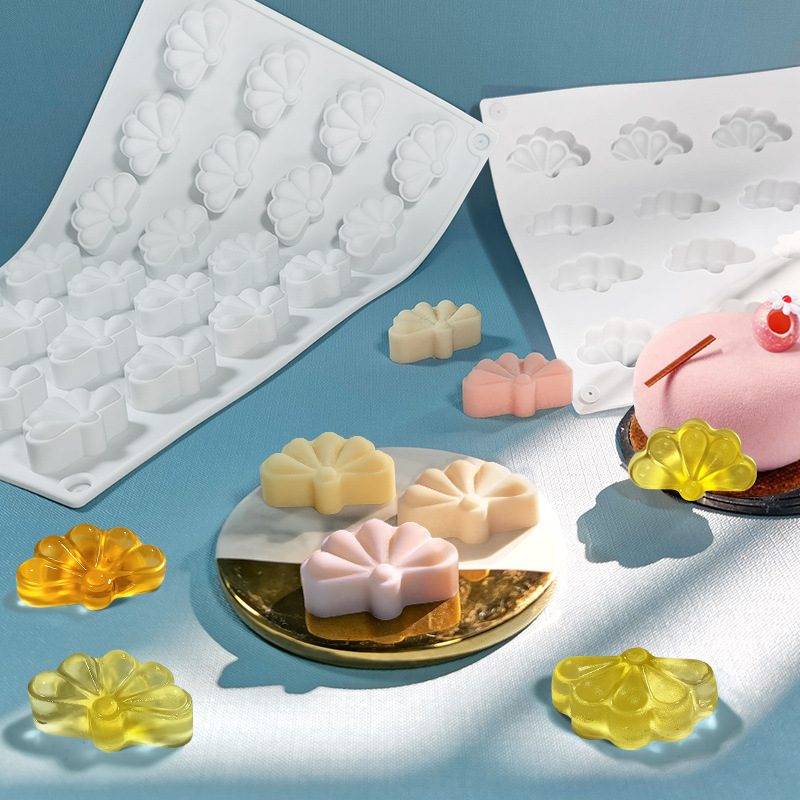
RUUIPON builds these as platinum RTV tools from a resin master (photo, sketch, or CAD) in Bao'an, Shenzhen (since 2018). Prototype is commonly 3–7 days after CAD lock; MOQ 20 molds per design. 21 CFR 177.2600 is an extraction test on the finished article, not an “FDA-approved factory” stamp. Name US retail, EU/LFGB, or craft-only on the RFQ so the document pack matches the compound.
Wet mass, undercut, jacket, Shore — the pastry version
Wet mass (filled tray). The load that sags the tool is the filled tray on the way to the freezer, then the frozen mass on the way back. A 400 × 300 mm six-cavity sphere tray with ~80 g portions is a few kilograms plus the rubber. Unsupported large food trays typically show about 0.5–1.5 mm edge sag; that shows up as outer-row portions running 3–6% heavy versus center if you're selling grams. Design for the loaded carry, not the empty mold on a desk.
Undercut. Petals, sphere undercuts, and a deep logo island need a peel, not a yank. If silicone can roll off the frozen piece without tearing a petal, an open-back one-piece cavity is fine. Crossed petals, a nearly closed sphere, or a bail-like handle need a split, a plug, or a two-stage demold. Don't solve every undercut by stretching 10A rubber harder.
Jacket. Here the “mother mold” is often a rigid tray frame, sheet-pan nest, or printed support that the soft cavities sit in. Without it, a Shore 10A–20A sheet twists when you walk it to the blast freezer. Baking molds sometimes run firmer (the sister baking molds page); sculptural mousse usually stays soft and borrows stiffness from the nest.
Shore. Typical cavity Shore is 10A–20A platinum so a frozen petal releases. A 35A–45A baking grade will hold a sheet flatter and also tear a thin leaf on demold. Geometry and wall thickness beat the catalog number: a thick 25A rim can feel stiffer than a thin 40A lip. Platinum shrink is typically 0.1–0.3%; that's how cavity volume drifts if you recast in tin later.
ISO 3302-1 is a rubber-*part* tolerance class. If you need portion grams, specify water volume or a frozen-weight map per cavity with the tray seated in its nest—not “precision mold” on the PO.
Common mix-up
Pastry buyers send a render of a mirror-glazed sphere and get quoted a baking sheet. Baking heat and frozen peel are different jobs. Another mix-up: treating a compound FDA/LFGB PDF as if RUUIPON were an FDA-approved factory. The report has to match the lot you pour; 21 CFR 177.2600 is extraction, not a building certificate.
Worked example: six-cavity 90 mm frozen sphere
Geometry: 90 mm sphere, slight parting at the equator so it isn't a locked ball, 80 g target, six cavities on a 400 × 300 mm tray.
Process: fill, blast-freeze, invert-and-peel, glaze. Destination: EU retail, so LFGB / BfR XV on the compound plus the extraction path the buyer named.
Tool family: CNC or polished master → platinum food-contact RTV, Shore 10A–20A, vacuum degas → cavities in a rigid nest/frame (the jacket) → prototype one tray, then MOQ 20.
Acceptance: water-volume map within the agreed grams; frozen demold of the real mousse without petal/sphere tear; loaded-tray edge sag in the 0.5–1.5 mm typical band with the nest on; no sticky inhibition from an undercured SLA master.
If the sphere is more than a hemisphere with a locked equator, this becomes a keyed two-part or a plug. Don't freeze the one-piece quote and “see how it goes.”
Failures you will actually see
| Symptom | How to confirm | Fix |
|---|---|---|
| Frozen petal or logo island tears on demold | Watch the peel; mark the tear against the undercut | Softer local Shore, more draft, split/plug; stop yanking a 40A baking grade |
| Outer-row portions heavier than center | Weigh a full frozen tray vs water map | Rigid nest; don't add cavities until sag is in band |
| Mirror glaze prints pinholes or seams | Raking light on the cavity vs master | Finish the master; degas; move the seam off the show face |
| Tray twists walking to the freezer | Loaded carry test | Jacket/frame; thicker border second, Shore last |
| Sticky face, inhibited cure | Touch test after pour; check SLA post-cure | Barrier coat the master; platinum, not a dirty print |
A photo that would prove the claim: tray in its nest on a scale, a water-volume sheet, and one frozen demold with the petal intact. Ask for that on prototype validation.
Typical shop values
Reference values only. Confirm material-specific limits against the supplier’s technical data and agree project acceptance criteria before production.
| Item | Typical shop value |
|---|---|
| Cavity Shore | 10A–20A platinum food-contact RTV, rigid nest behind it |
| Mix | Platinum 1:1 or 10:1 by grade; vacuum degas until the foam collapses |
| Linear shrink | ~0.1–0.3% (platinum) |
| Loaded-tray edge sag | About 0.5–1.5 mm unsupported; outer row often 3–6% heavy if it sags |
| Prototype | 3–7 days after CAD lock |
| Production MOQ | 20 molds per design |
What to ask when you're buying
- Frozen demold or bake-and-unmold? Don't let the quote assume an oven.
- Target grams per cavity, and will you map water volume with the tray in its nest?
- Can silicone peel this petal/sphere, or do we need a split?
- Which food-contact pack: 21 CFR 177.2600 extraction, LFGB / BfR XV, or both—and which compound/lot?
- Who owns the master and the nest after the tooling charge? Write it down.
- What's the one failure you most want to avoid: tear, sag, or volume drift?
We would not recommend a floppy unsupported mousse tray
We would not recommend a 35A–45A baking hardness for a frozen sculptural petal. We would not skip the rigid nest on a 400 mm tray and then “fix sag” by adding more cavities. We would not treat a generic FDA PDF as factory approval. We would not put a parting line across the glazed show face. We would not quote LSR steel with a cold-runner for a pastry cavity you fill by hand.
RUUIPON Mold Structure Decision:
- Mostly open-back dessert? - closed sphere / crossed petals -> Deep undercuts?
- Deep undercuts? - frozen peel is safe -> Open-back RTV cavities
- Deep undercuts? - locked geometry -> Two-part / removable plug
- Large loaded tray or Shore 10A-20A? - tiny single cavity -> Open-back RTV cavities
- Two-part / removable plug -> Rigid nest / jacket required
- Open-back RTV cavities -> Large loaded tray or Shore 10A-20A?
When this page is the wrong quote
A shallow cookie or cake pan that only needs oven stability belongs on baking molds. Chocolate bars and bonbons that never freeze belong on chocolate molds. High-volume steel gummy-part tools are quoted here as HTV products or molds, or as a different LSR-tool RFQ - ask us, not an RTV pastry tray. A one-off 50 mm demo cavity can skip the nest.
Mousse / entremet RFQ — copy this
- Dessert type and whether demold is frozen
- Target portion grams or ml; cavity count; tray envelope
- Show face vs acceptable seam
- Petal/sphere undercuts (photos or STL)
- Nest/sheet-pan constraint
- Destination market and document list (21 CFR 177.2600 extraction and/or LFGB — not “FDA approved factory”)
- Platinum food-contact grade; Shore if already validated
- Prototype test: real mousse, not only water
- Quantity: prototype + production (MOQ 20)
- Who keeps master and nest; recast of the RTV skin
Send the STL or master, the grams, and whether this is a frozen peel. [email protected] · +86 135 3006 2969 · Licheng Technology Industry Park, Xinhe Blvd, Shajing, Bao'an, Shenzhen.
Matched CTA: Send portion grams, frozen-demold photos, and the show-face seam constraint for a Shore-and-nest review. Contact / RFQ · materials / compliance · baking molds if this is actually an oven tool.
FAQ
Why isn't this just a baking mold? Baking wants a firmer sheet that survives the oven. Frozen mousse wants Shore 10A–20A so a petal peels. Using baking hardness on a sculptural entremet is a common way to tear the dessert.
Do I need FDA or LFGB documents? Name the market. US food-contact work often means 21 CFR 177.2600 extraction on the article/compound, not a factory stamp. EU work often means LFGB / BfR XV on the actual grade you buy. Match the PDF to the lot.
How do I keep portion weight from drifting? Seat the tray in a rigid nest and map water volume (then frozen weight) per cavity. Unsupported 0.5–1.5 mm edge sag is enough to make outer rows 3–6% heavy.
Can I start from a pastry photo? For a first look, yes. For grams and a locked sphere, send CAD, a printed master, or a physical sample. Mirror-glaze work is unforgiving of a rough master.
Does the tooling charge include the nest and the master? Only if the PO says so. Write ownership and whether a recast of the RTV skin is included after wear or a logo change.