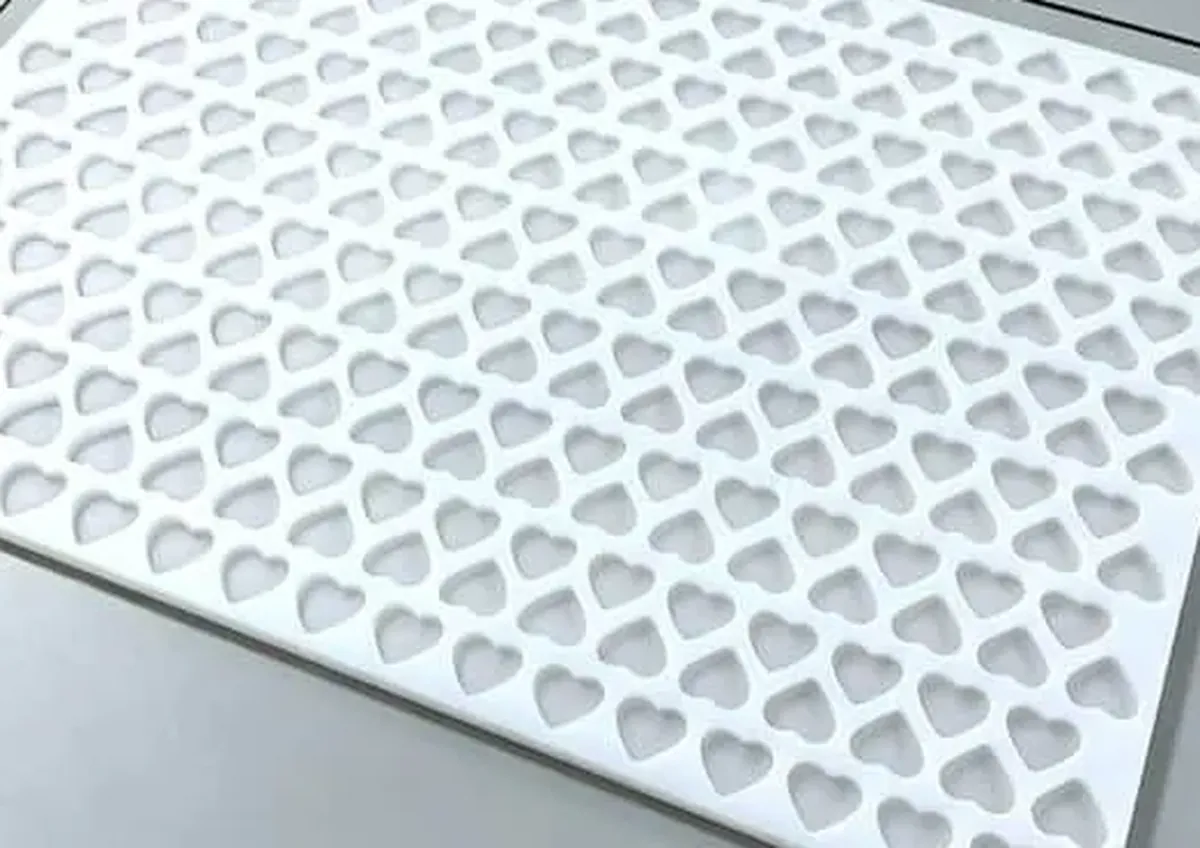
Depositor-Compatible Gummy Molds
Depositor-Compatible Gummy Molds for OEM buyers. DFM, material selection, prototyping, tooling and production planning from a Shenzhen silicone manufacturer.
When buyers search for gummy molds for depositor machines, they are usually trying to reduce one of three risks: a design that cannot be molded cleanly, a material that does not behave correctly in use, or a supplier that cannot repeat the approved sample.

RUUIPON treats this work as an engineering-and-production problem. The useful starting point is not “what is your best price?” but what must the part or mold do, and what evidence will prove that the first sample is correct?
This page is written for food brands, commercial kitchens and food-contact product buyers. It focuses on the decisions that change tooling, risk, material and repeatability.
Where this type of project is used
- pectin gummies
- gelatin gummies
- vitamin and supplement gummies
- commercial depositor trays
- branded and symbol cavities
The same silicone family can be used in very different ways across these applications. That is why we do not copy one hardness, one wall thickness or one tooling method from one project to another.
Five questions we want answered before quoting
| # | Engineering question | Why it changes the project |
|---|---|---|
| 1 | Nozzle count and center-to-center pitch? | Changes tooling split, shutoff or release path |
| 2 | Tray indexing direction and registration features? | Controls material/hardness and local wall design |
| 3 | Maximum outer tray dimensions? | Defines the functional inspection plan |
| 4 | Required cavity target mL/grams? | Determines prototype method and risk |
| 5 | Does the depositor need a rigid support frame? | Changes process/tooling economics |
If the answer to one of these questions is unknown, that is not a problem. It simply becomes something to prove during DFM or prototype.
The failure modes worth discussing before tooling

| Failure mode | First prevention step | How to validate |
|---|---|---|
| Sticky pectin product stretches out of a deep cavity | Design/process review before tooling | Functional prototype or first-article check |
| Outer rows fill at a different weight because the tray bows | Design/process review before tooling | Functional prototype or first-article check |
| Nozzle pitch does not match the cavity pattern | Design/process review before tooling | Functional prototype or first-article check |
| Micro-lettering tears the gummy | Design/process review before tooling | Functional prototype or first-article check |
| The cavity nominal ml does not match actual formulation density | Design/process review before tooling | Functional prototype or first-article check |
These are the issues that turn a cheap mold into an expensive project. The purpose of DFM is to expose them while they are still easy to change.
Weight and cavity volume: use a calculation, then verify the formula
For portion-controlled food products, the first engineering estimate is:
piece mass ≈ cavity volume × actual product density
That equation is useful, but the density must come from the customer's real formulation or a measured test. A 4 mL cavity is not automatically a 4 g gummy, chocolate or dairy portion.
A practical validation method is:
- Measure the cavity with water or CAD volume.
- Deposit the real product at normal process temperature.
- Sample pieces from the center and outer rows.
- Record average, range and any systematic row-to-row drift.
- Adjust cavity volume or tray support before production tooling is multiplied.
For a 60-cavity mold, even a small systematic difference matters. If the target is commercial portion control, actual piece weight belongs in the prototype acceptance criteria.
Material selection: Shore A is only one variable
- platinum-cured food-grade silicone is a common route for food-contact molds/products
- FDA/LFGB-related documents must correspond to the selected material and use case
- post-cure, odor and extractables requirements should be specified if the buyer has them
A softer compound can make demolding or assembly easier, but softness also reduces structural support. A harder compound can hold geometry better, but it can increase insertion force, demolding stress or pressure on a mating part.
The most useful material discussion therefore includes:
- nominal Shore A
- wall thickness at the flexible feature
- tear-prone transitions
- temperature and chemical environment
- required recovery after deformation
- color/translucency
- cure/post-cure requirements
- documentation required by the destination market
When the feel is uncertain, two prototype hardnesses are often more informative than debating one number by email.
Process selection: compare the route, not only the quote
Route 1: Master preparation
This route is considered when it gives the buyer a better balance of tooling risk, unit cost and repeatability. It should not be selected simply because it appears cheaper on the first quotation. We compare what has to be validated now, how likely the geometry is to change, and what production volume the buyer can realistically forecast.
For a new design, the key question is whether this route allows the team to learn from the first sample without locking an expensive mistake into production tooling.
Route 2: Mold-box or silicone-skin construction
This route is considered when it gives the buyer a better balance of tooling risk, unit cost and repeatability. It should not be selected simply because it appears cheaper on the first quotation. We compare what has to be validated now, how likely the geometry is to change, and what production volume the buyer can realistically forecast.
For a new design, the key question is whether this route allows the team to learn from the first sample without locking an expensive mistake into production tooling.
Route 3: One-piece, split, plug or inner-core design
This route is considered when it gives the buyer a better balance of tooling risk, unit cost and repeatability. It should not be selected simply because it appears cheaper on the first quotation. We compare what has to be validated now, how likely the geometry is to change, and what production volume the buyer can realistically forecast.
For a new design, the key question is whether this route allows the team to learn from the first sample without locking an expensive mistake into production tooling.
Route 4: Rigid mother mold for large/thin silicone skins
This route is considered when it gives the buyer a better balance of tooling risk, unit cost and repeatability. It should not be selected simply because it appears cheaper on the first quotation. We compare what has to be validated now, how likely the geometry is to change, and what production volume the buyer can realistically forecast.
For a new design, the key question is whether this route allows the team to learn from the first sample without locking an expensive mistake into production tooling.
Route 5: Prototype casting with the customer's material when possible
This route is considered when it gives the buyer a better balance of tooling risk, unit cost and repeatability. It should not be selected simply because it appears cheaper on the first quotation. We compare what has to be validated now, how likely the geometry is to change, and what production volume the buyer can realistically forecast.
For a new design, the key question is whether this route allows the team to learn from the first sample without locking an expensive mistake into production tooling.
DFM details that are easy to miss
Parting line and shutoff
A parting line creates a visible and functional witness. On a gasket, it can affect sealing. On a consumer product, it can affect appearance. On a casting mold, it determines cleanup on every cast.
We therefore place the split where the product can tolerate it and where the tool can be manufactured and maintained reliably.
Thin-to-thick transitions
A sudden change in silicone section can create local stiffness, fill or cure differences. In flexible products it can also concentrate stress.
A small radius, taper or gradual transition is often a better solution than simply specifying a “stronger silicone.”
Deep undercuts
Silicone can flex around undercuts, but repeated over-stretching is still a fatigue mechanism. For deep undercuts we compare softer material, split tooling, removable plugs, local relief and the direction of demolding.
Logo and surface texture
A permanent molded logo is usually more durable than a printed mark, but the artwork must be designed for silicone. Very fine strokes, deep sharp deboss and isolated islands can create weak tooling or cleaning problems.
Measurement method
A tolerance is incomplete until the measurement method is understood. Soft parts change shape under force. Flatness, wall thickness and outside dimensions may need a fixture or controlled conditioning time.
Prototype strategy: decide what one sample must teach you
A good prototype has a written question behind it.
For depositor-compatible gummy molds, useful prototype questions include:
- dry alignment with machine/nozzle template
- filled-weight sampling
- indexing repeatability
- tray support/flatness
- cleaning and handling test
Do not approve only from photos when the function is fit, force, weight, demolding or sealing.
A hypothetical gummy brief might state: 4.0 g pectin piece, 48 cavities, 600 × 400 mm maximum tray envelope, depositor pitch supplied by machine drawing, platinum-cure food-contact silicone, and a requirement to verify outer-row piece weight.
That is a useful engineering brief because it connects the design to a real production decision.
Quality control: inspect what makes the product work
| Checkpoint | Reference | When to check |
|---|---|---|
| Critical dimensions tied to function | Drawing / approved sample / buyer specification | Prototype + production lot as applicable |
| Parting-line/flash acceptance | Drawing / approved sample / buyer specification | Prototype + production lot as applicable |
| Surface and color standard | Drawing / approved sample / buyer specification | Prototype + production lot as applicable |
| Fit or assembly test | Drawing / approved sample / buyer specification | Prototype + production lot as applicable |
| Golden sample for repeat orders | Drawing / approved sample / buyer specification | Prototype + production lot as applicable |
Where appearance matters, a physical golden sample is useful. Where fit matters, the mating part is useful. Where portion weight matters, a measured product sample is useful.
“QC passed” should mean something specific.
Cost: where the money actually goes
- master/model development
- silicone mass and mold thickness
- number of mold parts/cores
- mother mold or support shell
- labor for split lines, keys, vents and finishing
The lowest unit price can come with a higher total cost if the quote omits tooling, trim, assembly, post-cure, inspection or packaging. For comparisons, ask suppliers to separate:
- engineering/NRE
- tooling
- unit price at each quantity
- secondary operations
- required test/document package
- packaging
- freight and Incoterm
This also makes future reorders easier to evaluate.
What to send in the RFQ
- STEP/STP or a dimensioned drawing; STL is useful for sculptural geometry
- physical sample or mating part when fit is critical
- material/use environment and target Shore A if known
- first-order quantity plus realistic repeat volume
- required reports, packaging, color and logo instructions
A complete RFQ reduces quotation time because the supplier does not have to guess at the risk.
What we would not lock too early
For a first project, avoid fixing these by assumption:
- exact Shore A before fit/demolding is tested
- the maximum possible cavity count
- steel/LSR tooling before the design is stable
- a tiny logo feature simply because it exists in vector artwork
- a medical/food compliance statement without identifying the real grade
- a production tolerance copied from a rigid plastic drawing
Freeze the requirements that matter. Test the uncertain ones.
How this differs from buying a stock silicone item
A stock item is selected from an existing geometry. A custom project creates or changes geometry, tooling and often the material/inspection definition.
That means the supplier should be able to explain:
- what is being engineered
- what is one-time tooling
- what can still change during prototype
- what becomes fixed after approval
- what data will be kept for the repeat order
If those boundaries are not clear, scope creep and revision arguments are almost guaranteed.
How we would structure EVT, pilot and production
EVT - prove the design
At EVT, the goal is learning. Keep the tool simple enough to revise. Freeze only the dimensions and requirements that are genuinely known.
A sensible EVT package for depositor-compatible gummy molds may include two hardnesses, one or two geometry revisions, fit samples, basic dimensional results and a record of why the preferred revision was selected.
Pilot - prove repeatability
The pilot should use the intended production material and a process close enough to production to expose trimming, handling, cycle and inspection issues. This is where the team creates the first practical work instruction and golden sample.
Production - control changes
Production should reference one drawing revision, one approved material, one color standard where relevant, and one inspection plan. If material, tool, cavity or process changes later, the change should be documented rather than silently introduced.
A buyer-side supplier qualification checklist
A serious buyer can ask a supplier for:
- a clear description of which steps are in-house
- current workshop evidence related to the quoted process
- the material grade proposed for the order
- how CAD revisions and approved samples are controlled
- what will be inspected before shipment
- whether the supplier can repeat the exact approved configuration
- how non-conforming parts are handled
- what information is needed before a repeat order is released
These questions are more useful than asking whether the factory is “professional.”
Packaging and shipping are part of the engineering brief
Large flexible silicone parts can take a compression set if packed badly. Mold cavities can be damaged by heavy items stacked on top. Food-contact parts may need sealed inner packaging. A fitted sleeve can deform if bundled under tension.
Tell the supplier whether the product will ship as:
- bulk industrial components
- individually bagged parts
- retail-boxed private-label products
- e-commerce units that must survive courier handling
- heavy silicone molds requiring reinforced cartons
Packaging should preserve the approved part condition, not simply minimize carton size.
Frequently asked questions
Can you start without CAD?
Yes. A physical sample, measured photos or a sketch can start the engineering review, but fit-sensitive geometry is safer with the real mating part or accurate scan.
Can one hardness work for every version?
Not necessarily. A change in wall thickness, span or fit can make the same compound feel very different.
Should the first sample use production tooling?
Only when the design is already mature and the volume justifies it. EVT programs often benefit from lower-risk tooling first.
Can you guarantee a tolerance before seeing the drawing?
No responsible supplier should. Tolerance needs to be tied to geometry, process and measurement method.
Do you provide material documentation?
Available documentation depends on the actual compound and target market. It should be confirmed before material approval.
How do repeat orders stay consistent?
Keep one approved CAD revision, material specification, inspection plan and golden sample as the production reference.
What if sticky pectin product stretches out of a deep cavity?
Treat it as a design or process problem to diagnose, not as a reason to immediately change silicone. We would first identify where the failure starts, compare the real part with the approved drawing, then check local geometry, hardness, cure, handling and the relevant mating/casting material. A controlled prototype change is more useful than changing several variables at once.
What if outer rows fill at a different weight because the tray bows?
Treat it as a design or process problem to diagnose, not as a reason to immediately change silicone. We would first identify where the failure starts, compare the real part with the approved drawing, then check local geometry, hardness, cure, handling and the relevant mating/casting material. A controlled prototype change is more useful than changing several variables at once.
What if nozzle pitch does not match the cavity pattern?
Treat it as a design or process problem to diagnose, not as a reason to immediately change silicone. We would first identify where the failure starts, compare the real part with the approved drawing, then check local geometry, hardness, cure, handling and the relevant mating/casting material. A controlled prototype change is more useful than changing several variables at once.
What if micro-lettering tears the gummy?
Treat it as a design or process problem to diagnose, not as a reason to immediately change silicone. We would first identify where the failure starts, compare the real part with the approved drawing, then check local geometry, hardness, cure, handling and the relevant mating/casting material. A controlled prototype change is more useful than changing several variables at once.
Start with the production problem
For depositor-compatible gummy molds, send the current CAD or sample, the real use condition, expected quantity and the acceptance criteria that matter most. If the design is incomplete, send what you have and identify what is still uncertain.
We can then decide whether the next step should be DFM, a low-cost prototype, a master mold, compression tooling, LSR evaluation or another route.
Technical appendix: how to turn the first sample into a production specification
A prototype only becomes a useful production reference when its successful behavior is converted into data. For depositor-compatible gummy molds, record the following before the tool or process is released:
A. Geometry record
Keep the native CAD revision, not only an STL export. Mark dimensions that control fit, cavity weight, sealing, alignment or visual symmetry. If a physical master is the authority, record how it was measured and whether the master remains available for future reorders.
B. Material record
Record the exact compound or approved equivalent policy, nominal Shore A, color/masterbatch reference and any cure or post-cure condition that matters. If the buyer relies on food-contact, biocompatibility or chemical-resistance documentation, keep the relevant report with the material approval.
C. Process record
Record which manufacturing route made the approved sample and any important processing assumptions. A sample made from hand-poured RTV does not automatically validate the surface, flash or shrink behavior of a future LSR part.
D. Functional record
Write the acceptance test in plain language. Examples include:
- “remains seated after 20 install/remove cycles”
- “all 48 gummy cavities produce pieces within the buyer's agreed weight window using the production formula”
- “does not collapse under the defined operator load”
- “support shell closes without forcing or visible distortion”
- “logo remains readable after the agreed wash/abrasion test”
E. Visual record
Keep controlled photographs and a golden sample for color, gloss, trim witness and molded logo appearance. Do not use compressed messaging-app photos as the only visual authority.
F. Change control
When the customer requests a revision, update the revision identifier and state what changes. The safest repeat orders are boring: the same drawing, the same material, the same acceptance plan, and no silent substitutions.
A practical pre-PO review for buyers
Before issuing a production PO for depositor-compatible gummy molds, a buyer can ask the following:
| Question | Why it matters |
|---|---|
| Which drawing revision will production use? | Prevents old CAD from returning |
| Which silicone grade is approved? | Prevents unreviewed material substitution |
| What is the production tool/cavity count? | Confirms output and tooling ownership |
| What will be measured before shipment? | Connects QC to function |
| What is the golden sample? | Controls appearance and feel |
| Which documents ship with the lot? | Prevents last-minute compliance gaps |
| How are changes approved? | Protects repeat orders |
This is the level of detail that makes a long B2B page useful. Length by itself does not create SEO value; buyer-specific decisions do.
Engineering worksheet: translate the buyer's complaint into a measurable requirement
A buyer will often describe the problem in everyday language:
- “too soft”
- “hard to demold”
- “doesn't fit tightly enough”
- “tray feels flimsy”
- “logo is not clear”
- “surface has too much flash”
Those descriptions are useful, but they are not yet production specifications.
For depositor-compatible gummy molds, the engineering task is to convert the complaint into something that can be tested. The central risk is piece-weight consistency, sticky demolding, tray flatness and compatibility with the customer's filling process.
A practical worksheet looks like this:
| Buyer statement | Engineering question | Possible measurement |
|---|---|---|
| Too soft | Which feature moves too much and under what load? | Deflection under defined load / Shore A + geometry |
| Too hard to demold/install | Where is the peak stretch or interference? | Demold/install force and local geometry |
| Doesn't fit | Which interface controls retention or clearance? | Critical dimension + functional fit test |
| Tray/mold deforms | Under what filled mass or support condition? | Loaded flatness/deflection |
| Logo is weak | Is the issue fill, depth, draft or surface? | Logo dimension + real molded/cast sample |
| Too much flash | Where is the shutoff/parting line? | Flash limit on marked critical surfaces |
This translation is one of the biggest differences between a catalog supplier and a development manufacturer.
Measurement strategy for flexible silicone
Sample piece weights from center and outer rows; if the tray works with a depositor, also verify cavity pitch and tray registration.
Silicone parts can change shape under the force of calipers, their own weight, packaging compression or temperature. When the dimension matters, define the condition:
- relaxed on a flat surface
- supported in a fixture
- installed on the mating part
- measured after a defined conditioning time
- measured after post-cure
- measured under a defined compression/load
The tighter the tolerance, the more important the measurement method becomes.
A buyer should avoid importing rigid-plastic tolerances into a soft silicone drawing without considering how the part will be held and measured.
Validation matrix: what to prove at each stage
| Stage | Main purpose | Recommended evidence |
|---|---|---|
| CAD/DFM | Remove obvious geometry/process risk | Marked drawing, DFM comments, approved revision |
| Prototype | Prove fit, feel, demold or cavity behavior | Functional sample, photos/video, measurement notes |
| Pilot | Prove repeatability in production-intent process | Multi-piece dimensional/visual sample, work instruction draft |
| Production | Control the released design | Inspection record, lot/material reference, golden sample |
| Reorder | Repeat without silent change | Same revision/material or documented approved change |
For this topic, deposit the real pectin/gelatin formula at normal process conditions, then check release after the real cooling/drying window.
Tooling-change decision: when should you revise CAD, change hardness, or change process?
When a sample fails, teams often jump to the easiest variable-usually Shore A. A better sequence is:
Change geometry first when:
- failure always starts at the same sharp corner or thin transition
- the part has an impossible demolding path
- retention relies on uncontrolled stretch
- a tray needs structural support rather than overall hardness
- a logo feature is below practical moldability
Change material/hardness first when:
- geometry is proven but the part needs a different force/feel
- temperature or chemical resistance is not adequate
- tear/elongation/compression-set properties do not match use
- a regulatory/material documentation requirement changes
Change process/tooling when:
- volume has outgrown the prototype route
- flash/tolerance/cycle requirements cannot be met economically
- automation or insert handling is now required
- the tool cannot support the necessary cavity count
For depositor-compatible gummy molds, prototype the cavity family and tray stiffness before multiplying production trays.
Operator and manufacturing ergonomics
A design can pass engineering review and still be unpleasant to make or use.
Watch how the tray is moved from depositor to cooling/drying; a high-cavity tray that twists can create more production loss than a smaller stable tray.
Questions worth asking:
- Can one operator load or carry the filled mold safely?
- Is the part easy to orient correctly in an assembly fixture?
- Can trimming be done without damaging a thin lip?
- Are visual defects easy to inspect?
- Can the mold be opened without a screwdriver or knife that damages silicone?
- Does packaging force the part into a shape that causes set?
- Can a food-contact cavity be cleaned without inaccessible recesses?
Small ergonomic changes often reduce scrap and labor more effectively than chasing a small material-price reduction.
Documentation package: build only what the project needs
A practical project file can contain:
- approved CAD/drawing revision
- approved material identification
- color/artwork reference
- prototype approval record
- critical-dimension inspection plan
- functional test method
- relevant material/test documents
- packaging specification
- golden sample reference
- change history
Not every project needs a heavy PPAP-style package. But every repeat-order project benefits from knowing what was actually approved.
For food-contact or medical-related work, documentation requirements should be confirmed before the material is frozen. A report is meaningful only if it corresponds to the actual compound and intended regulatory pathway.
Commercial risk: why a cheaper quote can be more expensive
Consider two quotations:
Supplier A quotes a lower tool price but has not included design correction, prototype testing, post-cure, fixture work or the required inspection.
Supplier B separates those items and explains which are one-time and which repeat.
Supplier A may look cheaper until the first sample fails or the buyer discovers that a required test/report was never included.
A useful commercial comparison therefore asks:
- Is the same geometry being quoted?
- Is the same silicone grade being quoted?
- Is the prototype included?
- Is the same inspection included?
- Are packaging and freight comparable?
- Which costs disappear on reorder?
- Which changes trigger new tooling?
This is especially important for depositor-compatible gummy molds, where piece-weight consistency, sticky demolding, tray flatness and compatibility with the customer's filling process can create a remake if scope is vague.
Reorder discipline: protect the approved result
Keep target cavity volume, approved formula test notes, tray dimensions and machine pitch with the reorder record.
For a repeat order, ask the supplier to confirm:
- CAD revision
- material grade
- color reference
- tooling ID/cavity count
- any tool repair or modification
- packaging
- critical QC checks
- requested quantity and shipping term
If something has changed, approve the change intentionally.
This is how a small pilot becomes a stable long-term production program rather than a sequence of slightly different batches.
Deep-dive buyer manual: running a technical review meeting
For a higher-value depositor-compatible gummy molds project, a 30-minute technical review should end with clear decisions rather than a longer email chain.
Part 1 - identify the one failure you cannot accept
Ask every participant to finish this sentence:
> “This project fails if ______.”
Possible answers include leakage, device movement, piece-weight drift, tearing on demold, poor color match, blocked aperture, uncomfortable grip, visible flash, or inability to hit production takt time.
The answer becomes the first acceptance criterion.
Part 2 - mark critical dimensions on the drawing
Do not label every dimension “critical.” Mark the few dimensions that control:
- fit
- seal
- alignment
- piece volume
- assembly
- appearance that cannot be reworked
Then decide how each will be measured on a flexible part.
Part 3 - separate fixed requirements from prototype variables
Fixed now:
- mating interface
- safety clearance
- external envelope
- target market
- known device/machine constraints
Prototype variables:
- Shore A
- local wall thickness
- texture depth
- retention geometry
- cavity draft
- support stiffness
This prevents the team from treating every first concept detail as untouchable.
Part 4 - select the lowest-risk tooling route
Use the first tool to answer the open questions. If the design is still changing, a lower-cost prototype route may be better than the tool with the lowest eventual unit cost.
If the design is mature and sustained volume is real, production tooling may be justified.
Part 5 - write the test before making the sample
For depositor-compatible gummy molds, the most useful test is the one that reflects piece-weight consistency, sticky demolding, tray flatness and compatibility with the customer's filling process.
Write:
- test setup
- sample quantity
- load/cycle/use condition
- measurement
- pass/fail rule
- who approves
This single habit greatly reduces “looks okay to me” approvals.
Part 6 - review the sample in the real environment
If it is a mold, pour the real material.
If it is a fitted cover, install it on the real device.
If it is a grip, apply the real torque/pull.
If it is a food tray, load every cavity.
If it is an LSR production part, remember that a hand-made prototype may validate geometry but not the final production process.
Part 7 - convert learning into revision-controlled data
Update the drawing and approval record after the test. Do not rely on a chat message that says “make this side a little thicker.”
Part 8 - run a pilot
The pilot should expose normal process variation. Sample multiple cavities and several parts, not only the best first article.
Part 9 - lock production references
Before mass production:
- final drawing
- material
- color
- golden sample
- inspection
- packaging
- revision/change process
should all be identifiable.
Part 10 - review after the first production lot
Ask what the factory and customer learned:
- Where was trimming slow?
- Which dimension showed the most variation?
- Did packaging deform anything?
- Was operator handling different from the prototype?
- Did the real casting/assembly process reveal a new stress point?
A good first order improves the second order.
Detailed FAQ for technical buyers
How much detail should I give a factory before NDA?
Enough to screen capability without disclosing proprietary geometry: application, approximate size, material/use condition, process target, quantity and critical constraints. Detailed CAD can follow after the NDA if needed.
Should I ask for the exact silicone brand before DFM?
Ask for the proposed grade or material family when documentation/properties matter. But do not lock a grade so early that the supplier cannot propose a better fit for the geometry.
Is “platinum cured” automatically better?
It describes a cure chemistry, not complete product suitability. You still need the right mechanical properties, process and application-specific evidence.
How do I avoid different results on a repeat order?
Use controlled revision, material identification, golden sample and the same acceptance plan. Require approval for substitutions.
When is a mold support shell worth the extra cost?
When the silicone alone would need to be excessively thick, heavy or unstable under the filled load. A rigid shell can improve geometry while reducing silicone mass.
When is LSR worth considering?
When annual volume, automation, repeatability and part geometry justify the tooling investment. It is not automatically the best EVT route.
What should I do if the first prototype is 80% right?
Document the 20% that is wrong in measurable terms. Keep the parts that passed and change only the variables tied to the failures.
What is the biggest SEO-era sourcing mistake?
Choosing a supplier because a landing page uses the right keywords. Manufacturing capability must be verified through technical discussion, material evidence, samples and repeatable delivery.
Start your custom silicone mold project
Send your design, target material, and quantity. We confirm silicone grade, hardness, and certification needs - usually within 24 hours.