
Does a Flexible Silicone Mold Need Draft Angle?
Sometimes a flexible RTV silicone mold can release a part with little or no conventional draft. That does not mean draft stops mattering once the cavity is rubber. The real question is whether the silicone can peel away from the casting without creating excessive vacuum, friction, local stretch or tear strain.
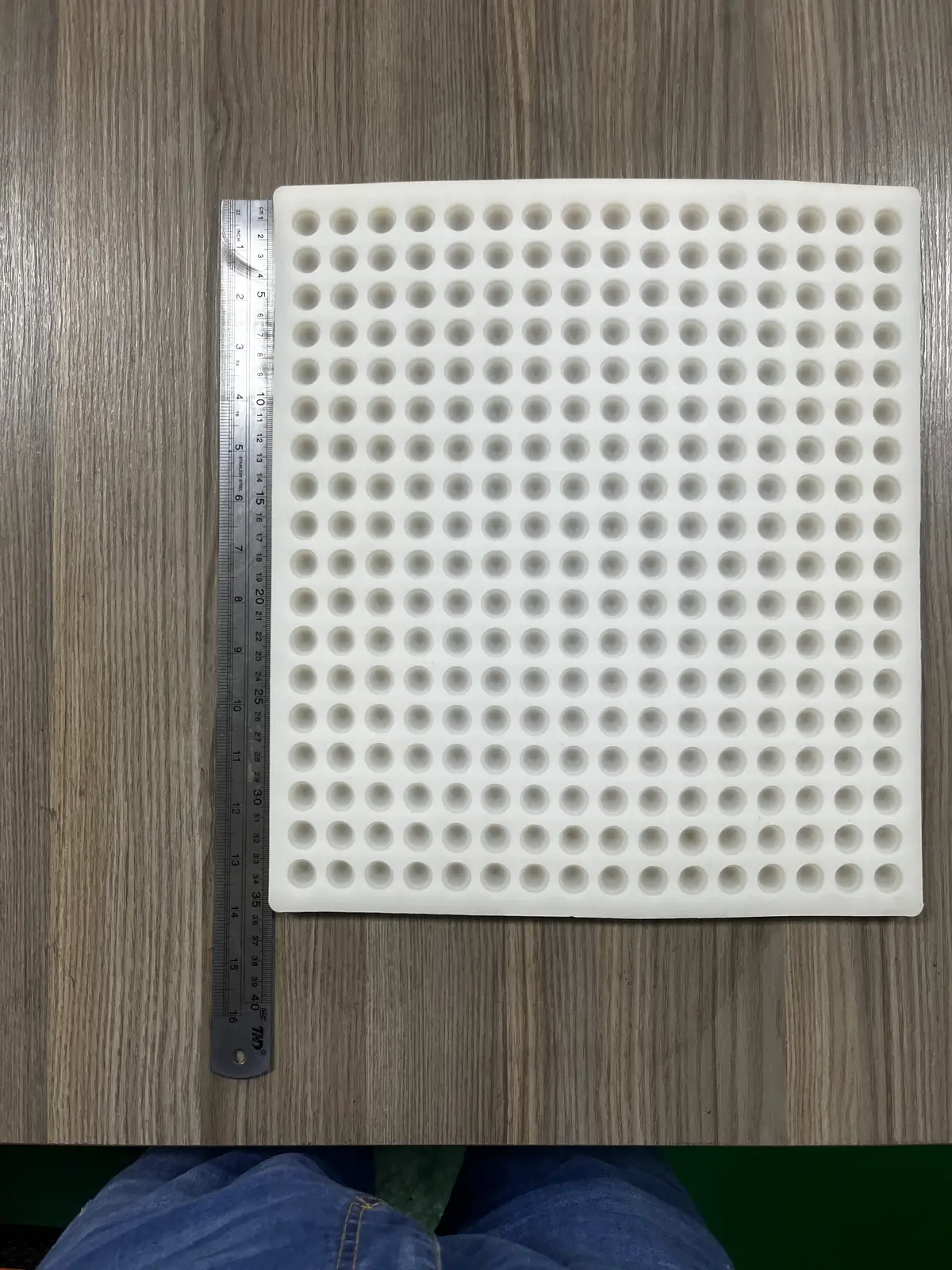
A shallow smooth cavity and a 60 mm-deep textured cavity may both show "0°" in CAD, yet behave completely differently at demold. Depth, surface area, Shore hardness, undercuts, casting stiffness and the operator's peel path all change the release force.
Separate draft from flexibility
Rigid tooling relies heavily on draft because the cavity cannot deform around the part. RTV silicone can deform, so it can tolerate geometries that would lock in a metal or rigid plastic mold.
But flexibility only buys you a finite release path. If a tall wall must stretch over a shoulder, scrape across texture and then invert around a logo island, the mold may release once and still fail as a repeat-production design.
Draft should therefore be treated as one variable in a larger release system:
- cavity depth;
- surface texture;
- local undercut depth;
- peel distance;
- silicone Shore and wall section;
- casting material stiffness at demold;
- whether the mold is open-face, slit, two-part or supported.
Shallow smooth cavities can tolerate less draft
A shallow resin coaster, soap bar or simple chocolate cavity may release cleanly with minimal draft because the silicone only needs to flex a short distance.
What usually makes this work:
- broad opening;
- smooth side walls;
- short vertical depth;
- no reverse hooks;
- no deep lettering on the side wall;
- enough silicone around the cavity to peel without concentrating stress.
In this geometry, adding large draft may unnecessarily change the customer's intended product shape.
Deep cavities change the release mechanics
As cavity depth increases, the amount of surface rubbing against the casting increases. Long nearly parallel walls can also create suction or vacuum-like resistance, especially on smooth castings.
Typical symptoms of marginal release geometry include:
- the casting lifts the whole mold before releasing;
- the wall turns white from repeated stretch;
- the operator must use a pick or pry tool;
- side texture drags or smears soft castings;
- the same thin rim tears after repeated pulls;
- a rigid casting suddenly releases and snaps small details.
The fix may be more draft-but sometimes the better solution is a different split, a relief vent, a softer local section or a removable plug.
Texture can matter more than the nominal angle
A wall can have positive draft and still release poorly if its texture acts like thousands of micro-undercuts.
Examples include:
- bark or stone texture;
- quilted patterns;
- aggressive leather grain;
- deep ribs;
- sharp embossed lettering;
- mechanical knurl-like surfaces.
For textured cavities, review the direction of the texture relative to the peel path. A ridge parallel to release is easier than a hooked ridge that the silicone must climb over repeatedly.
Shore A changes how the draft behaves
Harder silicone generally resists deformation more strongly. That can help a tray stay stable but can increase release force on a deep undercut. Softer silicone can peel more easily but may need a support shell to preserve geometry under load.
This is why "increase Shore A to make the mold better" is often the wrong first response to release problems.
The useful design question is:
Can the mold be supported while filled, then allowed to flex only where it needs to during demolding?
That often leads to a soft RTV skin plus rigid mother mold rather than a globally harder cavity.
Logos and lettering need local draft thinking
Fine text can create thin silicone islands or narrow grooves. Even if the main cavity has good release, small letters can tear the mold because the local geometry has its own negative draft or sharp root.
Review:
- stroke width;
- relief depth;
- inside-corner radius;
- direction of peel;
- distance to the parting line;
- whether the letter forms a trapped island.
If the logo is on a vertical face, small geometry changes can make a major difference in repeat demolding without visibly changing the brand mark.
When a split mold is better than adding more draft
Draft changes the product. A split line changes the tooling.
If the customer's geometry must remain nearly vertical or contains a local feature that cannot be drafted away, a two-part mold or removable plug may preserve the intended shape with lower demold strain.
Good candidates for a split rather than more draft include:
- full-3D figurines;
- handles and loops;
- crossed limbs;
- deep recessed logos;
- bottle-like shapes with shoulders;
- sculptural candles where the outer silhouette is fixed.
How to validate draft on a prototype
Do not approve draft from CAD alone. On the first mold, record:
- casting material used;
- time/temperature at demold;
- whether the mold is supported or free;
- where the operator starts the peel;
- whether any area must be pried;
- visible whitening or stretch marks after several cycles;
- damage to the casting or mold.
A short video of the demold can reveal more than a dimension table.
Where this page should sit in the RUUIPON structure
RUUIPON already has broader content about undercuts and self-demolding geometry. This page should remain narrowly focused on draft as a release variable, and link to the undercut, one-piece-vs-two-piece and parting-line pages rather than repeat them.
Before publishing, compare GSC queries with the existing self-demolding and undercut pages to confirm the new page has a distinct query footprint.
Next step
Send the cavity depth, the most difficult texture/undercut, your casting material and the surface that cannot change. RUUIPON can review whether the geometry needs more draft, a different Shore/support strategy, a split, or a local plug.