
Cavity Spacing and Border Width for Multi-Cavity Silicone Molds
The densest cavity layout is rarely the fastest production layout. Cavity spacing has to leave enough silicone for web strength, enough room for the mold to flex during demolding, and enough operator access to peel the correct cavity without overloading its neighbors. The outer border then has to stabilize and handle the tray without crushing edge cavities.
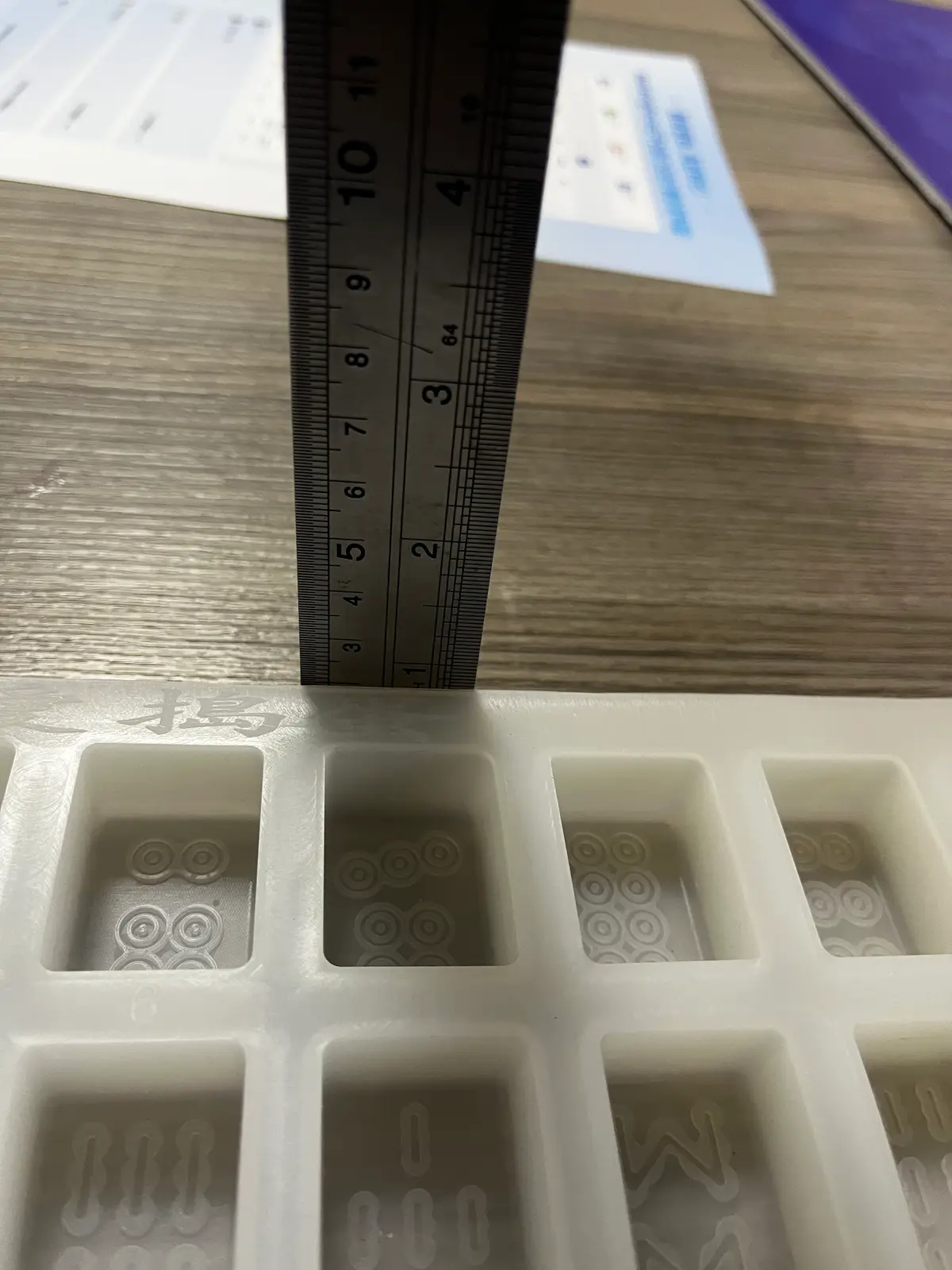
That means cavity count should be solved after spacing, demold path and tray footprint-not before.
The web between cavities is a structural member
The gap visible on a top view is not automatically the minimum silicone section.
For a deep cavity, the side wall may taper or bulge outward below the top surface. Two neighboring cavities that appear far apart at the opening can leave a much thinner internal web lower down.
Inspect the section through the deepest or widest region.
The web must survive:
- repeated row flexing;
- local peeling around undercuts;
- tray lifting and carrying;
- filled-weight deflection;
- trimming around cavity openings;
- any thermal cycling in the application.
Deep cavities need more than top-view spacing
A shallow gummy or chocolate cavity can often sit closer to its neighbor than a tall resin, soap or candle cavity because the demolding path is shorter.
Deep parts create three extra demands:
- more side-wall surface contact;
- larger peel travel;
- greater hand/finger access needed around the cavity.
If an operator cannot get a controlled grip, they often bend the whole tray. That transfers force into multiple webs and shortens mold life.
The outer border is the operator's handle
The perimeter is not wasted silicone. It can provide:
- grip during pouring and transport;
- stiffness at edge cavities;
- room for alignment features;
- support for a tray or frame;
- a clean area for part ID, orientation or batch marking.
A border that is too narrow forces operators to grab directly around the outside cavities. A very large border may add unnecessary weight and shipping volume.
The border should match the actual handling method.
Cavity spacing affects tray flatness
Packing more cavities into a fixed footprint can reduce the amount of continuous silicone that acts as the tray's frame. Under fill weight, the sheet may then sag or twist.
This matters for:
- commercial gummy depositing;
- flood-and-scrape processes;
- chocolate weight consistency;
- large soap trays;
- resin trays where the top surface must remain level.
If loaded flatness is critical, simulate or physically test the filled tray-not just the empty silicone sheet.
Compare 5×10 and 4×12 as production layouts, not arithmetic
Suppose a buyer wants roughly 50 cavities.
A 5×10 layout may be wider and easier to reach across one axis. A 4×12 layout may fit a machine bed better but become long and flexible. The "better" layout depends on:
- maximum tray envelope;
- depositor/nozzle arrangement if automated;
- operator reach;
- shelf/rack dimensions;
- filled mass;
- demold direction;
- carton size and freight efficiency.
Cavity count alone does not decide the answer.
Spacing also changes air and fill behavior
On open cavities, spacing influences how easily an operator can pour or scrape without contaminating adjacent features.
On closed molds, crowding can make it harder to route independent vents or gates to high points.
If each cavity has deep lettering, closely packed cavities may also make bubble inspection and touch-up more difficult.
Shipping cost is a real DFM constraint
A layout that grows beyond a practical carton dimension can raise freight and damage risk. For export projects, compare:
- tray footprint;
- number of trays per carton;
- stack method;
- support boards;
- whether the tray can be stored flat without deformation.
Sometimes two smaller molds outperform one large sheet even if the larger sheet uses fewer cartons in theory.
Scale cavity count only after the geometry is proven
For a new undercut shape, validate demolding first. A 2- or 4-cavity prototype can prove the geometry; then the production layout can be scaled with proper web and border design.
Do not approve a single-cavity prototype and then compress 24 copies into a dense production sheet without rechecking the structural web.
What should happen to the existing RUUIPON content
The current /blog/multi-cavity-silicone-mold-layout/ already owns this topic and should be rewritten, not supplemented with a near-duplicate spacing page.
The old article contains useful layout intent, but also fixed generic ranges, stale quantity claims and broad application numbers. Preserve any GSC-winning query coverage while replacing universal claims with geometry- and load-based decision logic.