
Anti-Static RTV Molds for Dust-Free Device Cavities
Anti-static RTV is dissipative, not EMI-conductive. Use it so a food, potting, or device tray doesn't hold dust. Spec a resistivity band, not a filler
 Kyler Yang · Founder8 min read
Anti-static silicone is a dissipative compound. It leaks charge slowly enough not to spark a CMOS die, and fast enough that the face does not remain a dust magnet. It is not an EMI gasket. It is not a carbon-loaded conductor. It is not a mold-release trick or an ionizer aimed at a standard insulating cavity.
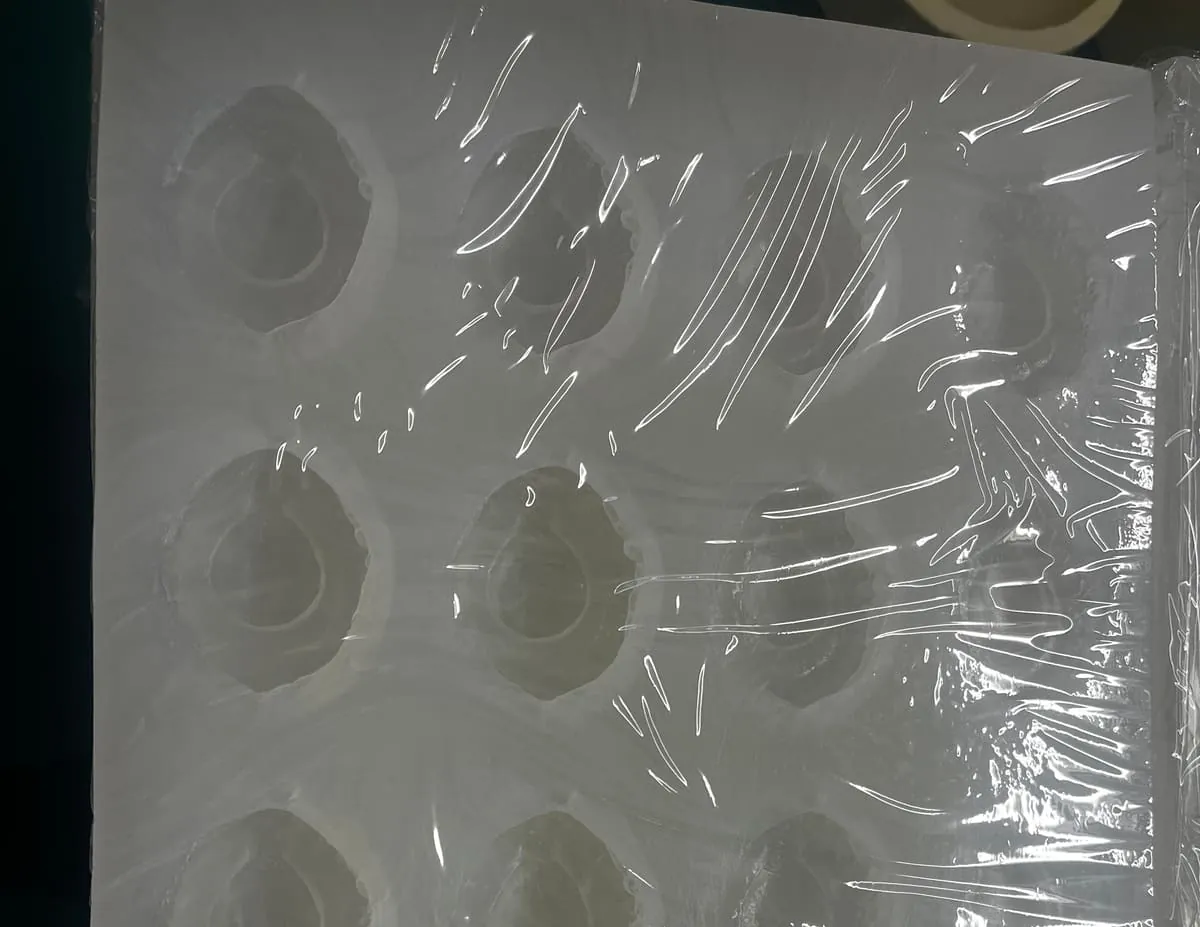
Unfilled platinum RTV is a high-resistivity elastomer. It tribocharges on peel, on a dry dump, and on a cleanroom wipe. In a chocolate, gummy, medical-tray, or electronics-potting cell that charge holds lint, skin flakes, and paper dust, then dumps into the casting or the device. The formulation job is to land surface or volume resistivity in a dissipative band the OEM already uses (often discussed under IEC 61340 ESD-control language), without turning the mold black, brittle, or extractable-dirty.
This article is about the poured mold. Controlling charge on a molded silicone *part* (stopper, keypad, tray that ships) is a cousin problem on a parts OEM.
Dissipative is a band, not a filler name
ESD-control practice splits surfaces roughly into conductive, dissipative, and insulative. Anti-static / static-dissipative RTV is specified so charge can bleed to ground through a planned path. Too conductive and you have a short and a marking carbon mold. Too insulative and the dust returns.
Write the method:
- Surface resistance or resistivity with electrode geometry (IEC 61340-2-3 is the measurement conversation many electronics files use)
- Volume resistivity if the path is through the bulk
- Humidity and temperature of the test — some ionic packages are humidity-helped
- Whether the cavity is tested as-poured, after wash, and after aging
Do not write “anti-static” on a gummy tray and mean “we wiped it with a dryer sheet.” Do not write it and mean a silver EMI O-ring. Carbon at dissipative loadings, permanent dissipative polymer packages, and some ionic / hygroscopic systems are the usual silicone answers. Loadings are the compounder's. Do not invent a shop percent.
Color is a constraint. Carbon packages go grey to black. Light-colored food or medical molds need a non-carbon permanent dissipative system, which is a different quote and a different humidity story.
Common mix-up: device part versus mold-room static
Fixing dust on a resin-casting or food mold is a mold-cell problem (humidify, ionize, dissipative mold grade, ground the jacket). Rewriting the device compound to solve a mold-room static problem is the expensive mix-up.
The reverse is also real: an insulating silicone cover that ships with a die is a part spec, not a reason to load the RTV jacket with carbon.
What to ask when you're buying
- Is the dissipative object the RTV cavity, or a molded silicone article that ships?
- Surface-resistance band, method, T/RH, after which wash?
- Color limit — can the mold be grey, or must it stay food-mold translucent?
- Ground path: how does the tray bleed (table, jacket, operator)?
- Food-contact path if this is chocolate/gummy: 21 CFR 177.2600 and/or LFGB / BfR XV on the finished, additive-containing mold.
Worked example: 24-cavity gummy sheet, dusty outer row
A nutraceutical line had a 24-cavity platinum RTV sheet, Shore 15A, jacketed, about 3,000 dumps a month. Outer-row bears were picking lint and running 3–6% heavy when the unsupported edge sagged ~0.5–1.5 mm. Two separate problems: support the tray (jacket / frame), and if charge was collecting dust, specify a dissipative platinum grade with a groundable frame — not an EMI carbon gasket compound that would mark pectin and fail food-contact.
ISO 3302-1 M2 on the pocket is still a rubber class, not an ESD class.
Medical dust, electronics, and food
In a device plant, dust on silicone is a particulate on a fluid path or visor. Charge makes the rubber a collector. So does tack from an undercured platinum face or leftover oil from a self-lubricating grade you did not mean to pour into a mold.
- Platinum RTV with a documented dissipative package for the cavity
- Post-cure / full cure before you call the library stable
- No tin-cure as a food or device mold archive
- ISO 10993 / USP Class VI on a base gum do not automatically cover the dissipative additive if the *part* is medical
- 21 CFR 177.2600 / BfR XV: the additive belongs in the food-contact article
On a bench, an insulating cover peels off a fixture and clicks a discharge into a connector. A dissipative cover bleeds. Give it a ground path. A dissipative gasket in an insulating plastic housing cannot bleed unless you design the path. Resistivity without a ground is a slower dust magnet.
Migratory antistats can wipe off. Permanent systems are the production conversation for molds that get washed. Humidity-dependent ionic systems can pass in a wet lab and fail in a dry winter line.
When this article is the wrong quote
If you needed an EMI enclosure gasket, that's carbon/nickel/silver parts on a different PO. If you needed thousands of dissipative stoppers, that's LSR/HCR, cold-runner, not a LIM hot tool. A tiny shallow tray in a humid kitchen may skip a special dissipative grade if ionizers and a ground strap already work.
Related reading: custom RTV molds, food-grade molds, gummy trays, what tooling means.
What to send for an RTV mold quote
- Object: dissipative platinum RTV cavity (not EMI, not a part tool)
- Resistance band, method, T/RH, after wash
- Color / food-contact / medical additive constraints
- Grounding of the jacket or frame
- Master, split, Shore, jacket, recast
- Current failure: dust, zap, marking carbon
Send tray photos, the dump material, and whether the rubber must stay insulating except for a dissipative face. We'll refuse a silver “be safe” swap.
We would not recommend an EMI grade to “be safe”
We would not recommend substituting a conductive EMI compound on a device-cover mold or a gummy tray. We would not raise Shore A first to “hold less dust.” We would not treat mold-side ionizers as the only control and then ship an insulating cavity into a dry electronics cell. Tooling charge ≠ ownership of an ESD program.
RUUIPON Mold Structure Decision: flat back? open-back. Cannot peel? two-part / plug / core. Large wet dump or 10A–20A? mother mold, and ground that jacket if the grade is dissipative.
- Cavity or shipping part? - cavity / tray -> Dissipative platinum RTV + ground path
- Cavity or shipping part? - keypad, stopper, cover -> Different RFQ: LSR/HCR part
- Dissipative platinum RTV + ground path -> Food or medical?
- Food or medical? - yes -> Additive in the extraction / 10993 article
- Food or medical? - electronics only -> IEC 61340 method + T/RH
- Dissipative platinum RTV + ground path -> EMI decade?
- EMI decade? - yes -> Wrong compound; stop
Typical shop values: dissipative RTV cavity
| Item | Typical shop value | | --- | --- | | Cavity Shore | 10A–20A platinum, jacket behind it | | Mix | 1:1 or 10:1; vacuum degas until foam collapses | | Platinum shrink | ~0.1–0.3% | | What “anti-static” means | Dissipative band with a named method; not EMI | | Carbon color | Grey to black; light food molds need non-carbon packages | | Loaded-tray edge sag | ~0.5–1.5 mm if the jacket is missing — dust and weight drift together |
Reference values only. Confirm material-specific limits against the supplier’s technical data and agree project acceptance criteria before production.
FAQ
Is anti-static silicone the same as electrically conductive silicone? No. Anti-static / dissipative grades sit in a resistivity band meant to bleed charge without acting as a wire. Conductive carbon, nickel-graphite, and silver grades are for grounding straps and EMI. Using an EMI compound on a mold or device cover can short a circuit and mark food.
Will a dissipative RTV mold stay clean in a dusty warehouse? It will hold less charged dust than an insulating twin if it can bleed. It will not defeat an unclean process. Oil bloom, tacky cure, and cardboard packaging will still decorate the cavity.
Can I have a white or translucent food mold that is anti-static? Sometimes, with a non-carbon permanent dissipative system. Carbon packages are grey to black. Whatever package you pick belongs in the food-contact or biocompatibility test article. Do not assume the natural platinum file covers the additive.
Does IEC 61340-5-1 certify my silicone tray? No. 61340-5-1 is an ESD-control program for electronics operations. The tray can be a dissipative element inside that program if you measure it with a named method. The standard does not stamp a rubber grade.
Why did resistance rise after we washed and dry-packed the molds? A migratory antistat washed off, or an ionic package lost humidity. Permanent dissipative systems are the usual fix for washed food and electronics molds. Retest after the real wash and at the real pack humidity.
Custom silicone development · DFM & prototype support
CAD, drawing, photos or sample details