
Are Custom RTV Molds Safe for Food? Test the Article
An RTV mold is food-safe only as a tested finished article under 21 CFR 177.2600 or LFGB/BfR XV. Platinum-cure is typical. BPA-free is not the proof.
 Kyler Yang · Founder9 min read
Some custom RTV silicone molds are suitable for food. Plenty that look like bakeware or chocolate bars aren't. If you're asking whether a mold is “safe,” you're really asking whether the finished cavity that will touch cake, chocolate, candy, or ice was formulated for food contact, platinum-cured as is typical, post-cured, cleaned, and then extracted or migrated under a named rule: FDA 21 CFR 177.2600 in the United States, LFGB/BfR XV on the German/EU path.
A mold can fail that test and still look like a kitchen tool. A mold can pass 177.2600 and still fail LFGB sensory. “FDA approved” as a product registration is the wrong claim either way. Read the report on this cavity, not the icon. If the PDF is full of cold-runners and heated steel, you're reading a molded-part file, not this RTV mold.
Common mix-up: wash a craft mold and it's bakery-safe
A lot of buyers treat a chocolate-bar shape plus a sink wash as the safety class. In the shop that usually means tin-cure RTV on an unsealed SLA master, no jacket, no post-cure record, and the first pulls smell like condensation byproduct.
21 CFR 177.2600 doesn't certify a drum of gum. It sets composition constraints for rubber articles intended for repeated use and then extracts the food-contact surface of the finished article — water at reflux for aqueous use, n-hexane at reflux for fatty use, against milligram-per-square-inch ceilings — and it expects a thoroughly cleansed article. LFGB isn't a sticker either. Germany applies food-contact law to silicone largely through BfR Recommendation XV: composition thinking, volatiles, simulants (commonly water, 3% acetic acid, 95% ethanol), and an organoleptic check. Regulation (EC) 1935/2004 is the EU umbrella.
If the seller can't name the regulation, the food type, the specimen SKU (this platinum RTV cavity, this color, this post-cure), you're not looking at a documented food-safe mold. Translucent isn't documentation.
What to ask when you're buying a food-safe RTV mold
- Can they name 21 CFR 177.2600 and/or LFGB/BfR XV on *this* cavity, with food types, lab, and date — not “FDA approved”?
- Is the chemistry platinum RTV, or is it tin-cure poured in a food-shaped master?
- Was the lab specimen production-real (same master, jacket, pigment, post-cure) or a spatula / plaque?
- What's the post-cure recipe for the thickest wall, and does the packed mold match that bake?
- How do they isolate platinum pours from tin-cure craft work so you don't get a tacky, inhibited face?
- Who owns the master, and can they recast when a tear reaches a logo?
Failure modes that show up in shop order
The usual failures aren't mysterious: industrial compound with extending oils or unlisted pigments; tin-cure RTV; short or missing post-cure; mold-release left on the master or the cavity; the wrong specimen covering a chocolate mold; overheating beyond the claimed use; inhibition against a dirty SLA master (a tacky face is a cure failure, not a seasoning ritual).
A sticky or oily new mold is a process signal. Wash as production should have washed. If odor remains after a proper wash and air-out, don't invent a home cure — that's volatiles or sensory. Craft-channel molds sold for resin, soap, or candles are a frequent mismatch. Geometry isn't a safety class. If the maker printed resin as the intended use, don't promote it into a bakery tool by washing harder.
Platinum addition-cure RTV is typical because it's addition chemistry without a condensation byproduct, and because a thickness-scaled post-cure can clear what labs look for. It doesn't make every platinum pour legal. Pigment packages, processing aids, a skipped bake, and inhibition from tin, sulfur, or some 3D-print residues still fail. Platinum-cure also doesn't equal medical grade. ISO 10993 and USP Class VI aren't bakeware tickets.
LSR injection with a cold-runner, platinum HCR compression, and platinum RTV pour are three processes. A report from one doesn't cover the others. For this site the expected answer is platinum RTV against a named master, not heated steel.
Worked example: six-cavity bar from a craft pour
A chocolatier bought a 6-cavity bar, cavities about 80 × 30 × 8 mm, from a craft listing, intending 200–400 pulls a month. The rubber was tin-cure RTV poured on an unsealed SLA master, no jacket, no 177.2600 or BfR XV file.
Washing didn't change the catalyst. The first pulls smelled, and the unjacketed skin warped so fill weights drifted. The safe replacement is a CNC or fully post-cured, barrier-coated master, platinum RTV, keyed if the bar is two-sided, a rigid jacket, post-cure scaled to the thickest section, wash, and an article report for the food types claimed. Until that chain exists, the craft pour is a resin tool that happens to look like chocolate.
A usable report names the regulation, the article (SKU, color, platinum RTV, thickness), post-cure actually used, food types or simulants, and the lab, date, and method — no invented certificate numbers. Reject a sister-product file and a drum letter that never saw the poured cavity. Temperature misuse is a separate way a previously tested mold stops being the tested article. Treat broiler peaks and empty pans on a hot rack as outside the file unless the maker tested that abuse.
When this article is the wrong quote
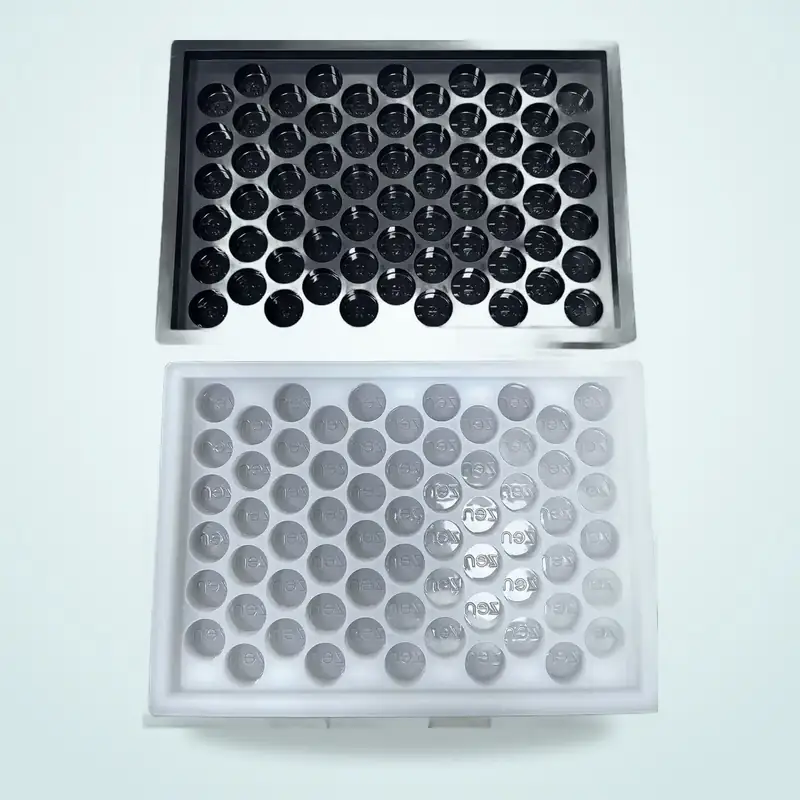
If the listing is a resin or soap mold, washing harder doesn't make it bakery-safe — buy a platinum RTV food mold or don't dump food. If you need medical biocompatibility (ISO 10993, USP Class VI), that's a different folder, not a loaf pan ticket. If you need molded LSR *parts* as consumer ware, that's a parts OEM with a cold-runner. A tiny, shallow one-piece tray is easier to wash and less likely to hide soil; a 64-cavity blasted chocolate sheet isn't. Geometry can override quantity.
Related reading: what food-grade means, how the cavity is tested, cleaning a food-contact RTV mold, food-grade molds.
What to send if you're checking food safety before you dump
Copy this. “Looks like bakeware” isn't comparable.
- Intended food and temperature; child's snack vs commercial dump
- Chemistry: platinum RTV vs tin-cure (ask them to name the kit)
- Report: 21 CFR 177.2600 and/or LFGB/BfR XV on *this* SKU, color, post-cure — lab, date, method
- Master finish (CNC vs SLA barrier coat) so platinum isn't inhibited
- Jacket and keys; who owns the master; recast path if a tear reaches a logo
- Current symptoms if you already have a mold: tack, oil, odor after wash, warpage
Send the listing or the physical mold photos, the food you'll dump, and any PDF they called a certificate. We'll tell you if it's a food-contact article, a craft pour, or a parts file.
We would not recommend washing a craft pour into bakery duty
We would not recommend a smell-or-pinch test as 21 CFR 177.2600. We would not season a sticky cavity with oil. We would not treat dishwasher-safe as food-safe, or ISO 10993 as a loaf-pan ticket.
- Causes to check -> Tin-cure or industrial kit
- Causes to check -> Skipped post-cure / cyclics
- Causes to check -> Release left on master
- Causes to check -> Inhibition vs dirty SLA
- Tin-cure or industrial kit -> How to confirm: name the kit; tack; odor after wash
- Skipped post-cure / cyclics -> How to confirm: name the kit; tack; odor after wash
- Release left on master -> How to confirm: name the kit; tack; odor after wash
- Inhibition vs dirty SLA -> How to confirm: name the kit; tack; odor after wash
- How to confirm: name the kit; tack; odor after wash -> Corrective: platinum RTV recast, post-cure, wash, article report
Typical shop values: food-safety checks on an RTV cavity
| Item | Typical shop value | | --- | --- | | Chemistry | Platinum RTV 1:1 or 10:1 — not tin-cure | | Shore | 10A–20A skin + jacket | | Post-cure | Thickness-scaled; a quiet pinch test is not a flask | | 177.2600 fatty | 175 mg/in² then 4 mg/in² n-hexane if chocolate/batter fat is in use | | Lab specimen | This cavity, this color — not a sister spatula | | First-use wash | Mild unscented detergent, rinse, dry; no oil |
Reference values only. Confirm material-specific limits against the supplier’s technical data and agree project acceptance criteria before production.
FAQ
Can I tell a food-safe RTV mold by smell or pinch test? Odor can hint at a short post-cure, but a quiet part can still fail extraction. Pinch and translucency aren't 21 CFR 177.2600. Ask for the article report on this cavity.
If a mold is platinum-cured RTV, is it automatically safe for cake? Platinum addition-cure is the typical chemistry, not the test. Pigments, release left on the master, jacket dust, and post-cure still decide the flask. Tin-cure looking platinum-colored is a different, worse problem.
Does dishwasher-safe mean food-safe? Dishwasher is a durability and sometimes a test-condition claim. Food-safe is extraction or migration of the finished article under a named food-contact rule. You can have one without the other if the seller mixed claims.
Why is “FDA approved” the wrong sentence on a custom mold listing? FDA doesn't register baking or chocolate molds as approved products under 177.2600. The section is finished-article extraction for repeated-use rubber. The honest sentence names the section, the food type, and the SKU.
Is a European LFGB pass enough for a US bakery chain using this RTV tray? Usually not by itself. US buyers typically want 177.2600 on the article, while LFGB/BfR XV is the German/EU path. Dual-market programs run both. Don't nest them.
Custom silicone development · DFM & prototype support
CAD, drawing, photos or sample details