
CNC Tolerances: RTV Masters vs Steel LSR Tools
The mill can hold a hundredth on aluminum or H13. RTV copies the master, not the press. Do not paste a prototype mill block onto a poured jacket or a hot
 Kyler Yang · Founder10 min read
The mill can hold a hundredth on aluminum Monday and a hundredth on H13 Wednesday. The *mold* will not hold the same hundredth in a 180 °C LSR press — and a poured RTV jacket will not hold it either if the master was a floppy SLA you never sealed.
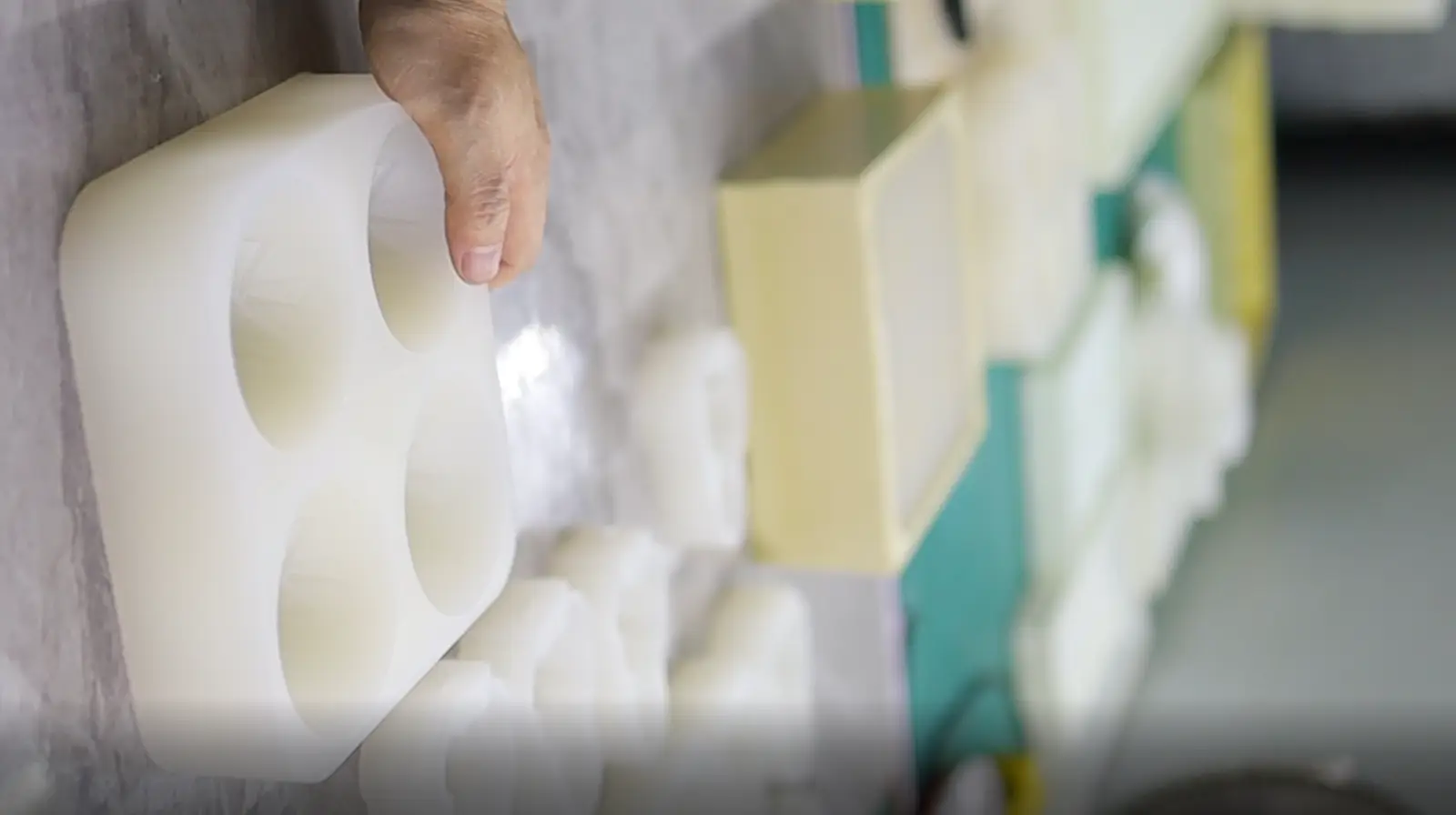
On this site the CNC object is usually the master (and sometimes a rigid mother or metal core), not a production LIM shoe. Aluminum prototyping tools (7075, 6061, QC-10-class) exist on the parts side to buy a T0 in days. Steel production tools (P20, H13, S136 / 420ESR) exist to keep a shut-off through a life you intend to run. For RTV, mill the master to the dump’s needs, then let platinum shrink (~0.1–0.3%) and the jacket do their quieter jobs.
SPI/SPMA class language (101–105) is a construction intent for *steel part tools*, not a mill callout on a chocolate master. An aluminum 105-ish tryout and a hardened 103 LSR tool can both be “±0.02 mm in CAD.” Only one of them still is after 10,000 hot cycles. A 15A jacket never was.
What CNC is actually holding
A 3-axis or 5-axis mill plus EDM plus grinding. Typical shop realities, not a certificate:
- Open features (pockets, cores, profiles): well-run CNC can sit in a roughly 0.01–0.02 mm band on steel and aluminum if the setup is rigid, the tool is honest, and the metrology is CMM, not a worn caliper. Tighter is a grind or a walk-in, not a default roughing pass.
- Shut-off flats: LSR wants land gaps in the few-micron to ~0.005 mm leak band. That is spotting, grinding, and lapping after the mill, on steel. Aluminum can be cut pretty. It will not stay that pretty under clamp. RTV “shut-off” is keys and a mother — mill the key forms; do not promise 5 µm on rubber.
- Small ribs and logos: cutter radius and deflection lie. A 0.2 mm steel rib is a different program from a 0.2 mm aluminum rib. The aluminum rib also bends in use. On a master, a 0.2 mm serif that the cutter did not actually cut becomes every dump.
- Deep cores: stick-out, chatter, taper. Compensation in CAM is not a core-shift fix in the press or a mandrel-seat fix in the box.
ISO 3302-1 is a *part* (or dump) rubber standard. Do not put it on the tool steel — or on the master metal — as if the mill owed you M1. Tool tolerances are metal. Article tolerances are shrink plus flash plus measurement of rubber.
If you ignore cutter deflection in a 40 mm core, the defect is a beautiful CMM on the shank and a banana in the cavity — or a banana master that every jacket copies.
Aluminum tryouts: fast, soft, thermally loud
Use aluminum when:
- On LIM: cavity count is low, life is short, and you need parts that look like the CAD for a fit.
- On RTV: you need a durable master that will be poured against more than once, or a metal core/mandrel. Aluminum masters beat sealed SLA for recast life and for texture that must survive handling.
- You are proving a 0.2 mm membrane fill (LSR) or a logo on a master (RTV) before you freeze the expensive half.
Do not expect:
- Flashless medical lands for a year. Aluminum brinells. LSR clamp to hold expansion will print the land.
- Stable pitch versus a cold deck designed for steel growth. Aluminum CTE is roughly twice steel (shop memory: ~23 vs ~12 × 10⁻⁶ /K). A 200 mm layout mill-perfect at 20 °C will not sit on a steel-deck pitch at 180 °C the same way a steel cavity will.
- Texture that matches a Mold-Tech steel plaque after 2,000 cycles of filled HCR. You can mill or blast a grain. It wears. Recast RTV from a worn aluminum master copies the wear.
HCR compression in aluminum is common for short runs. The same bruise story applies on the land. Vacuum boxes still need a seal that the plate does not dish.
Printed masters (SLA/DLP) are faster than aluminum and inhibition-prone until washed, UV’d, and barrier-coated. Do not mix “CNC ±0.02 mm” language onto an unsealed print.
Steel production: slower cutter, cheaper per shot later
Steel buys shut-offs that can be ground, heater holes and thermal mass, EDM VDI texture, and inserts you can replace. CNC on steel is slower. Call the process on the RFQ: mill pre-hard then harden and grind lands, or mill hardened, or EDM the cavity.
Stainless (S136-class) for clear medical LSR fights rust and can fight the cutter. Do not demand aluminum-tryout lead time on a four-drop stainless medical tool with valve gates.
RTV production “steel” is usually overkill for the *jacket*. Spend metal on the master and on cores that must locate. A steel mother mold exists for large, long-run dump tools; it is still not a LIM shoe.
How to spec mill tolerances without a fight
Split the drawing:
- Master / cavity CAD surfaces that make rubber dimensions: compensate for shrink *after* you have a process, or steel-safe and recut. A ±0.01 mm mill spec on an uncompensated LSR cavity is false precision. On RTV, CAD-safe logos until the first dump coupon; platinum shrink is small but not zero.
- Fits (pins, inserts, cold-deck pitch, mandrel seats): metal-to-metal, at *operating* temperature for LIM. State whether dimensions are cold. RTV seats are shop-temperature fits.
- Lands: flatness and match, often as a process (spot to a blue, grind) rather than a single ±. RTV: key seating as a process.
- General mill on the shoe or box: whatever the toolroom’s default is. Do not drag the whole plate into ±0.01 mm.
Prototype aluminum and production steel should not share one tolerance block copied from a plastic Class 101 checklist. Neither should a poured jacket.
RUUIPON Mold Structure Decision: Flat back? → open-back, mill the master face. Else two-part / core. Large wet dump? → mill or print a mother that stays flat — the mill tolerance on the jacket rubber is the wrong line.
Common mix-up: ISO 3302-1 on the mill drawing
A lot of RFQs stamp M1 on the aluminum master. In the shop that usually means a metal tolerance fight and a dump measured with a probe that dents 15A.
What to ask when you're buying
- Object: aluminum LIM tryout, steel production part tool, or CNC/SLA master for RTV?
- Which dimensions are metal fits vs rubber articles?
- Flashless lands required (steel) or keyed split (RTV)?
- Cold-deck yes/no (LIM only); mandrel seats yes/no (RTV hollows)?
- Master process and barrier coat if printed?
Worked example
You're pouring an 8-cavity 70 × 50 × 22 mm soap, platinum RTV, CNC aluminum master, ±0.05 mm on the logo pocket metal, ISO 3302-1 M2 on the dump after wait. Do not put ±0.01 mm everywhere and M1 on the mill block. If the follow-on is a 4-cavity LSR industrial grip, recut steel for the land and the heat; the aluminum master stays the RTV pattern.
We would not recommend copying a prototype mill block onto a production land
We would not recommend ISO 3302-1 as a mill callout, aluminum flashless medical lands for a year, or unsealed SLA as a “±0.02 mm master.” We would not ignore CTE when a cold deck meets an aluminum LIM tryout.
- What ships? - RTV cavity -> CNC or sealed SLA master
- CNC or sealed SLA master -> Metal tol on master; M2 on dump
- What ships? - LSR/HCR parts -> Al tryout vs steel production
- Al tryout vs steel production -> Lands ground; fits at operating T
- Need a milled silicone tool - M1 on the mill block -> False precision
Typical shop values
Reference values only. Confirm material-specific limits against the supplier’s technical data and agree project acceptance criteria before production.
| Item | Typical shop value | | --- | --- | | Open CNC features | Roughly 0.01–0.02 mm band when setup and CMM are honest | | LSR leak band | About 0.005 mm — grind/lap on steel, not a default mill pass | | Aluminum vs steel CTE | About 23 vs 12 × 10⁻⁶ /K — shop-order memory | | Platinum RTV shrink | About 0.1–0.3% | | LSR / HCR shrink | About 2–3% / 1.5–2.5% | | ISO 3302-1 | M2 common on the rubber article, not on the mill block |
Copy this into a mill-intent RFQ
- Aluminum tryout vs steel production vs RTV master
- Process (LSR / HCR / RTV), cavity count, flashless lands vs keys
- Cold-deck yes/no; which dimensions are steel-safe or CAD-safe
- If you need ISO 3302-1, put it on the article drawing and let the toolmaker back into metal
Send the STEP and which object is the master. We'll mill the pattern to the dump, not to a Class 101 checklist. Custom RTV molds.
Related: 2D to STEP, texture mapping, what tooling means.
FAQ
Can an aluminum LSR mold hold the same CNC tolerance as steel in production? The mill might. The press will not. Aluminum grows more, bruises on LSR clamp, and wears on shut-offs. Use it to learn fill and shrink, then recut steel for the life and the flash spec you will ship. An aluminum *master* for RTV is a different, valid long-term object.
Should I put ISO 3302-1 on the mold machining drawing? No. That standard is for rubber article dimensions. Tool drawings need metal tolerances, fits at temperature (LIM), and a shrink plan. Translate part classes into metal after the grade and the process window exist.
Why did a ±0.02 mm aluminum cavity miss the silicone part by more than that? Shrink, hot growth, flash, and measuring rubber with a probe. The mill number was never the part number. Compensate from measured parts in the real heat — or, on RTV, from a dump coupon after the stated wait.
Is hard-milled H13 more accurate than EDM for LSR logos? It depends on the rib. EDM is honest on deep, sharp, hard features and on VDI grain; hard milling is fast on open surfaces. Many production tools mill the open, EDM the logos, and grind the lands. Specify by feature. RTV logos live on the master finish.
Do SPI mold classes tell me the mill tolerance? They tell you construction intent and life for steel part tools, not a hundredths table for every pocket. Class number plus “aluminum, flashless, 0.01 mm everywhere” is three contradictory intents. It is also the wrong language for a poured jacket.
Custom silicone development · DFM & prototype support
CAD, drawing, photos or sample details