
2-Shot PC/ABS Plus Silicone: RTV Analog vs LIM
Rotary 2-shot LSR over PC/ABS is a parts cell. On this site the analog is platinum RTV poured over a rigid master or frame at room temperature, not a hot
 Kyler Yang · Founder9 min read
“Co-injection” on a silicone RFQ usually means 2-shot: a rigid thermoplastic first shot, then liquid silicone overmolded in the same cell. That cell is a rotary or index tool with two injection units — a hot runner into a *cooled* plastic cavity, and an LSR cold-runner into a *heated* silicone cavity. It is a molded-*part* quote.
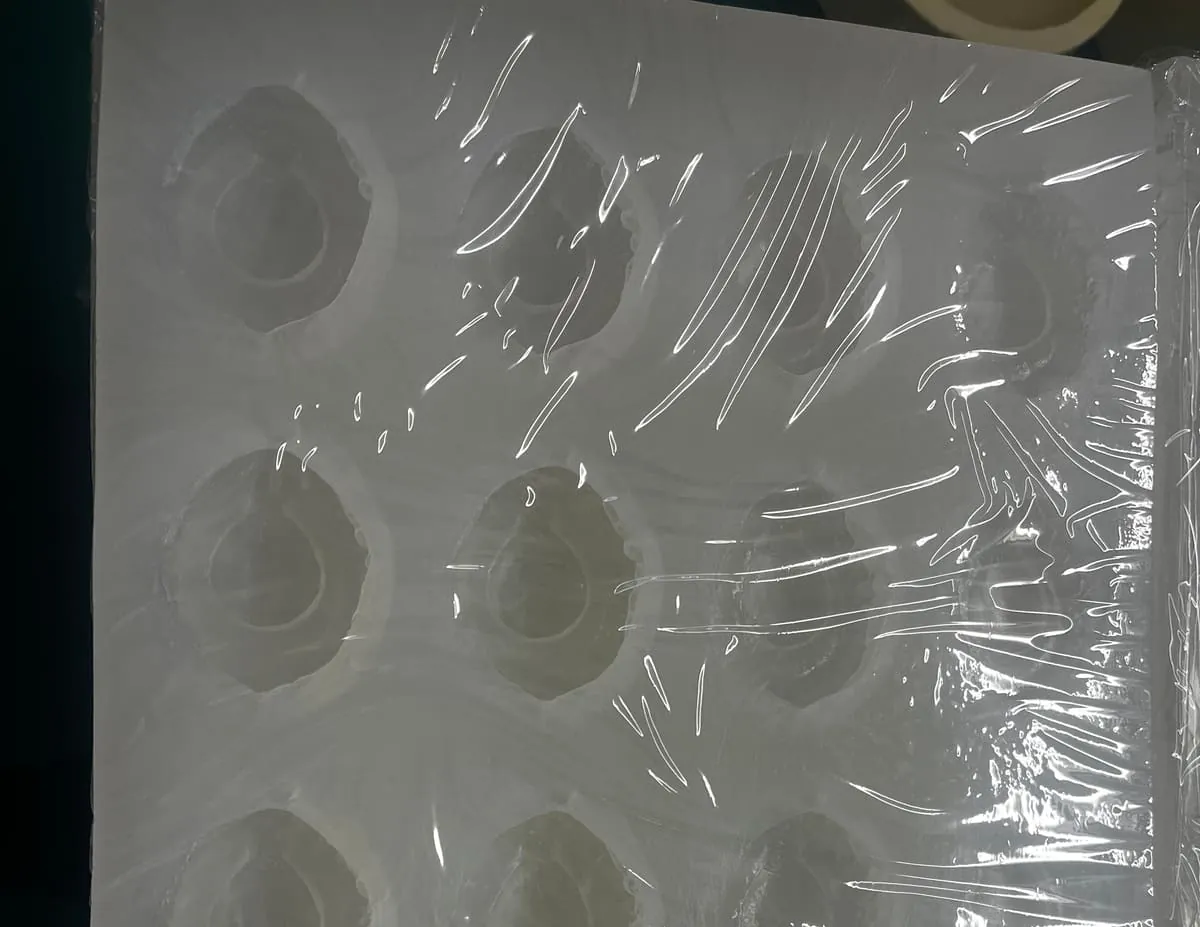
On this site the analog is different. If you need a PC/ABS (or CNC) frame with a soft silicone skin for a prototype, a dump cavity, or a room-temperature encapsulation, you pour platinum RTV against a rigid master or around the frame. Room-temp cure is the point: you do not park PC next to a 160–200 °C LSR cavity. Send the 2-shot rotary RFQ to a parts OEM. Send the master, the frame, and the skin thickness here.
Insert-molding a pre-made PC part in a second LSR tool is a cousin (transfer overmold). RTV over a PC prototype is a mockup of *shape*, not a qualified 2-shot bond. Pick one object and RFQ it.
Two shots, two chemistries — or one pour
LIM 2-shot (parts OEM): Shot 1 is PC, ABS, or PC/ABS — melt, fill, pack, cool enough to hold shape through index. Shot 2 is LSR through a cold deck into a hot cavity so the rubber vulcanizes against plastic that still carries heat. Residual heat helps the interface. A cold insert in a standalone overmold tool does not get that gift unless you preheat.
RTV analog (this site): There is no second injection unit. You have a rigid master or a molded frame, a mold box, A/B platinum (1:1 or 10:1 by grade), vacuum degas, and a pour. The skin cures at shop temperature. Bond is mechanical first: wrap, through-holes, grooves, a keyed jacket that locates the frame. Primer or a self-bonding *LSR* grade is a parts conversation; on RTV you still degrease, and you still test inhibition from flame-retardant PC/ABS, mold release, and printed legends.
Glass-filled grades change warp and how the master sits. Flame-retardant packages and extra mold release change bond more than the data sheet admits. Name the exact resin, not “black plastic.”
If you ignore drying of PC on a LIM cell, the defect is splay on shot 1 that everyone blames on LSR flash. If you ignore inhibition on an RTV pour over ABS, the defect is a sticky face against the plastic that looks like a mix-ratio error.
Shut-offs vs keys
LSR will leak through about 0.005 mm. Steel must pinch the substrate on a designed land (in-line shut-off), not swipe along a taper you cannot keep at two temperatures. Crush ribs on the plastic help the pinch and disappear under rubber. Flash under the substrate is a peel-start.
RTV flash is a split and key problem. The jacket pieces must seat. A 0.3 mm RTV film on a glossy PC plateau with no lock and a square step will peel after a soak just like a bad LIM shut-off — for a different reason: no mechanical wrap, and a pour that wicked under the edge. Keys, a mother mold, and a written assembly order beat another clamp strap.
Avoid on both routes: gates or pour paths that wash a thin PC wall; parting lines that print on a sealing lip; release on the bond land.
Heat isolation is why the analog exists
The LSR cavity wants 160–200 °C class heat. PC will distort, stress-whiten, or lose a tight hole if index time, insulation, and water in the plastic half are wrong. ABS can be worse. That is the 2-shot-specific failure.
Platinum RTV does not need that heat. That is why wearable mockups, optical windows you cannot warp, and PET-adjacent frames often belong in a pour fixture instead of a rotary table. Do not “turn the LSR tool down” as a fantasy to save a PC lens; change process.
HCR 2-shot exists in special cells and is rare next to LSR. Neither qualifies an RTV skin, and an RTV skin does not qualify a 2-shot LSR bond.
DFM before the box or the rotary shoe
- Uniform RTV thickness where you can. A blob next to a 0.4 mm membrane fights through-cure and tear together.
- Radii on plastic corners that would cut the rubber.
- Room in the mold box for the frame, keys, and a pour gate that does not trap air on the bond face.
- ISO 3302-1 on the rubber skin if it is a dimensioned article; a plastic drawing standard on the frame; a relationship dimension for the overmold edge. Write all three.
- UL 94 on the PC/ABS, FDA 21 CFR 177.2600 or ISO 10993 on the silicone if contact requires it, and a peel-after-soak on the *pair*. A V-0 plastic with an untested RTV face is not a finished stack.
RUUIPON Mold Structure Decision: Flat back on the skin? → open-back pour over the frame. Else deep undercuts + peel? If the silicone cannot peel safely → two-part / plug. Large wet dump or soft 10A–20A skin? → mother mold.
Common mix-up: calling an RTV overmold “2-shot”
A lot of RFQs treat a poured jacket over a PC handle as 2-shot because two materials are visible. In the shop that usually means one bidder quotes a rotary LIM cell and the other quotes a mold box. You cannot tell until the object is named: production 2K part, or a room-temp skin on a master/frame.
What to ask when you're buying
- Is this a rotary 2-shot LSR *part*, or an RTV skin over a master/frame?
- Exact resin and HDT — PC, ABS, or PC/ABS, not “black plastic”?
- Mechanical lock (wrap, holes, grooves) or a hope that primer will do the wrench?
- Shut-off land (LIM) vs keyed split (RTV) — which drawing?
- Peel-after-soak on the pair, not only a dry tug?
Worked example
You're mocking a 80 × 40 × 12 mm PC/ABS grip with a 2 mm platinum RTV skin, 200 handles. Pour a keyed two-part jacket over the frame (or over a master of the overmolded shape), vacuum degas, room-temp cure. A rotary LIM cell for 200 is the wrong factory. If annual volume later hits tens of thousands of a frozen geometry, that is a parts OEM 2-shot quote — different shrink, different bond file.
We would not recommend parking PC in a 180 °C LSR cavity to “save a tool”
We would not recommend a 0.3 mm RTV film on a glossy plateau with no wrap, release on the bond land, or calling the pour a qualified 2-shot bond. We would not cook LSR drops to “save space” in a rotary shoe — that is a cold-deck job on the parts cell, not a pour-shop layout.
- Volume + heat the plastic can take? - Hundreds / cannot take LIM heat -> Platinum RTV over master or frame
- Platinum RTV over master or frame -> Keys + wrap + degas
- Volume + heat the plastic can take? - Frozen CAD, thousands, production LSR -> Parts OEM: 2-shot cold-runner LSR
- Parts OEM: 2-shot cold-runner LSR -> In-line shut-off + peel-after-soak
- Need PC/ABS plus silicone skin - Call the pour 2-shot -> Wrong factory / wrong bond file
Typical shop values
Reference values only. Confirm material-specific limits against the supplier’s technical data and agree project acceptance criteria before production.
| Item | Typical shop value | | --- | --- | | RTV mix | Platinum 1:1 or 10:1 by grade; vacuum degas until the foam collapses | | Cavity / skin Shore | 10A–20A when the skin must peel; 20A–30A when the wall is thin and the jacket is stiff | | Platinum RTV shrink | About 0.1–0.3% after full cure | | LSR shrink (contrast) | About 2–3%; HCR about 1.5–2.5% — different quote | | LSR leak band (parts cell) | About 0.005 mm at the land | | ISO 3302-1 | M2 common on the rubber skin unless the drawing says M1/M3 |
Copy this into a 2-material RFQ
- Object: 2-shot LSR over PC/ABS (parts OEM) or platinum RTV skin over master/frame (this site)
- Exact resin, color, HDT; self-bonding vs primer vs mechanical wrap
- Shut-off concept (LIM) or keys + jacket (RTV)
- Bond test: peel after water or chemical soak
- Who owns the master / jacket / steel — tooling charge is not unrestricted title
Send the STEP of the frame, the skin thickness, and whether the plastic can take LIM heat. We'll return a pour split and jacket plan, or tell you this is a rotary-cell quote. Custom RTV molds.
Related: flex PCB insert / encapsulation, overmolding onto glass, what tooling means.
FAQ
Is 2-shot the same as pouring RTV over a PC part? No. 2-shot keeps both injections in one cell so the plastic still carries heat into an LSR shot through a cold-runner. RTV over a frame is room-temperature pour in a jacket. Bond, warp, and shut-off all change. Quote the cell you will actually run.
Why does a self-bonding LSR that worked on PC fail on PC/ABS? The blend is a different substrate. ABS fraction, mold release, and flame-retardant packages change the interface. Treat the blend as its own material and peel it after the real soak. The same warning applies if you pour platinum RTV against a released ABS handle.
Can the LSR half use a thermoplastic-style hot runner in a rotary tool? No. LSR needs a cold-runner / cold deck so the feed does not vulcanize, while the plastic half uses the hot runner. Cooking the LSR drops to “save space” seizes them. RTV pours have no deck.
What shut-off keeps rubber off the PC show face? On LIM: an in-line land where steel pinches the plastic, often with a small crush rib. On RTV: a keyed split that seats, plus a wrap so the pour cannot wick under the edge. Tapered swipe-by shut-offs are hard to keep tight at two temperatures.
Does UL 94 on the PC/ABS cover the overmolded part? It covers the plastic grade as tested. The assembled part, the silicone, and any primer are a different specimen. If the device needs a flame rating, test the stack. If it needs food or skin contact, file FDA 21 CFR 177.2600 or ISO 10993 on the silicone, not on the ABS datasheet.
Custom silicone development · DFM & prototype support
CAD, drawing, photos or sample details