MOQ 20 pcs · 3D design $50 USD · Prototype 3–7 days

WhatsApp +86 135 3006 2969

RUUIPONRUUIPON
Blog/custom silicone mold wall thickness

Silicone Mold Wall Thickness: Why 2.5-5 mm Changes Tear Rate

Custom silicone mold wall thickness - why 2.5-5 mm between cavities controls tear rate, Shore A pairing, spacing 8-20 mm, and RUUIPON production specs at MOQ 50.

Kyler Yang · Founder5 min read
Silicone Mold Wall Thickness: Why 2.5-5 mm Changes Tear Rate

A 12-cavity tray with 1.8 mm webs tears on pour 80 - every demold risks snapping the bridge between logo cavities. RUUIPON specs custom silicone molds at MOQ 50 with walls 2.5-5 mm and spacing 8-20 mm unless your CAD proves otherwise. Prototypes ship in 3-7 days. This guide explains why thin walls fail and how to quote thickness on your PO.

Quick answer: Silicone mold walls between cavities and around the perimeter should stay 2.5-5 mm for production trays. Below 2 mm, tear rate climbs sharply on Shore A 30-40 when you peel resin or demold frozen chocolate. Above 5 mm without spacing adjustment wastes silicone and slows heat transfer on baking lines - not wrong, just heavier and pricier per tray.

Wall Thickness in One Paragraph

Walls are the silicone between cavity outer walls and the tray edge - plus webs between adjacent cavities. They carry demold stress, clamp pressure on two-part molds, and stack load in storage.

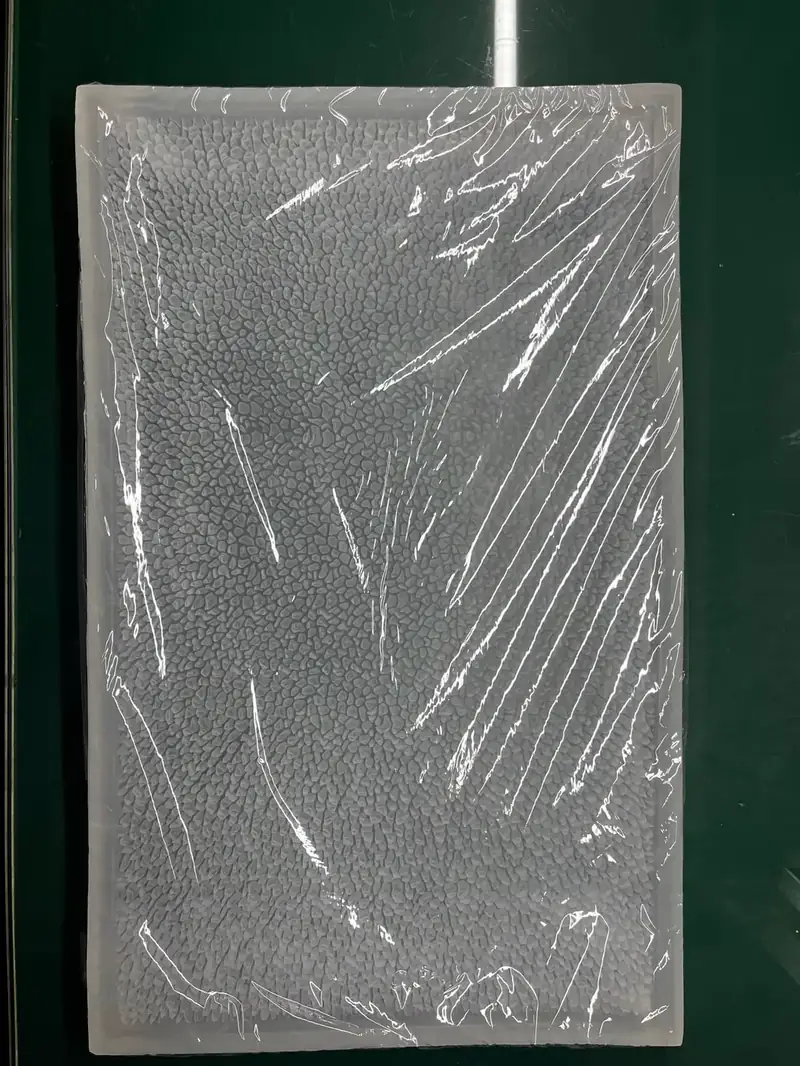
Multi-cavity custom silicone mold showing wall thickness between cavities
Webs between cavities below 2.5 mm are the first tear point on stiff Shore A resin trays.
Wall zoneMin recommendedTypical production
Cavity-to-cavity web2.5 mm3-4 mm
Cavity to tray edge3 mm4-6 mm
Flange / registration rim2.5 mm3-5 mm - two-part keys
Deep draw sidewall2.5 mm + draft3-5 mm on tall candles

Why Wall Thickness Matters More Than Cavity Count

Dense 24-cavity layouts sell on paper; thin webs die in week two. Tear strength drops when you chase cavity count without adding tray footprint.

  • Demold peel force - resin with 2° draft still pulls sideways on soft webs. Tear strength guide.
  • Two-part clamp - flange compresses; thin lip extrudes flash. Flash QC.
  • Stack storage - weight on thin rims bows cavities. Storage & warping.
  • Shrink stress - silicone cures ~0.1% shrink; thin sections curl. Tolerance.

2.5-5 mm Ranges by Application

ApplicationShore AWall targetNotes
Chocolate / gummy20-302.5-4 mmSofter silicone - less peel stress
Resin / epoxy30-403-5 mmStiffer peel - favor thicker webs
Soap25-353-4 mmCaustic soak - avoid knife-edge
Candle / wax25-353-5 mmHot pour 60-80 °C - candle guide
Baking30-403-5 mmOven repeat cycles - heat limits

Single deep cavity figurines: sidewall 3 mm minimum at base, 2.5 mm only on short shallow food pieces with generous draft.

Shore A & Wall Thickness Pairing

Soft Shore A 20-25 stretches instead of tearing - but webs still fail if under 2 mm because stress concentrates at the notch between cavities.

QC caliper measurement of silicone mold wall thickness between cavities
Sample approval includes spot-check on web thickness - not just cavity dimensions.

Stiff Shore A 40-50: walls can stay 2.5-3 mm on small trays but crack on sharp internal corners - radius ≥1 mm on web roots. Full hardness chart: Shore hardness guide.

Wall Thickness vs Cavity Spacing 8-20 mm

Spacing is center-to-center or edge-to-edge gap - not the same as wall thickness. A 15 mm gap with 8 mm cavity outer diameter leaves ~7 mm web - comfortable. A 10 mm gap with 8 mm cavities leaves ~2 mm web - reject at quote.

LayoutCavity ODGap edge-to-edgeResulting web
6-cavity round35 mm12 mm~12 mm - easy demold
12-cavity square28 mm8 mm~8 mm - production standard
24-cavity dense22 mm6 mm~6 mm wall if centered - verify CAD
Overpacked30 mm4 mm~4 mm - borderline; prefer wider sheet

Layout module: multi-cavity layout. Vacuum degassing does not thicken walls - it removes bubbles only. Vacuum degassing.

Tear Failures We See in QC

  1. Web tear at demold - user reported at 50-200 cycles; root cause 1.5-2 mm web on Shore A 35 resin tray.
  2. Flange rip at key pocket - key depth 6 mm + wall 2 mm = punch-through. Keys need 3 mm minimum remaining wall.
  3. Corner crack - 90° external tray corner with 2 mm radius - stress riser on repeated flex.
  4. Operator cut line - knife trim between cavities thins web below spec.

Defect catalog: common defects. Lifespan: lifespan & care.

Production Spec at MOQ 50

PO lineExample
Min web thickness2.5 mm (3 mm preferred resin)
Perimeter wall4 mm
Cavity spacing12 mm edge-to-edge
Shore A30-35 resin / 20-25 chocolate
SiliconePlatinum cure, vacuum degassed
QCCaliper 3 points on sample tray

CAD review in ~24 hours. [email protected] | Contact RUUIPON | WhatsApp +86 135 3006 2969.

Frequently Asked Questions

Can walls be 1.5 mm to fit more cavities?
Not for production MOQ 50 - prototype only, expect short life.

Does thicker wall always mean longer mold life?
Up to a point - 6 mm webs on small trays add cost without much gain past 5 mm.

Who calculates wall from my STL?
RUUIPON DFM on quote - flag <2.5 mm before prototype.

Two-part mold walls?
Each half needs flange 2.5-5 mm at parting line. One-part vs two-part.

Wall thickness on sample vs production?
Same spec - sample is your contract.

MOQ 50 with oversized tray for thicker walls?
Yes - footprint grows; unit price per cavity may rise slightly.

Prototype timeline?
3-7 days after CAD approval.

Ready to order custom silicone molds?

Free quote for OEM/ODM projects. MOQ 20 · Prototype 3-7 days · FDA/LFGB available.

Need a custom mold?

MOQ 20 · Quote in 24h

WhatsAppInquire