
Hand-Cut Parting vs a Designed RTV Split | RUUIPON
A knife split after a block pour is a shop seam, not a designed land. When we would cut, when we CAD the split. Typical shop values. MOQ 20.
 Kyler Yang · Founder7 min read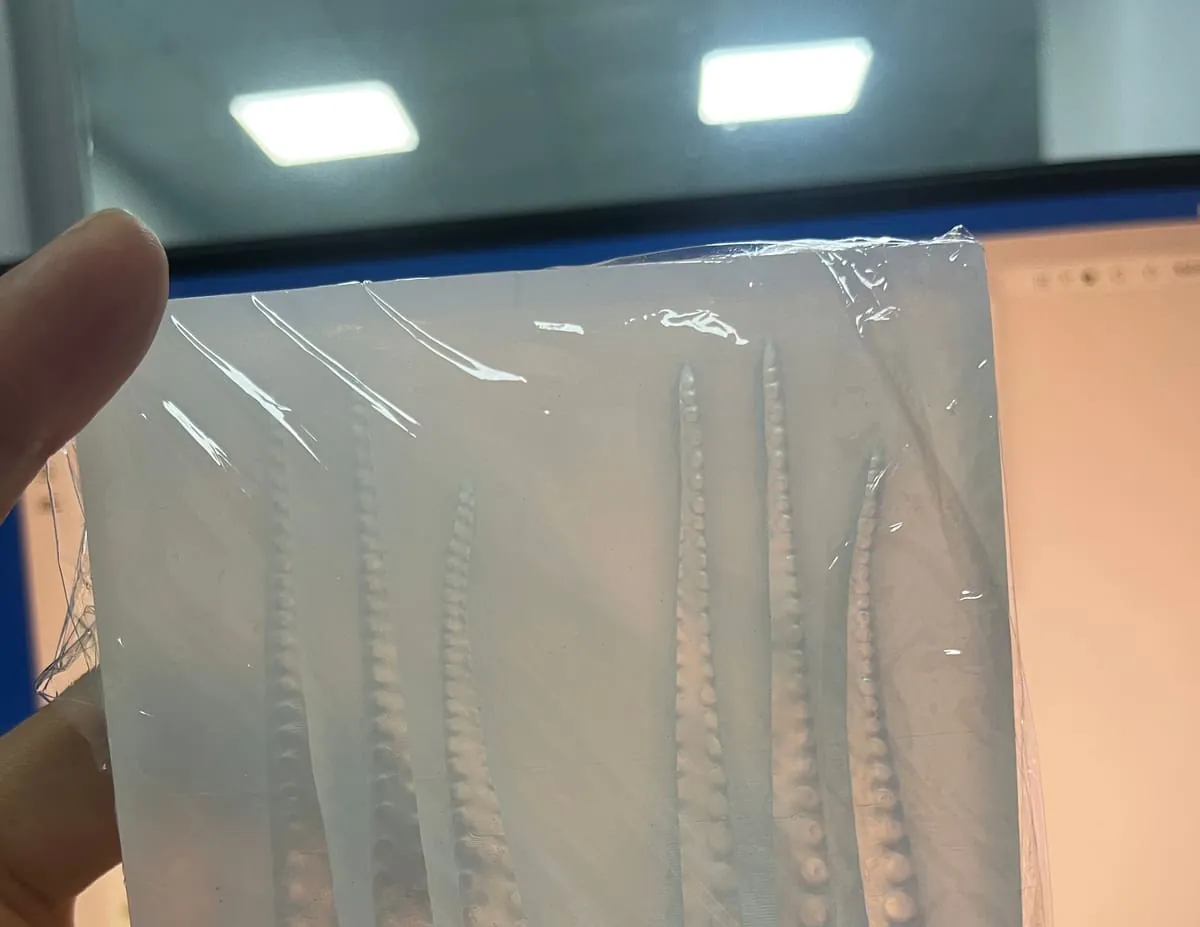
Cutting a cured RTV block open with a scalpel is how shops find a seam on a one-off master when CAD never defined a land. The knife goes where the operator can see, not necessarily where flash will hide on the show face. Production SKUs — figurines, chocolate shells with a visible equator, anything you will recast twenty times — get a designed parting: keys, a flash fence, a land off the logo. We will still cut a witness block when you need to *see* an undercut before you spend CAD. We will not multiply a wandering knife seam to MOQ 20 and call it revision A.
RUUIPON designs splits in Bao'an since 2018. On this site the path is photos, sketch, or CAD, then a 3D-printed pattern, often a temporary silicone flip, a resin production mother, then batch RTV. The mother is not the pattern. Free DFM. HTV/HCR compression mold tooling is also quoted on RUUIPON.
Does not apply when the tool is already an open-back tray (no shut to cut), when you are slicing a plaster jacket, or when the "cut" is deflash on an HCR *part*. Food shells can have a designed equator; we would not freehand-cut a chocolate brand line. No grease, no tin.
When a hand cut is honest
One master, unknown undercuts, you need to look. Pour a block, cut on a marked equator, inspect, then CAD the land for production. The cut block is a mule, not the tool you ship twenty of.
Craft prop, never recast. A knife seam with registration keys pushed in clay can be enough. Still keep the seam off the face if you can.
Production, repeatable flash spec, recast from archive. Design the split. Keys in CAD. Flash land off the show face. Recast copies the land; a knife does not copy itself.
Run Structure Decision before you pick up the blade: flat back → open-back, don't bury then cut. Else peel? If no → two-part / plug / core, and that two-part should be a land, not a surprise cut. Large wet dump → mother mold either way.
A wandering seam on a food shell becomes a dirt trap and a flash ridge in couverture. We would not oil that ridge to hide it.
What a designed land includes that a knife forgets
Unique keys so halves cannot close 180° off. A flash fence that overflows away from the logo. Draft on the shut so you aren't scraping platinum to open. A place for the operator's fingers. Jacket pockets if a mother is coming. ISO 3302-1 M2 on the dump drawing, not "cut it by eye."
- Will we recast or ship MOQ 20? - no one-off look -> Hand-cut mule is in play
- Will we recast or ship MOQ 20? - yes production -> CAD the land, keys, flash fence
- Hand-cut mule is in play -> Inspect undercuts, then decide plug vs split
- Inspect undercuts, then decide plug vs split -> CAD the land, keys, flash fence
- CAD the land, keys, flash fence -> Food shell?
- Food shell? - yes -> Land off show face; dry well; no tin
- Food shell? - craft -> Witness dump, then MOQ 20
- Land off show face; dry well; no tin -> Witness dump, then MOQ 20
The photo that would prove a designed land: CAD screenshot of the equator plus the first dump with flash off the face, coin for scale. A knife in a block is the mule photo.
Typical shop values
Reference values only. Confirm material-specific limits against the supplier’s technical data and agree project acceptance criteria before production.
| Item | Typical shop value |
|---|---|
| Mule cut | scalpel on a marked equator after full cure |
| Production split | CAD land, keys, flash fence |
| Mix | platinum 1:1 or 10:1 by weight |
| Platinum shrink | about 0.1–0.3% after full cure |
| Food cavity | designed land; no freehand brand cut; no grease; no tin |
| Prototype | 3–7 business days after CAD lock |
| Production MOQ | 20 pieces per design |
| Simple 3D | USD $50 when that CAD scope applies |
Flash land versus a picturesque equator
Buyers point at a figurine waist and say "cut there, it will look like a belt." A belt-line seam is still flash on a show face. A designed land hides behind a hair, a collar, or a base. Chocolate shells hide at the join of two halves you will weld with temper, not at a logo. If the only legal seam is mid-face, expect a conversation about a plug or a different process — not a prettier knife.
Hand-cut blocks also swallow keys: the blade nicks a pip and the next close steps. Designed lands keep keys off the knife path. Platinum shrink about 0.1–0.3% still applies after full cure of either method; the knife does not "relieve shrink."
Food reminder: a ragged chocolate equator is a dirt trap. Dry well. No grease to hide the ridge. No tin leftover to blame for the taste.
Mule-to-production traveler
Write on the traveler: mule cut / designed land. Operators should not "improve" a CAD seam with a scalpel on shift three. If the land is wrong, we recast from the unsanded master after a CAD change ($50 when that scope applies). MOQ 20 is of the locked land, not of improvised cuts.
Worked example (anonymized)
Resin fox, buyer asked to "just pour a cube and cut it." We cut one mule, found a tail hook the STL hid. $50 CAD for a split plus a small tail plug. Production skins copied the land. MOQ 20. A chocolate version of the same art was a separate open-back shell with a designed equator, dry well.
A plaster or FRP jacket should split on the *same* land as the skin. A hand-cut rubber seam against a designed jacket seam fights you every open. Align them in CAD, or cut the mule and then laminate the mother to that cut — once — then lock it.
One procurement mix-up
Paying for a production pack of hand-cut blocks and expecting identical flash. Knife paths drift. Tooling charge is not a CNC seam unless we modeled the land.
Stay on this page / skip this page
Stay when you are deciding whether a scalpel cut on a witness block is honest, or whether the SKU needs a designed parting land.
Skip if the split is already in CAD with keys and a flash fence. Skip an HTV/HCR steel shut - that press-tool RFQ stays on RUUIPON but this page is RTV. Skip finished parts - a different RFQ - ask us. Skip pitching the knife cut as a master / box / keys / jacket stack.
We will not freehand-cut a chocolate brand equator. We will not multiply a mule cut to MOQ 20. We will not grease a ragged seam so it "looks designed." We will not cut through keys you already poured.
What to ask when you're buying
- Mule cut to inspect, or CAD land for production?
- Where flash is allowed on the show face?
- Plug vs full split after we see undercuts?
- Food vs craft — two tools if both ship?
- Who archives the master for recast of the *designed* split?
RFQ copy-pack
Send to [email protected] · +86 135 3006 2969 · Xinhe Blvd, Shajing, Bao'an.
RUUIPON hand-cut vs designed-split RFQ Dump: food shell / resin figurine / other Need a mule cut first? yes / no Show-face seam allowed? yes / no / hide at equator Qty: mule / witness designed split / MOQ 20 CAD: $50 3D for the land if geometry open
Matched next step: say whether this is a look-once mule or a recastable SKU. We cut mules; we CAD production lands. We will not knife a chocolate brand line. Prototype 3–7 business days after CAD lock. MOQ 20 per design.
Related: undercuts and split molds, two-part figurine arms and legs, one-part vs two-part, contact.
FAQ
Is a hand-cut seam weaker than a designed land? The rubber is the same. The *repeatability* is weaker. Flash walks, keys get nicked by the blade.
Can you copy my hand-cut block as the production tool? We can scan it, but we would rather CAD a clean land. $50 when that scope applies.
Do food shells always need a split? Flat-back bars are open-back. Hollow shells often need a designed equator or a core. Don't cut them by eye.
Will a harder Shore make a knife seam cleaner? Harder rubber is harder to cut straight and harder to peel. Design the land.
If the mule cut looks good, can I skip CAD and order 20 cuts? We would not. Twenty knife paths are twenty seams. Lock CAD, then MOQ 20.
Custom silicone development · DFM & prototype support
CAD, drawing, photos or sample details