
FDA vs LFGB Extractives for Chocolate and Baking RTV
21 CFR 177.2600 and LFGB/BfR XV are extractives tests, not badges. Chocolate fat and oven heat fail different limits. Test the colored, post-cured RTV
 Kyler Yang · Founder11 min read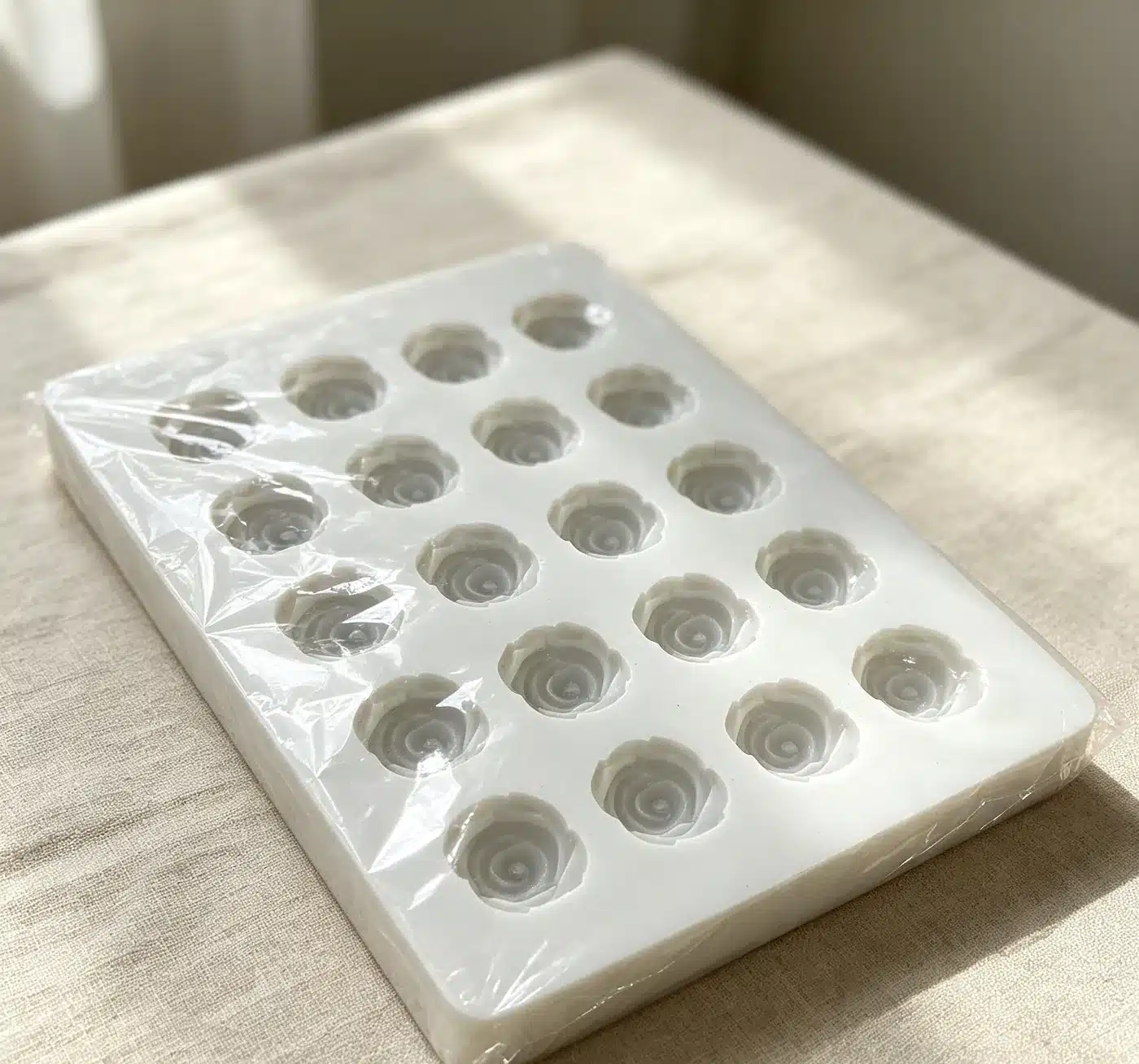
21 CFR 177.2600 is not an FDA approval stamp on a chocolate mold. It is a recipe list plus extractives limits for rubber articles intended for repeated food contact. LFGB is not a German sticker either. In practice it means the German Food and Feed Code, with BfR Recommendation XV as the silicone technical text, plus EU Regulation (EC) No 1935/2004 on not changing the food.
A compound certificate is a starting document. The finished RTV mold, in the color you ship, after the post-cure you actually run, is what the lab extracts. On this site the silicone *is* the cavity: platinum RTV, jacket, master. Tin-cure is the wrong food-contact chemistry.
The FDA extractives numbers, not a stamp
The regulation covers rubber articles used repeatedly with food. Silicone elastomers sit in that family. It does not inspect your factory, and it does not grade chocolate molds separately from baking pans. It sets how much total extractable matter may leave the food-contact surface under defined reflux conditions.
For aqueous food, distilled water at reflux: not more than 20 milligrams per square inch in the first 7 hours, and not more than 1 milligram per square inch in the next 2 hours.
For fatty food, n-hexane at reflux: not more than 175 milligrams per square inch in the first 7 hours, and not more than 4 milligrams per square inch in the next 2 hours.
Chocolate is a fatty food. Butter cake is a fatty food. Steam or water-based fillings are aqueous. A mold that will see both needs both legs of the test on the finished article, not a water-only report from a natural slab.
The regulation also tells you to thoroughly clean the finished rubber before first food contact. That is a process step, not a footnote. Unwashed flash, mold release, and handling grease will show up as extractables even when the polymer is clean.
LFGB, 1935/2004, and the 0.5 percent limits
LFGB §31 is the German prohibition on commodities that taint food. BfR Recommendation XV (Silicones) is the composition and finished-article guidance German labs use for silicone elastomers. The EU overlay, (EC) 1935/2004, requires that materials do not transfer constituents in amounts that endanger health or change odor, taste, or composition unacceptably.
BfR XV is a positive-list document: permitted polymers, fillers, pigments, and catalysts, with limits. An ingredient that is not listed is not “probably fine.” It needs its own safety case.
Two finished-article numbers from BfR XV matter more than the logo on a COA:
- Volatile organic matter: not more than 0.5 percent (typical method: dry, then 4 hours at 200 °C).
- Extractable components: not more than 0.5 percent.
Those 0.5 percent limits are why post-cure is not optional on food tools. Platinum RTV that leaves the bench smelling of siloxane will often fail volatiles until it is baked out. Tin-cure condensation RTV is the wrong chemistry for this path: it keeps releasing condensation byproducts and is not the food-contact route.
LFGB sensory testing is the part FDA extractives never cover. German practice (and DIN 10955-style protocols) bakes or contacts a test food, then a panel scores odor and taste transfer. A muffin cup that passes hexane extractives can still fail because the first bake tastes like rubber. That failure is usually residual oligomers, a non-listed pigment, or a skipped post-cure.
Chocolate is not a baking pan
Do not specify one “food mold” and assume both jobs are covered.
Chocolate and confectionery molds. Contact is cool to warm. Cocoa butter and other fats sit in the cavity for minutes to hours. Mechanical risk is demold stretch and fat swell at the surface, not oven heat. Hexane (FDA fatty) and a fatty simulant plus sensory (LFGB) are the relevant legs. Color transfer into white chocolate is a pigment and cure problem, not a hardness problem. A mold used only for chocolate does not need an empty 220 °C bake rating, but it does need fat-contact data and a clean, post-cured face.
Oven baking molds. Contact is hot. Typical home and bakery ovens run 160–230 °C. Fat from butter and oil plus high temperature drive both extractables and volatiles. Sensory tests for bakeware use a test dough or muffin protocol at oven temperature (commonly around 180 °C in German bakeware practice), not a 40 °C olive-oil soak copied from a spatula. Wall thickness, a rigid jacket, and whether the tool sits on a metal sheet all change local temperature. The FDA reflux extraction is severe chemistry, but it is not a substitute for an oven sensory test.
A chocolate mold that never sees an oven can still fail a baking sensory panel if you later sell it as “also for cake.” Write the intended food, peak temperature, and contact time on the test request. Labs cannot invent your use.
Pigment is part of the article
Natural translucent RTV and a red 20A baking tray are not the same test article. Organic pigments, carbon blacks, and some lake colors can raise extractables, fail sensory, or (in platinum systems) inhibit cure so the surface stays tacky and sheds.
Rules that belong on the RFQ:
- Pigment must be a food-contact grade listed for the destination market, dosed at or below the supplier’s food-contact loading.
- The lab plaque or molded cavity must be the production color, not a natural slab with a “color available” note.
- Masterbatch carriers that are not on the BfR or FDA rubber list will fail even if the gum is clean.
- A color change is a new article. Retest. Do not transfer last year’s blue report onto this year’s mint green.
If you need a deep color at high loading, expect more post-cure time, not a waiver.
Post-cure is how you pass, not how you decorate
Platinum food-contact RTV is routinely post-cured in air (follow the gum supplier’s food-contact schedule; often a hot-air band in the 150–200 °C conversation). That step drives off cyclic siloxanes and residual inhibitor. Skipping it to save oven time is a common reason a “food-grade compound” mold fails BfR volatiles or smells on first bake.
Post-cure after pour, on the finished geometry, is what counts. A post-cured slab used to qualify a thick muffin pan is not conservative if the pan’s thick rim never reaches the same core temperature. Call out section thickness on the test sample. Support the skin in the jacket so heat does not banana a 10A–20A tray.
What a certificate does not prove
- “FDA approved factory.” 177.2600 does not approve factories.
- “LFGB certified silicone.” There is no single LFGB license. There is a test report on a defined article.
- A gum supplier’s FDA letter. Useful for formulation. Not a finished-mold extraction.
- A dishwasher icon. Irrelevant to extractives. It is a durability claim.
- Platinum-cure as a synonym for food-safe. Platinum is the usual chemistry. The article still has to pass.
- SGS report No. invented on a slide. Ask for the method, the article, and the color. Do not buy a number.
Common mix-up: testing a natural LSR slab for an RTV chocolate tray
A parts OEM’s natural LIM plaque is not your red 12-cavity RTV tool. Process (platinum RTV vs LSR vs HCR), color, post-cure, and geometry all belong on the test request.
What to ask when you're buying
- US, DE/EU, or both — and chocolate, fatty bake, or aqueous?
- Peak contact temperature and time?
- Platinum RTV (not tin), color, Shore, jacket?
- Test article is the finished mold, not a natural slab?
- Recast: does a new skin need a new extraction?
Worked example: 12-cavity 18 mm chocolate bear
12-cavity, 18 mm, platinum 10A–20A, jacket, cocoa-butter contact, about 2,000 dumps a month. RFQ: 21 CFR 177.2600 fatty extractives on the *colored* post-cured tray; if EU, BfR XV volatiles and extractables plus sensory. Do not accept a water-only natural-slab COA. Do not spray release “to help the first dump.”
When this article is the wrong quote
If you need vulcanized silicone *parts* (teats, spatulas off a LIM cell), the test article is the part, not an RTV cavity — parts OEM. A tiny shallow ice tray still needs the same chemistry logic if it sees food. Geometry can override oven claims: a thick closed muffin cup is not a thin mat.
Related reading: food-grade RTV molds, gummy trays, cleaning culinary cavities, custom RTV molds.
Put this on the RFQ
State market (US, DE/EU, or both), food type (chocolate / fatty bake / aqueous), maximum contact temperature and time, color, hardness, process platinum RTV (ban tin-cure), jacket, and whether the test article is the finished mold. Require 21 CFR 177.2600 aqueous and/or fatty extractives on that article for the US, and BfR XV volatiles plus extractables plus sensory under the actual heat for Europe. Do not accept a natural-slab COA in place of the colored, post-cured tool.
Send the intended food, peak temperature, color, and the STL. We will quote platinum RTV, jacket, and the test article — not a logo that says “FDA approved.”
We would not recommend tin-cure for this food path
We would not recommend a solvent spray on the pour face. We would not raise Shore A first to “pass FDA.” We would not transfer last year’s blue report onto mint green. We would not cut LSR steel so the tray can “also be medical.”
RUUIPON Mold Structure Decision: chocolate and gummy trays are cavities you dump into. Flat back? open-back. Deep undercuts that cannot peel? two-part. Soft 10A–20A plus wet dump? mother mold. Food-contact is the article, not the jacket material.
- Tin-cure? - yes -> Wrong chemistry; recast platinum
- Tin-cure? - no, platinum -> US, EU, or both?
- US, EU, or both? -> Finished colored post-cured article
- Finished colored post-cured article -> Chocolate / fatty?
- Chocolate / fatty? - yes -> FDA hexane leg + fatty sensory
- Chocolate / fatty? - aqueous too -> Add water leg
- Finished colored post-cured article -> Oven bake?
- Oven bake? - yes -> BfR volatiles + bake sensory
- Oven bake? - chocolate only -> FDA hexane leg + fatty sensory
Typical shop values
Reference values only. Confirm material-specific limits against the supplier’s technical data and agree project acceptance criteria before production.
| Item | Typical shop value | | --- | --- | | Chemistry | Platinum RTV 1:1 or 10:1; vacuum degas; not tin | | Cavity Shore | 10A–20A with jacket | | Platinum shrink | About 0.1–0.3% after full cure | | FDA aqueous (reflux) | ≤20 mg/in² first 7 h; ≤1 mg/in² next 2 h | | FDA fatty / hexane (reflux) | ≤175 mg/in² first 7 h; ≤4 mg/in² next 2 h | | BfR XV volatiles / extractables | Not more than 0.5% each, typical finished-article limits |
FAQ
Is 21 CFR 177.2600 an FDA approval stamp on a chocolate mold factory? No. It is a recipe list plus extractives limits for rubber articles intended for repeated food contact. It does not inspect your factory or grade chocolate molds separately from baking pans. The finished RTV mold, in the color you ship, after the post-cure you run, is what the lab extracts.
Why is chocolate a fatty-food test and not water-only? Chocolate and butter cake are fatty foods; the FDA fatty leg uses n-hexane reflux limits. Aqueous fillings need the water leg. A mold that will see both needs both on the finished article, not a water-only report from a natural slab. Unwashed flash and release also show up as extractables.
Can a muffin cup pass hexane extractives and still fail LFGB? Yes. BfR Recommendation XV adds composition plus finished-article volatiles and extractables, typically the 0.5 percent limits, and German practice adds sensory odor and taste. Residual oligomers, a non-listed pigment, or a skipped post-cure fail a bake panel that FDA extractives never cover. Tin-cure RTV is the wrong food-contact chemistry.
Why retest after a color change if last year's blue already passed? Pigment is part of the article. Organic pigments, carbon blacks, and some lakes raise extractables, fail sensory, or inhibit platinum so the surface stays tacky. A color change is a new article. Do not transfer a blue report onto mint green, and do not qualify a natural slab for a red tray.
Does a gum supplier's FDA letter qualify the finished baking mold? It supports formulation. It is not a finished-mold extraction, not an "LFGB certified silicone" license, and not a dishwasher-icon durability claim. Platinum-cure is the usual chemistry; the article still has to pass. Write food type, peak temperature, contact time, color, and platinum RTV on the test request.
Custom silicone development · DFM & prototype support
CAD, drawing, photos or sample details