
High-Volume Dumping Into Custom RTV Silicone Molds
High dump counts on RTV molds need cavitation, jackets that register on the line, and a recast plan. Steel LSR tools quote molded parts, not this food
 Kyler Yang · Founder9 min read
If you're dumping high volume into a custom RTV silicone mold, you're buying a system: cavitation that matches the depositor, jackets that nest in the fixture, compound that arrives in lots you can trace, and a recast story that doesn't eat the piece-price you quoted. The pour-table hour is rarely the real limit. Master finishing, spare skins, oven or chill space, and one torn cavity in a 24-pocket tray usually are.
This is about repeating food, gummy, chocolate, or resin dumps at a rate where master amortization is no longer the dominant line. It isn't about pouring more tin gloves. If the SKU is still changing weekly, you're not in high volume — freeze the drawing first.
If the RFQ is actually for thousands of molded silicone *parts*, that's a different quotation — HCR compression or LSR injection with a cold-runner — not this RTV mold.
Cavitation and jackets that match the rate
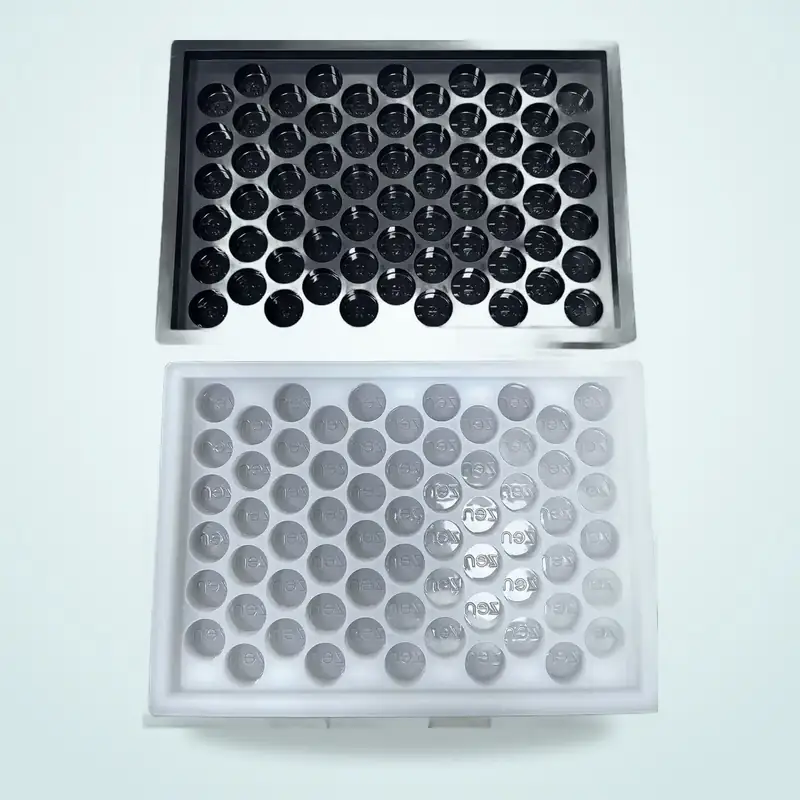
More cavities aren't automatically cheaper. An unbalanced 24-cavity gummy tray with one starved pocket and one overfilled logo makes mixed bags. A well-registered 12-cavity with a rigid jacket and a real dump fixture can outrun it on yield.
Name on the RFQ:
- Cavity count and whether family trays (multiple SKUs in one jacket) are allowed. Family trays save masters and create changeover risk.
- How the jacket locates on the depositing line or the chocolate wheel — pins, nests, or “we'll tape it.”
- Dump orientation, fill height, and whether a human still peels undercuts every cycle.
- Recast cadence and whether spare skins exist while one tray is on the bench.
Platinum RTV is the usual high-dump chemistry because it holds size in storage. Tin-cure at volume is a calendar problem. SPI/SPMA class language is steel construction intent; it doesn't warranty dumps. Published cycle counts on a TDS remain intents, not warranties.
Compound supply and the dump you forgot
Pectin, chocolate, resin, and certified food-contact RTV grades have lead times. A dual-source fantasy that names “equivalent 20 Shore A” without a freeze window will drift hardness, shrink, and food-contact status. High volume needs a specified RTV family (or a written equivalent window with a delta first-article rule), lot traceability from drum to tray, inventory policy for FDA 21 CFR 177.2600 / LFGB listed grades, and a plan when a lot fails incoming.
Flash at the split is a labor rate. A tray that needs a person with a scalpel on every dump isn't a high-volume tray, even if the depositor is fast. Design keys and vents in the box so the article leaves in a state a simple jig can handle. SPC at volume is a few charts you'll keep (dump weight, flash at a named split, a hardness proxy on the skin), not a laminated Cpk poster.
Common mix-up: more cavities as the whole capacity story
A lot of RFQs treat “make it 24-cavity” as high volume. In the shop that usually means you ignored jacket registration, recast lead time, and oven or chill maps. Post-cure or chill racks that were “fine for 200 dumps” become a bottleneck and a size-scatter source when every pocket of a 24-cavity tray hits the line every shift. Map the rack, label jackets, and treat recast as rated capacity.
Spare skins and spare jackets belong in the original program, not after the line stops. One cavity dies first. Running 22 of 24 without a documented window change trains mixed product. PM cadence belongs to tear width, key play, and dump temperature, not to a mythical shot count from a brochure. Store the spare stack as carefully as the live one. Warped spares aren't spares.
China-based high dump counts are common for consumer gummy and chocolate because masters, platinum drums, and jacket shops sit in one truck radius. That concentration doesn't replace a process freeze. Time-zone lag on a torn-logo complaint will cost more than a slightly dearer local recast if your retailer window is tight. Many programs pour in China and inspect closer to the market. Write that split; don't discover it in a chargeback.
What to ask when you're buying
If any of these are missing, you're comparing two different jobs:
- Annual dumps, lot quantity, and ramp?
- Platinum or tin, grade family, dump-color count?
- Cavity count, jacket registration on the line, automation yes/no?
- Flash spec at the split, measurement state of the dump?
- Recast policy, spare skins, who pays for a new jacket?
- Certificates that must travel (food, toy), packaging, destination?
A factory that only answers with a piece price hasn't quoted high volume. They've quoted a hope.
Worked example
A 24-cavity gummy bear, 18 mm tall, food-contact platinum RTV, fiberglass jacket with pin nests for a depositing line, low tens of thousands of dumps a month in season. The program priced two skins against one CNC master, wrote recast triggers (tear at the ear, key play), and bagged first dumps by cavity. A parallel quote for an 8-cavity LSR *part* tool with a cold-runner was the wrong object — it wouldn't dump pectin. The constraint that actually showed up was jacket chill space, not table hours.
When high-dump RTV is the wrong asset
If the SKU still changes weekly, freeze the drawing before you pay for 24 cavities. If you needed molded silicone *parts* at volume, cavitation on an RTV tray won't help — quote LSR with a cold-runner or HCR compression. A 4-cavity platinum tray with honest recasts can beat a 24-cavity family jacket that mixes flash. Geometry can override quantity: sticky high-undercut gummies may stay on a smaller tray because peel time, not pocket count, is the cycle.
Related: low-volume casting, depositing-line design, gummy trays.
High-dump RFQ the line can actually run
- Annual dumps, lot quantity, ramp
- Platinum grade family, dump-color count
- Cavity count, jacket nests/pins on the depositor, peel vs dump orientation
- Flash spec at the split; measurement state of the dump
- Recast policy, spare skins, who pays for a new jacket
- Food/toy certificates, packing, destination
Send monthly dumps, jacket photos or fixture envelope, and recast terms. We'll price cavitation and spare skins against the line, not a lonely piece price.
We would not recommend “make it 24-cavity” as the whole capacity story
We would not recommend treating extra pockets as high volume while jacket registration, recast lead time, and chill maps stay blank. We would not run 22 of 24 torn pockets as mixed bags, and we would not use tin-cure as a library tool at depositing rates. We would not paste an LSR cold-runner quote onto a pectin tray. Spare skins belong in the original program.
RUUIPON Mold Structure Decision: family tray vs dedicated jacket is a changeover call. Soft Shore 10A–20A on a depositor? mother mold with pin nests. Sticky high-undercut gummies? peel time, not pocket count, is the cycle — a 12-cavity that actually locates can outrun an unbalanced 24.
- Jacket locates on the line? - tape / rock -> Not high volume yet
- Jacket locates on the line? - pins / nests -> Flash even by cavity?
- Flash even by cavity? - one pocket dies, mixed bags -> Recast that skin; spare skins
- Flash even by cavity? - balanced -> Rate vs peel time
- Rate vs peel time - peel dominates -> Fewer cavities, better split
- Rate vs peel time - deposit dominates -> 12-24 cavities with spare skins
Typical shop values
Reference values only. Confirm material-specific limits against the supplier’s technical data and agree project acceptance criteria before production.
| Item | Typical shop value | | --- | --- | | Depositing cavity count | 12–24 pockets is a common food/gummy band | | Cavity Shore | 10A–20A platinum RTV, fiberglass or resin jacket | | Mix | Platinum 1:1 or 10:1 by grade; vacuum degas until the foam collapses | | Platinum shrink after full cure | About 0.1–0.3% | | Loaded-tray edge sag if nests are missing | About 0.5–1.5 mm | | Outer-row gummy vs center if the loaded tray sags | Edge often 3–6% heavy vs the center pocket | | Spare skins | Price at least one recast / spare against the live tray |
FAQ
When does a 4-cavity tray become more expensive than a 24-cavity? When labor, changeover, and missed retailer volume exceed the extra master and jacket cost over the real annual dumps. There's no universal dump count. Run the arithmetic on *your* pectin price and *your* trim labor. A cheap dump with easy demold may keep a small tray longer than a sticky gummy that can't be nicked.
Can I add cavities later to scale? Sometimes. A jacket built with extra nest room can take inserts. A fully packed 2-cavity box with no pour-head room can't. Say “possible recavitation” at RFQ. Retrofitting cavities into a tight box is often a new mold with extra scars.
How do I keep dump color consistent across months? Freeze the pigment system of the *dump*, keep retains, and incoming-check lots against a master plaque. Don't allow a “close RAL” substitution without a delta. Lighting for visual approval should be the same at first dump and at incoming.
Does high volume mean I should skip first article after a recast? No. A recast is a process change. Slim the pack if you must, but re-check flash, size at the measurement state, and cavity identity. The recast cavity is the one that will be different.
Is extrusion a high-volume silicone process I can mix onto this PO? For profiles, tubes, and cords, yes — on a different factory: dies, continuous cure, cut-to-length, not RTV cavities. Don't mix extrusion piece-price math with tray cavitation math. If you need both a molded cap and an extruded tube, you have two production systems, and neither is this food cavity unless you said so.
Custom silicone development · DFM & prototype support
CAD, drawing, photos or sample details