
Mix RTV Without Streaks: Fold, Don't Whip | RUUIPON
Streaks in A/B platinum are unmixed catalyst. Fold, scrape the walls and floor, dump to a second cup. Whipping seeds bubbles. Typical shop. MOQ 20.
 Kyler Yang · Founder7 min read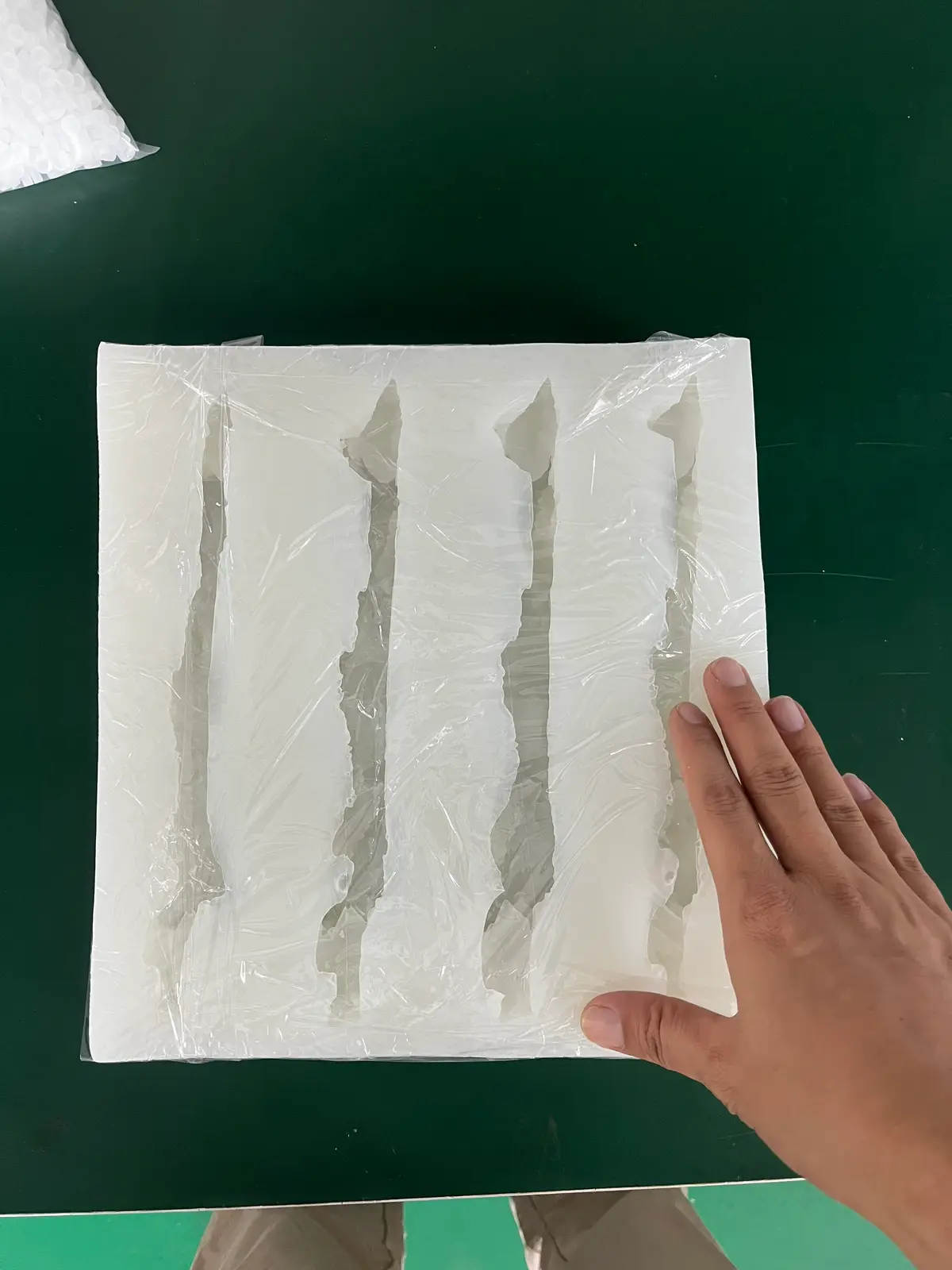
Streaks in a platinum A/B mix are unmixed catalyst or unmixed base, not a color problem. If you can still see ribbons of A in B after you thought you were done, those ribbons cure at a different rate: sticky lanes on the cavity face, a hard jacket back, or a tear along the streak after the first demold. The fix is mechanical — weigh 1:1 or 10:1 by grade, fold with a spatula, scrape the walls and the floor, dump into a second clean cup, fold again — not a drill mixer on high. Whipping is how you seed the bubbles the vacuum then has to collapse. We would not certify a food-contact skin poured from a streaked cup.
RUUIPON mixes and vacuum-degases platinum RTV in Bao'an since 2018. Prototype is 3–7 business days after CAD lock. Production is MOQ 20 pieces per design. Simple 3D is USD $50 when that CAD scope applies. LSR injection of a *part* in a heated cavity with a cold-runner is an HTV product RFQ here. Vacuum tray work: vacuum-degassed platinum.
Does not apply when the "streak" is pigment you added by hand to a clear kit (that is a colorant dispersion job), when the face is tacky from SLA inhibition rather than ratio, or when you are stirring tin-cure with a wooden stick from a craft kit and calling it our food path. Inhibition looks like a sticky *contact* face with a cured back. Streaks look like lanes through the mass.
Fold, scrape, dump — the sequence that actually mixes
Weigh A and B. Volume marks on a cup are how a 10:1 grade goes off-ratio. Typical platinum food and resin tools here are 1:1 or 10:1 by weight.
Use a flat spatula, not a whisk. Cut through the center, scrape the wall, scrape the floor, fold the mass over. Clock time is not a mix spec — visual uniformity is. Clear grades are honest: you can see the ribbon disappear. Pigmented grades hide ribbons, which is why the second-cup dump matters. Scrape the first cup empty into the second so the unmixed floor does not stay behind, then fold the second cup.
Pot life starts when A meets B, not when you finish folding. A long artistic mix on a short-pot grade is how you pour already-gelling rubber and trap knit lines that look like streaks after cure. Warm rooms shorten the window. Cold rooms hide streaks because the mix is thick and then they show up as chevrons in the cured wall.
A drill paddle on high is a bubble pump. If you must use a mixer on a large block pour, keep it slow, keep the paddle buried, and still finish with a spatula scrape. Vacuum after mix is required on food logos and transparent resin tools. Mixing "until fluffy" is the opposite of ready.
The photo that would prove a good mix is a second-cup ribbon with no marble, a vacuum foam that rises and collapses, and a cured sprue that is uniform when cut. A swirled first cup poured straight into the box is the failure photo.
Typical shop values
Reference values only. Confirm material-specific limits against the supplier’s technical data and agree project acceptance criteria before production. Not a timed lot.
| Item | Typical shop value |
|---|---|
| Ratio | 1:1 or 10:1 by weight, named grade |
| Tool | Spatula + second cup; slow paddle only on large mass |
| Visual end point | No marble ribbons; walls and floor scraped |
| Vacuum | Until foam collapses — after mix, not instead of mix |
| Shrink | platinum about 0.1–0.3% linear |
| Cavity Shore | 10A–20A skin common |
| Prototype | 3–7 business days after CAD lock |
| Production | MOQ 20 pieces per design |
| Drawing class | ISO 3302-1 M2 unless the print says otherwise |
Common mix-up: more stirring equals a better cure
Buyers whip for five minutes because a video said "mix thoroughly" and then wonder why the cavity is a crater field. Thorough means homogeneous, not aerated. The cousin mix-up is adding extra B "to be sure it cures" when you still see streaks — that throws the ratio and can leave a different sticky. A third: pouring the first cup without a dump because "we would waste silicone." The waste of a second cup is grams. The waste of a streaked food logo is the skin.
Worked example (anonymized)
A 1:1 platinum, about 1.2 kg for a keyed resin block. First attempt used a kitchen whisk until the mix looked like mousse. Vacuum foam never fully fell in the pot life. Cured face had lanes of tack and pinholes. Remake: weighed 600 g / 600 g, spatula fold 2–3 minutes with wall-and-floor scrapes, dumped to a second cup, folded again, vacuum until collapse, brush coat on the master, then pour. Same CAD, no extra $50, still inside a 3–7 business day proto window for the second skin. Production stayed MOQ 20 of the locked design. This was a resin tool, not a food cavity — we still would not have shipped a streaked food face.
We would not recommend
We would not recommend a high-speed drill mix on a food logo well.
We would not recommend "fixing" visible ribbons by adding extra catalyst.
We would not recommend pouring from the first cup without scraping the floor.
We would not recommend calling a sticky inhibited SLA face a mix streak and adding more stir time.
- Weigh 1:1 or 10:1 -> Fold with spatula — scrape wall and floor
- Fold with spatula — scrape wall and floor -> Dump into second cup
- Dump into second cup -> Fold again until no marble
- Fold again until no marble -> Vacuum until foam collapses
- Vacuum until foam collapses -> Brush coat then pour
- Fold with spatula — scrape wall and floor -> Whip / extra B / skip second cup
- Whip / extra B / skip second cup -> Streaks, tack lanes, or bubbles — remake
What to ask when you're buying mixed production skins
- Do you weigh 1:1 or 10:1, or is someone still using cup marks?
- Is a second-cup dump part of the shop SOP on pigmented grades?
- Will you refuse a food pour from a streaked cup, or try to "blend it in the box"?
- Pot life of the named grade vs the grams you plan to mix?
- After CAD lock, is the proto still 3–7 business days, then MOQ 20?
Related: RTV process, contact.
RFQ copy-pack — mix discipline on the PO
Email [email protected]:
Grade: platinum 1:1 or 10:1 Duty: food cavity / resin / wax / plaster / concrete (jewelry and concrete are not food) Color: clear / pigmented (second-cup dump required) Mass per skin (or box dims so we size grams) Vacuum: required CAD: locked / USD $50 if you model Prototype 3–7 business days after CAD lock, then MOQ 20 / design Do not pour a streaked cup
Send the grade and whether the face is food or craft. We mix to a uniform cup, then degas — we do not whip. Phone +86 135 3006 2969.
FAQ
How long should I mix RTV so there are no streaks? Until ribbons disappear and the floor is scraped, then dump to a second cup. Clock minutes vary with mass and temperature. A fluffy five-minute whip is the wrong end point.
Can I use a paint mixer? On a large block pour, a slow buried paddle can help, then you still spatula-scrape. High speed is a bubble pump. Food logos should not start that way.
Why is the back cured and the face streaky-sticky? If the tack sits only where the mix touched the master, think inhibition (SLA, sulfur, tin). If lanes run through the sprue too, think mix or ratio. Do not treat those as the same remake.
Does a vacuum chamber fix streaks? No. Vacuum pulls air. It does not homogenize A and B. Streaks that go in the chamber come out as streaked rubber with fewer bubbles.
If one proto skin streaked, do I still owe MOQ 20? We remake a failed shop mix before we lock production. A CAD-locked design that you approved still produces at MOQ 20 once the mix SOP is clean. A tooling charge is not a free unlimited remake bank if you change the model.
Custom silicone development · DFM & prototype support
CAD, drawing, photos or sample details