
Pouring-Cup Contamination in Platinum RTV | RUUIPON
Sulfur rubber spatulas, tin residue, and dirty cups inhibit platinum. The master can be clean and the face still greasy. Slug the tools. MOQ 20, $50 CAD.
 Kyler Yang · Founder7 min read
Platinum RTV fails in the cup as often as it fails on the master. A sulfur-cured rubber spatula, a wooden stick that sat in tin last month, a cup that held condensation-cure leftover, latex gloves on the mix, or a pigment jar with an unknown inhibitor will leave the cavity face greasy while the traveler says the SLA was sealed. The master is innocent. The tools are not. Weigh 1:1 or 10:1 in a dedicated PP cup, stir with a clean plastic or metal stick that has never seen tin or natural rubber, slug 20 g on a coupon if the cup is new-to-food.
RUUIPON mixes in Bao'an, Xinhe Blvd, Shajing, since 2018. Prototype is 3–7 business days after CAD lock. Production is MOQ 20 pieces per design. Simple 3D is USD $50 when that CAD scope applies. Platinum shrink after a full cure is typically about 0.1–0.3%. LSR/HCR *parts* are not mixed in a cup: an HTV product RFQ here. Ratio mistakes are a cousin: mix-ratio mistakes.
Does not apply when the face is tacky only against the master and the sprue is fine — that is master inhibition (SLA, sulfur clay, latex on the print). It also does not apply to tin-cure craft you chose on purpose. Food chocolate still wants platinum and a clean cup.
The cup is a wetted part of the tool
Anything that touches A or B before vacuum is in the network. Natural-rubber bands on the flask, a "silicone" kitchen spatula that is not platinum, a foam brush, a cardboard mixer, leftover 10:1 in a 1:1 cup — all of these show up as tack or as crumbly lanes. Colorant paste from a jar that lived next to sulfur clay is a quiet one.
Symptom pattern that points at tools, not master: *whole* mix stays undercured, or random greasy swirls that do not match the master surface, or a slug in a *new* cup that cures while the production cup fails.
- Sprue and slug in a new cup OK? - yes, face-only tack -> Master inhibition — seal or remake
- Sprue and slug in a new cup OK? - no, slug in old cup fails -> Cup / stick / glove / tin residue
- Cup / stick / glove / tin residue -> Dedicated PP cup, clean stick, nitrile
- Dedicated PP cup, clean stick, nitrile -> 20 g slug, then pour
- 20 g slug, then pour -> Slug snap-cures?
- Slug snap-cures? - yes -> Pour the flask
- Slug snap-cures? - no -> Change tools or kit lot — do not pour food
The photo that would prove a cup call: old ribbed cup with tin film, new PP cup, two slugs labeled. A clean master beauty shot does not clear the mixer.
ISO 3302-1 M2 will not save a poisoned shot. CAD lock still happens; we just will not pour food into a dirty-cup cavity.
Dedicated food cups stay off resin and tin benches. That cabinet split is the same idea as food vs lye, smaller.
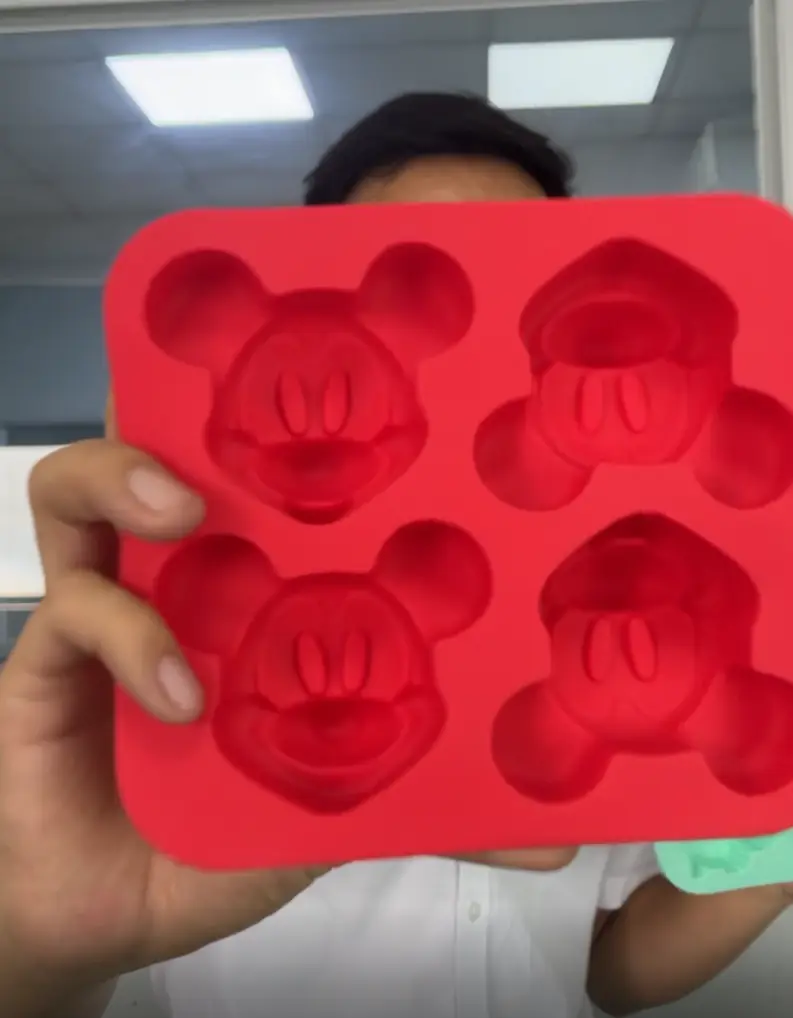
Failure: greasy swirl that does not match the print
Symptom: marbled tack; fingerprint stays in the back of a block; food odor on first dump.
Cause: sulfur stick; tin heel in the cup; latex; off-ratio plus contamination stacked.
Confirm: 20 g slug in a brand-new cup from the same kit. If that slug cures, the production tools are the poison.
Fix: throw the stick, wash or replace the cup, recast. Do not bake a contaminated food face. Do not add extra B "to force cure."
Wood sticks are not forbidden if they are clean and dry, but they hide tin in the grain. We prefer dedicated plastic. Kitchen sponges are a no.
Typical shop values
Reference values only. Confirm material-specific limits against the supplier’s technical data and agree project acceptance criteria before production.
| Item | Typical shop value |
|---|---|
| Mix / shrink | 1:1 or 10:1 by weight; platinum about 0.1–0.3% |
| Slug | about 20 g on a clean coupon |
| Cavity Shore | 10A–20A skins; 20A–40A trays |
| Prototype | 3–7 business days after CAD lock |
| Production MOQ | 20 pieces per design |
| Simple 3D | USD $50 when that CAD scope applies |
| Drawing class | ISO 3302-1 M2 as a common default |
Tools we would not mix with
We would not recommend a natural-rubber spatula in platinum.
We would not recommend a cup that last held tin, even if you "wiped it."
We would not recommend latex gloves on mix day for a food cavity.
We would not recommend saving a mixed heel in the same cup overnight as tomorrow's detail coat.
A tooling charge is not unrestricted ownership of our cup SOP. Ask for the grade name if you recast at your bench.
Worked example: jewelry flask, sulfur band on the box
Jewelry resin flask, 1:1 platinum, sealed SLA, slug on the print passed. Production face greasy in swirls. Cause: a sulfur-cured rubber band holding the flask walls, plus a kitchen spatula. New cup, plastic stick, nitrile, recast. Prototype 3–7 business days after CAD lock (already locked). $50 CAD did not apply. Production MOQ 20 of that design. Related: jewelry resin.
If you mix at your bench, send us the cup story when a first article fails. We would rather slug your cup than argue about the print twice.
Pigment jars deserve the same suspicion as cups. A popsicle stick that stirred a sulfur-adjacent colorant and then stirred B part is a mobile inhibitor. Dedicate a stick to colorant or weigh colorant as a named paste in a platinum-only jar. For food cavities we would rather skip in-tool pigment than chase a bleed-plus-inhibition stack. Color the dump, not the food tool, unless the PO names a platinum-compatible paste and a slug.
Nitrile still picks up tin if you handle a craft mold and then mix food. Gloves are single-task on food day. That sounds fussy until the first sticky 24-up tray. Loaded sag and jackets do not care about cups; do not let a contamination recast distract you from a missing jacket on the same PO.
Mix-up: sticky means the master is sulfur clay
Sometimes. Face-only tack against the master is the master. Whole-shot tack is the cup, the kit, or the clock. Run both slugs. The other mix-up is washing a tin cup with soap and calling it a food cup. Film remains.
What to ask when you're buying a pour you will mix
- Dedicated platinum cups and sticks, never tin?
- Nitrile vs latex on mix day?
- Who mixes — RUUIPON or your bench?
- Food cabinet split from resin/lye?
- After CAD lock, 3–7 business days, then MOQ 20 / design?
Related: vacuum-degassed trays, contact.
RFQ copy-pack — clean mix path
Paste into [email protected]:
Object: platinum RTV mold (not an LSR/HCR part) Who mixes: RUUIPON or our bench If our bench: cup material, stick material, last chemistry in that cup Dump chemistry; food docs if food File: STEP / STL / photos with a millimetre scale CAD: mold-ready STEP OR USD $50 3D if that scope applies Prototype 3–7 business days after CAD lock, then MOQ 20 per design
Send how you mix, not only the STL. We slug dirty tools before we recast food — not a blank free quote. Phone +86 135 3006 2969. Licheng Technology Industry Park, Xinhe Blvd, Shajing, Bao'an. Shop since 2018.
FAQ
Can a dirty cup inhibit platinum even if the master is sealed? Yes. Slug in a new cup. If that slug cures, change tools and recast.
Are wooden stir sticks OK? Clean and dedicated maybe. Grain hides tin. We prefer plastic or metal sticks that never saw condensation-cure.
Will extra B fix a poisoned mix? We would not. Off-ratio plus poison is still scrap.
Do you mix food and resin in the same cups? We would not on a food PO. Cabinet split.
Does a cup change the 3–7 day clock? No. The clock is CAD lock. A recast from a dirty cup is still inside shop scheduling, not a reason to skip lock. MOQ 20 per design.
Custom silicone development · DFM & prototype support
CAD, drawing, photos or sample details