
RTV Silicone Mold vs Steel Tooling: How to Choose
RTV is the cavity you pour into. Steel is the tool that molds a silicone part. Volume does not make one a cheaper version of the other.
 Kyler Yang · Founder8 min read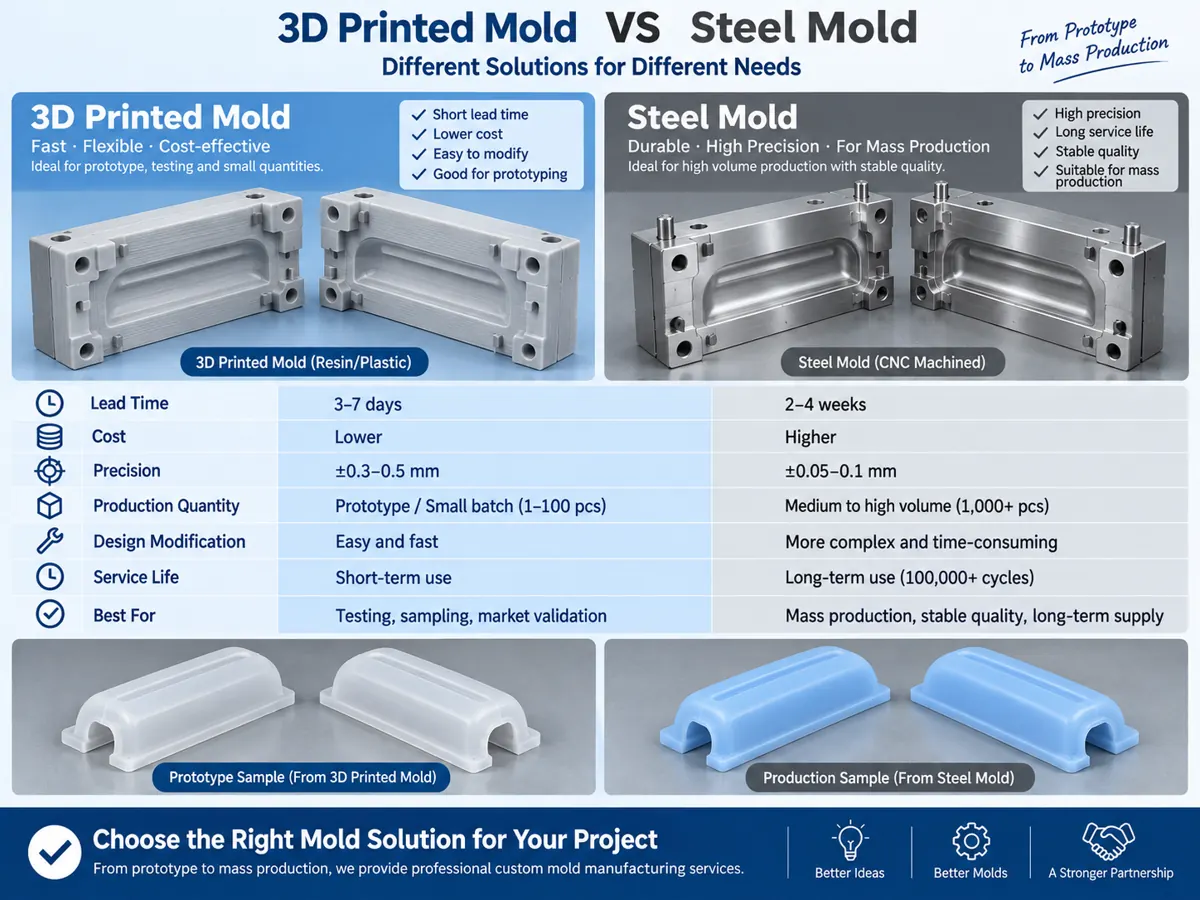
RTV silicone casting molds and steel production tooling solve different manufacturing problems.
Name the object on the manufacturer page before you compare a unit price. The route split is on RTV vs HTV.
A flexible RTV silicone mold is commonly used when the customer needs a mold to cast another material such as resin, wax, plaster, soap, chocolate, gummy or another compatible material.
Steel tooling is used when the manufacturing process itself requires rigid production tooling, such as HCR/HTV compression molding or LSR injection molding for finished silicone parts.
Production volume matters, but the first question is still: What do you need to receive?
| Buyer Need | Typical Route |
|---|---|
| Flexible mold used to cast resin, wax, plaster, food or similar material | RTV silicone casting mold |
| Finished solid-silicone product or component | HCR/HTV compression molding may fit |
| Finished liquid-silicone precision/repeat-production part | LSR injection molding may fit |
| Silicone integrated with a compatible insert | Overmolding / insert molding |
| Unsure | DFM/process review before tooling |
This is a starting point, not an automatic process rule.
What It Is
The silicone mold is the production tool used by the customer to cast another material.
Common applications:
- resin
- plaster
- candle wax
- soap
- chocolate
- gummy
- ice
- baking
- decorative casting
Advantages can include:
- flexible release
- relatively fast development
- suitability for undercut geometry
- lower tooling investment for many custom casting projects
- easy design revisions before repeat production
When the Finished Product Itself Is Silicone
HCR/HTV uses heated metal tooling to mold finished silicone products.
Typical examples:
- gaskets
- seals
- trays
- covers
- keypads
- grips
- kitchenware
- consumer silicone parts
- industrial components
Tooling economics, cavity count and MOQ are quoted by product.
Liquid Silicone Injection Molding
LSR can fit parts that need:
- liquid silicone material
- repeatable production
- precision geometry
- automation
- thin/complex features
- integrated production volumes that justify injection tooling
The tool design and economics differ from RTV casting molds.
Volume Affects Economics, Not the Definition of the Process
Higher volume can justify:
- more RTV molds
- higher cavity count
- production tray optimization
- compression tooling
- LSR injection tooling
- more automation
Do not choose steel simply because the order is “large,” and do not choose RTV simply because the first order is small. Process must match the product.
Cost can include:
- CAD/modeling
- master development
- mold/tool construction
- cavity count
- tool material
- inserts
- prototype validation
- production quantity
For applicable RTV mold programs, MOQ starts from 20 molds per approved design.
Simple 3D modeling is typically around USD 50 when required and straightforward.
RTV mold programs can often be revised relatively quickly before production quantity is repeated.
Metal tooling revisions can be more involved, especially after hardened tool features or complex runner/ejection systems are built.
Prototype and DFM reduce revision risk in either route.
We only need 20 molds now but may scale later. Should we still use steel tooling?
Not automatically. If you are buying a casting mold, RTV may still be the correct route. If the finished product itself is silicone, HCR/HTV or LSR should be reviewed from the start.
We need one prototype before committing to metal tooling. Is that possible?
Yes. Prototype validation before higher tooling investment is a sensible development path where the product/process allows it.
We have a physical sample but no CAD. Can you compare both routes?
Yes. Physical samples can be measured/reverse-engineered, then the final production route can be selected after DFM.
Ask:
- What is the final delivered object?
- What material is being formed?
- What production volume is expected?
- What geometry/undercuts exist?
- What precision/automation is required?
- What tooling investment is acceptable?
- How likely is the design to change?
Does RTV mean prototype only?
No. RTV molds can be used for repeated production depending on the application.
Is steel always cheaper at high volume?
Not automatically. Compare the complete process and delivered product.
Can RUUIPON quote both routes?
Yes.
Custom silicone development · DFM & prototype support
CAD, drawing, photos or sample details