
Sealer or Release First on the Master Pour | RUUIPON
Porous masters get sealer first, then an optional named release. Reverse the order and platinum copies pinholes or inhibits. First-pour sequence from
 Kyler Yang · Founder7 min read
On a first platinum pour, sealer goes on the master before any release. Sealer closes pores in plaster, wood, FDM layer lines, and dusty prints so the rubber does not drink air and lock into the grain. Release, if you use it at all, is a thin named film *after* that coat has cured, and only when the master would otherwise glue to platinum. Reverse the order and you trap grease in the pores: the sealer cannot wet, the face copies craters, and a food well is not something we “wipe until it is official.”
RUUIPON, Shajing / Bao'an since 2018, pours master → box → A/B → vacuum → jacket. Mix 1:1 or 10:1 by weight. Prototype 3–7 business days after CAD lock. Lock includes a sealed, quiet master, not only pretty millimetres. MOQ 20 pieces per design. USD $50 when CAD scope still applies. LSR/HCR *parts* are an HTV product RFQ here.
Does not apply when the master is already non-porous CNC metal or sealed acrylic we trust, when you are talking about release on *your dump* (resin in the finished cavity), or when the “sealer” is hairspray from a commute. Those jobs skip this sequence or we refuse the pour.
Why the order is not a preference
Porous masters outgas into wet platinum. Plaster, air-dry clay, raw wood, and unsealed FDM are the usual offenders. Vacuum on the mix does not replace a closed surface — it can pull more air *out of* an open pore into the face. A detail brush coat still needs a wall to wet.
Sealer first. A compatible barrier (we name it on the job card; we do not invent a brand in this article) soaks, then skins. You wait until that skin is dry to the schedule on the can, including shadowed undercuts. Then, and only then, a *thin* release if the master chemistry would glue.
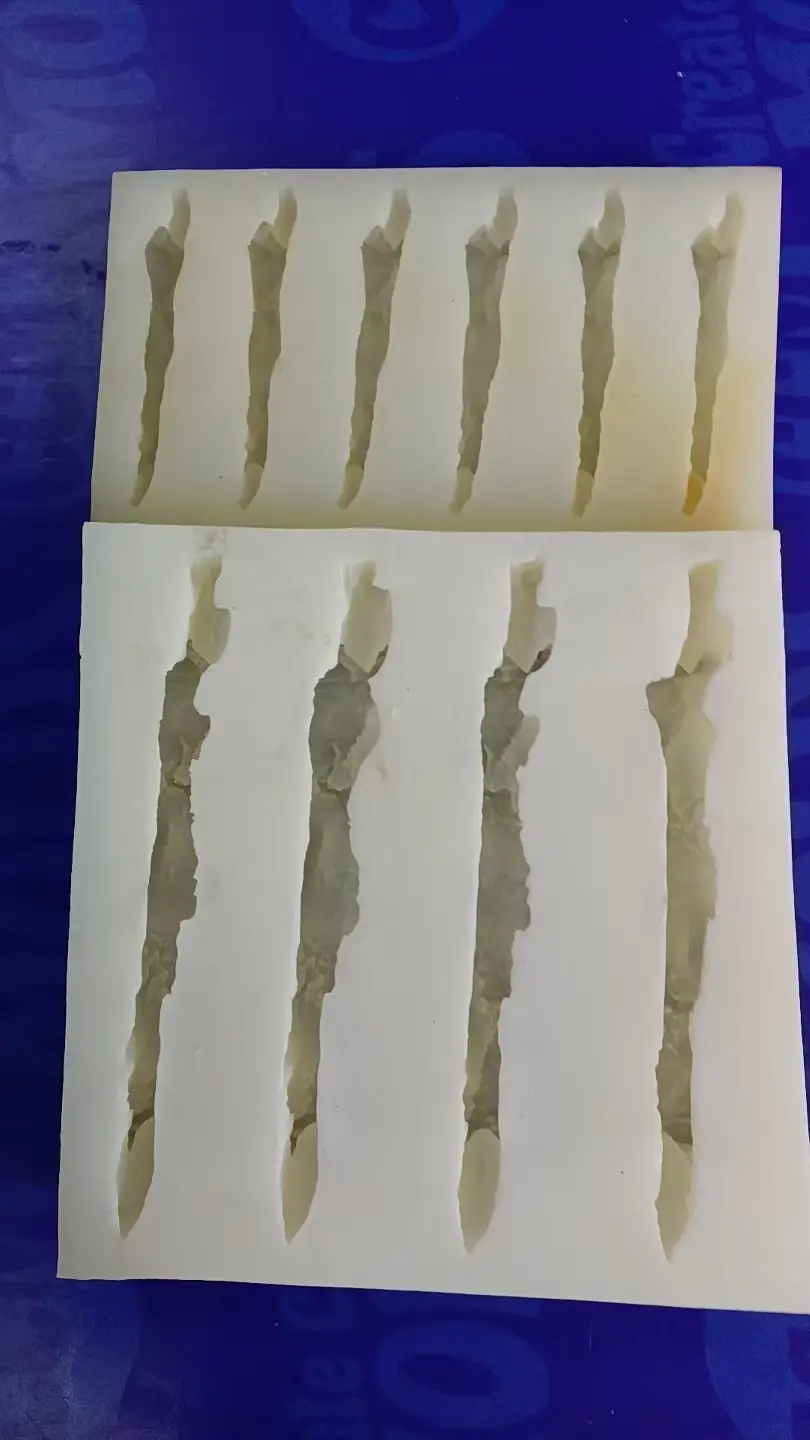
Release first. Grease or spray sits in the grain. Sealer beads. Platinum sees a mottled, oily sponge. Confirm: raking light after demold — pinhole field that matches plaster pores, not mix bubbles in the jacket. Fix: strip, recast from a correctly sealed master. Do not pour a second skin over the cratered face and call it a jacket trick.
Neither coat, raw plaster. Classic mechanical lock plus possible inhibition from some clays and some print washes. Face may string (poison) or merely tear the grain out of the master (mechanical). Confirm with a stick test plus a look at whether plaster dust is embedded in the rubber.
Too much release after a good sealer. Cured rubber, oily copy, flash at puddles — the petroleum-film pattern, not inhibition. Degrease the master; recast.
Food-contact cavities: we would not spec a random release on the master “to be safe.” We seal what must be sealed, we pour platinum, we keep the document path on the article. 21 CFR 177.2600 is extraction on what you ship, not a factory stamp.
Typical shop values
Reference values only. Confirm material-specific limits against the supplier’s technical data and agree project acceptance criteria before production.
| Item | Typical shop value | First-pour note |
|---|---|---|
| Platinum mix | 1:1 or 10:1 by weight, vacuum until foam falls | Vacuum is not a sealer |
| Detail coat | Brushed on logos, undercuts, verticals | Needs a sealed wall |
| Platinum shrink | about 0.1–0.3% | Unsealed plaster also moves; lock mm after seal |
| Cavity Shore | 10A–20A gloves; 20A–40A trays | Soft rubber copies grain harder |
| Prototype | 3–7 business days after CAD lock | Seal/cure of the coat is *before* the clock if you supply the master |
| MOQ | 20 pieces per design | A cratered first skin is not a production pack |
| Simple 3D | USD $50 when that CAD scope applies | We will remodel rather than seal a rotten foam master |
The photo that would prove order: master with sealer on one half and release-only on the other, both poured as witness slugs, cratered half labeled “release first.”
Worked example (anonymized)
A plaster mascot, 90 mm, buyer had sprayed a grocery release then brushed a PVA over the oil “so it would seal.” Platinum 20A glove. Face was a pinhole field; jacket was clean. Stick test: no strings — not inhibition. We asked them to stop. We took $50 CAD, rebuilt a closed master, sealed, no grocery spray, poured in the 3–7 business day window after lock. First resin witness copied a closed face. MOQ 20 of that design. The plaster original stayed a display.

One procurement mix-up
“Prep the master however you usually do” is not a sequence. Write sealer product family if you supply the master, whether a release will be used, and whether the well is food. A photo of a shiny plaster is not proof it is sealed. Tooling charge does not buy a second pour because the coats were stacked backwards.
We would not recommend
We would not recommend release on a porous master before sealer.
We would not recommend hairspray, PVA over grease, or petroleum jelly as a “universal first coat.”
We would not recommend skipping sealer on FDM layer lines and hoping vacuum will hide stairs.
We would not recommend putting a cratered first skin on a food-contact path after a solvent wipe.
- Master porous? plaster wood FDM print - No, CNC or sealed acrylic -> Skip sealer; release only if glue risk
- Master porous? plaster wood FDM print - Yes -> Sealer first — wait full dry
- Sealer first — wait full dry -> Will master glue to platinum?
- Will master glue to platinum? - No -> Pour A/B — no grocery release
- Will master glue to platinum? - Yes -> Thin named release AFTER sealer
- Thin named release AFTER sealer -> Pour A/B — no grocery release
- Pour A/B — no grocery release -> Face cratered or oily?
- Face cratered or oily? - Craters matching pores -> Order was reversed or sealer missed — remake
- Face cratered or oily? - Strings vs jacket -> Inhibition — different page
- Face cratered or oily? - Clean -> Witness dump, then MOQ 20
What to ask when you're buying
- Who supplies the master, and is it porous?
- What sealer, and how long does it dry in undercuts?
- Is any release planned, and is it for the master or for later dumps?
- Food well or craft? Random release ends a food conversation on that skin.
- If the first pour craters, is the recast quoted, and who keeps the master?
RFQ copy-pack
[email protected] · +86 135 3006 2969 · Xinhe Blvd, Shajing, Baoan.
RUUIPON first-pour coat-order RFQ Master: plaster / wood / FDM / SLA / CNC / other Who supplies master: buyer / RUUIPON Sealer used: name or none; dry time Release used: none / named / grocery Food-contact? yes / craft Photo: master before pour; if failed, face vs jacket Qty: first sample / remake / MOQ 20 CAD: locked / need $50 3D
Matched next step: tell us the master family and the coat order you already tried. We seal, then we pour. We will not reverse that to hit a date. Prototype 3–7 business days after CAD lock. MOQ 20 per design.
Related: how custom molds are made, 3D-printed masters, mold from photos, contact.
FAQ
Sealer or release first on a plaster master? Sealer first, full dry, then a thin named release only if the sealed plaster would still glue. Release first prints pores.
Do I need release on a sealed SLA? Often no, if the barrier coat is a true sealer and the print is fully UV’d. Extra spray is how you get oily letters. Ask before you coat.
Can vacuum replace sealer? No. Vacuum on the mix pulls air out of the rubber. Open plaster can feed more air into the face under vacuum.
Is the first pour a production tray? No. First pour is a witness. Production is MOQ 20 pieces per design after the face is closed and quiet.
If my plaster is already greased, will $50 CAD fix it? USD $50 applies when we model a new master. Degreasing a ruined plaster is not always possible. We would rather remodel than pour on oil-in-pores.
Custom silicone development · DFM & prototype support
CAD, drawing, photos or sample details