
How to Choose the Right Silicone Durometer for Your Production
Durometer is a measure of silicone rubber hardness, expressed on the Shore A scale. For food mold manufacturers, selecting the correct durometer is critica
 Kyler Yang · Founder5 min read
Understanding Shore A Hardness
Durometer is a measure of silicone rubber hardness, expressed on the Shore A scale. For food mold manufacturers, selecting the correct durometer is critical — it affects demolding performance, detail reproduction, cavity longevity, and ultimately, your production efficiency.
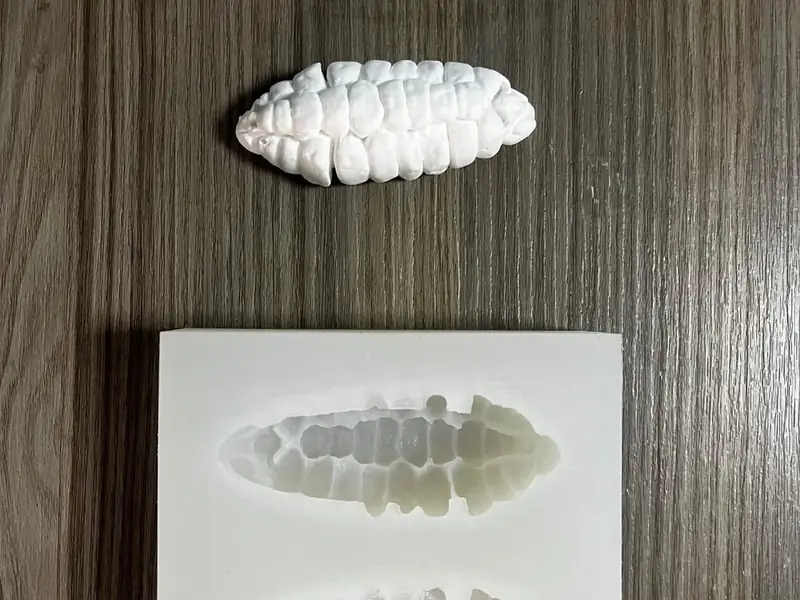
This guide explains durometer selection for commercial food production applications.
The Shore A Scale Explained
The Shore A scale measures the indentation hardness of elastomeric materials. A durometer gauge presses a spring-loaded pin into the silicone surface, and the depth of indentation determines the hardness reading.
| Shore A Range | Relative Hardness | Common Applications |
|---|---|---|
| 5A-10A | Very Soft / Gel-like | Sealants, gaskets, specialty casting |
| 10A-15A | Ultra-Soft | Deep-undercut molds, intricate detail replication |
| 15A-20A | Soft | Flexible molds, undercuts, delicate product release |
| 20A-25A | Standard | Gummy molds, candy molds, general food production |
| 25A-30A | Medium-Firm | Chocolate molds, hard candy, structural applications |
| 30A-40A | Firm | Industrial gaskets, tool handles, rigid parts |
| 40A+ | Very Firm | Structural components, wheels, rollers |
For commercial food mold production, the relevant range is typically 10A to 30A Shore A.
Durometer Selection by Product Type
Gummy Molds: 20A-25A (Recommended)
Why this range:
- Balanced flexibility for clean demolding
- Sufficient structural rigidity for multi-cavity trays
- Resists deformation under depositor pressure
- Maintains cavity detail over thousands of cycles
When to go softer (15A-20A):
- Gummy shapes with deep undercuts
- Very small or delicate gummy formats
- Manual demolding operations where ease of release is prioritized
When to go firmer (25A-30A):
- Large-format gummies that need structural support
- High-volume production where tray rigidity is critical
- Hot-fill applications where slight firmness helps maintain cavity shape
Chocolate Molds: 25A-30A (Recommended)
Why this range:
- firmer durometer supports the weight of molten chocolate
- maintains cavity definition during demolding
- resists deformation during temperature cycling
- provides clean release for glossy chocolate surfaces
Note: Chocolate molds can also use 20A-25A for intricate decorative shapes where maximum flexibility aids release.
Hard Candy Molds: 25A-30A
Why this range:
- Hot sugar deposition (up to 160°C) requires dimensional stability
- firmer durometer resists thermal distortion
- clean release of rigid candy products
Nutraceutical Gummy Molds: 20A-25A
Why this range:
- Precision dosing requires consistent cavity volumes
- Balanced durometer supports both detail reproduction and cavity integrity
- compatible with automatic depositor systems
The Trade-Off: Flexibility vs. Durability
Durometer selection involves a fundamental trade-off:
| Property | Softer Silicone (10A-15A) | firmer Silicone (25A-30A) |
|---|---|---|
| Demolding ease | Excellent — minimal force required | Good — may require more force |
| Detail reproduction | Excellent — flows into fine features | Very Good — captures most details |
| Tear resistance | Moderate — more susceptible to tearing | High — resists tearing and abrasion |
| Cavity deformation | Low — easily flexes around product | Minimal — maintains shape under pressure |
| Lifespan | 1,500-3,000 cycles | 2,000-5,000+ cycles |
| Cost | Slightly higher (specialty formulation) | Standard pricing |
The key insight: There is no universally "best" durometer. The optimal choice depends on your specific product geometry, production volume, demolding method, and equipment compatibility.
How Durometer Affects Production Performance
Demolding Force
Softer silicones require less force to flex around a product during removal. This matters when:
- Demolding is done manually (less operator fatigue)
- Products have complex undercuts (easier release)
- Production speed is critical (faster demolding cycle)
Cavity Volume Consistency
firmer silicones resist cavity deformation under depositor pressure, maintaining volume consistency. This matters when:
- Weight dosing accuracy is critical (regulated products)
- Using automatic depositor systems
- Producing high-volume trays with many cavities
Detail Fidelity
softer silicones can capture finer details because they flow more easily into small features. This matters when:
- Producing intricate decorative shapes
- Reproducing fine text or logos
- Creating products with surface texture
Thermal Stability
both 20A and 25A formulations handle the full food production temperature range (-65°C to +230°C). The durometer choice has minimal impact on thermal performance within the food production range.
Durometer Selection Decision Tree
Use this decision tree to select the optimal durometer for your application:
`` START │ ├── Is your product a chocolate mold? │ └── YES → 25A-30A (firmer for structural support) │ ├── Does your product have deep undercuts (>50% of cavity depth)? │ └── YES → 15A-20A (softer for easier release) │ ├── Are you using an automatic depositor? │ └── YES → 20A-25A (balanced for rigidity and flexibility) │ ├── Is weight dosing accuracy critical (a job-specific weight band after DFM or tighter)? │ └── YES → 20A-25A (firmer for volume consistency) │ ├── Are you producing very small gummies (<1g)? │ └── YES → 15A-20A (softer for detail reproduction) │ └── DEFAULT → 20A-25A (recommended standard for most gummy production) ``
Common Durometer Mistakes
Mistake 1: Assuming Softer Is Always Better
Many producers assume that softer silicone is universally better because it makes demolding easier. However, overly soft silicone can:
- Deform under depositor pressure, causing weight variation
- Tear at cavity edges during repeated use
- Lose detail fidelity over time
Mistake 2: Using the Same Durometer for All Products
Different products have different requirements. Using a single durometer across all your molds may result in suboptimal performance for some products.
Mistake 3: Ignoring Tear Strength
Durometer and tear strength are related but distinct properties. A mold can have the right hardness but insufficient tear strength, leading to edge damage and premature failure. Always evaluate both properties.
FAQ
Q: Can I change the durometer of an existing mold? A: No. Durometer is determined during the silicone formulation and cure process. If your current molds have demolding or durability issues, the solution is to commission new molds with the appropriate durometer.
Q: Does durometer affect FDA compliance? A: No. FDA 21 CFR 177.2600 compliance is determined by the silicone formulation, not the durometer. Both 15A and 25A formulations can be fully food-contact path on request.
Q: What durometer do you recommend for a beginner? A: For most new gummy producers, 20A-25A Shore A is the recommended starting point. It provides the best balance of demolding ease, cavity consistency, and mold durability.
Q: Can you produce molds in custom durometers? A: Yes. We offer durometer options from 10A to 40A Shore A, depending on your application requirements.
*Published: 2026-08-12 | Category: Material Science | Read Time: 9 minutes*
Custom silicone development · DFM & prototype support
CAD, drawing, photos or sample details