
Why We Would Not Make DIY Molds From Caulk | RUUIPON
Acetoxy caulk and hardware-store "silicone" are not platinum RTV tools. We would not use them for food-contact or production dumps. RFQ a real RTV tool.
 Kyler Yang · Founder7 min read
We would not build a food-contact or production mold from hardware-store silicone caulk. Acetoxy (vinegar-smell) caulk, many "100% silicone" tubes, and acetone-thinned DIY mixes are not platinum A/B RTV poured in a vacuumed box against a sealed master. They inhibit, they shrink as they lose acetic acid, they are filled with unknown extenders, and they have no 21 CFR 177.2600 story as *your* article. RUUIPON pours named platinum (and, when you name a craft reason, tin) RTV tools in Bao'an since 2018. Prototype 3–7 business days after CAD lock. MOQ 20 pieces per design. USD $50 when CAD applies.
If you need a molded silicone *part* from steel/LSR, that is an HTV product RFQ here, or ask us for a high-volume LSR tool. A caulk bead around a bathtub is not a cold-runner article either.
Does not apply when you are sealing a window, when a craft TikTok is explicitly a one-off costume piece you will never document, or when you already have a failed caulk "mold" and only want us to copy the *shape* into real RTV from a scan. We can take a scan or photos into CAD ($50 when that scope applies). We will not "upgrade" the caulk skin and keep it as the production tool.
What those tubes actually are
Hardware acetoxy caulk is a one-part, moisture-cure, acetic-acid-leaving paste. Neutral-cure oxime or alkoxy tubes are still one-part, still filled, still not a vacuum-degas 1:1 platinum. Neither is a food-contact mold rubber because you squeezed it onto a plate.
Symptom after a DIY caulk mold: vinegar odor weeks later; sticky face; dump tastes wrong; mold crumbled at a thin logo; platinum you poured *against* the caulk never cured. Cause: acetic acid and other leaving groups, fillers, no controlled mix ratio, inhibition into addition-cure rubber, no post-cure path you can write. Confirm: paperwork on the tube (acetoxy vs "mold making platinum"), a string test, a smell test you should not then use for food. Fix: scrap the food idea. If the shape matters, we model or scan a master and pour platinum RTV. Don't bake the caulk "to make it food-grade."
Acetone-thinned caulk (a common DIY "brushable mold") adds solvent swell and a haze story on top. We would not recommend that mix for anything you sell.
Tin-cure *moldmaking* rubber from a named kit is a different product from caulk. Tin can be a craft tool we will discuss. It is still the wrong food start. Don't lump tin kits and bathtub tubes into one "cheap silicone" line.
Why production dies even when food is off the table
A production RTV tool needs:
- A master with locked millimetres
- A box, keys, vacuum, documented 1:1 or 10:1
- Shore chosen for peel vs abrasion
- A jacket when wet dumps sag 0.5–1.5 mm
- Recast from an archived master
- ISO 3302-1 class on the 2D if you care about rubber dump tolerance
Caulk skins have none of that. They keep shrinking as they cure through thickness. They tear at undercuts because there was no Mold Structure Decision: flat back → open-back; peelable undercuts → glove; if not → split / plug / core; large wet dump → mother mold. A caulk smear over a figurine is a one-piece accident, not a glove spec.
The photo that would prove the point: a vinegar-smelling caulk skin next to a platinum recast from a sealed master, same mascot, same scale. We will not fake that photo with a named influencer.
Typical shop values
Reference values only. Confirm material-specific limits against the supplier’s technical data and agree project acceptance criteria before production.
| Item | Named RTV tool (this shop) | Hardware caulk DIY |
|---|---|---|
| Chemistry | platinum 1:1 or 10:1 (tin only if craft-named) | acetoxy / oxime one-part |
| Vacuum | yes on the tool pour | no |
| Shrink in service | platinum about 0.1–0.3% | keeps moving as it loses leaving group |
| Food article path | 177.2600 / LFGB on the *tool you dump into* | we would not |
| Prototype | 3–7 business days after CAD lock | "overnight on the kitchen counter" |
| Production | MOQ 20 pieces per design | not a production system |
| CAD | USD $50 when that scope applies | a tube nozzle |
| Recast | from living master | no archive |
Worked example (anonymized)
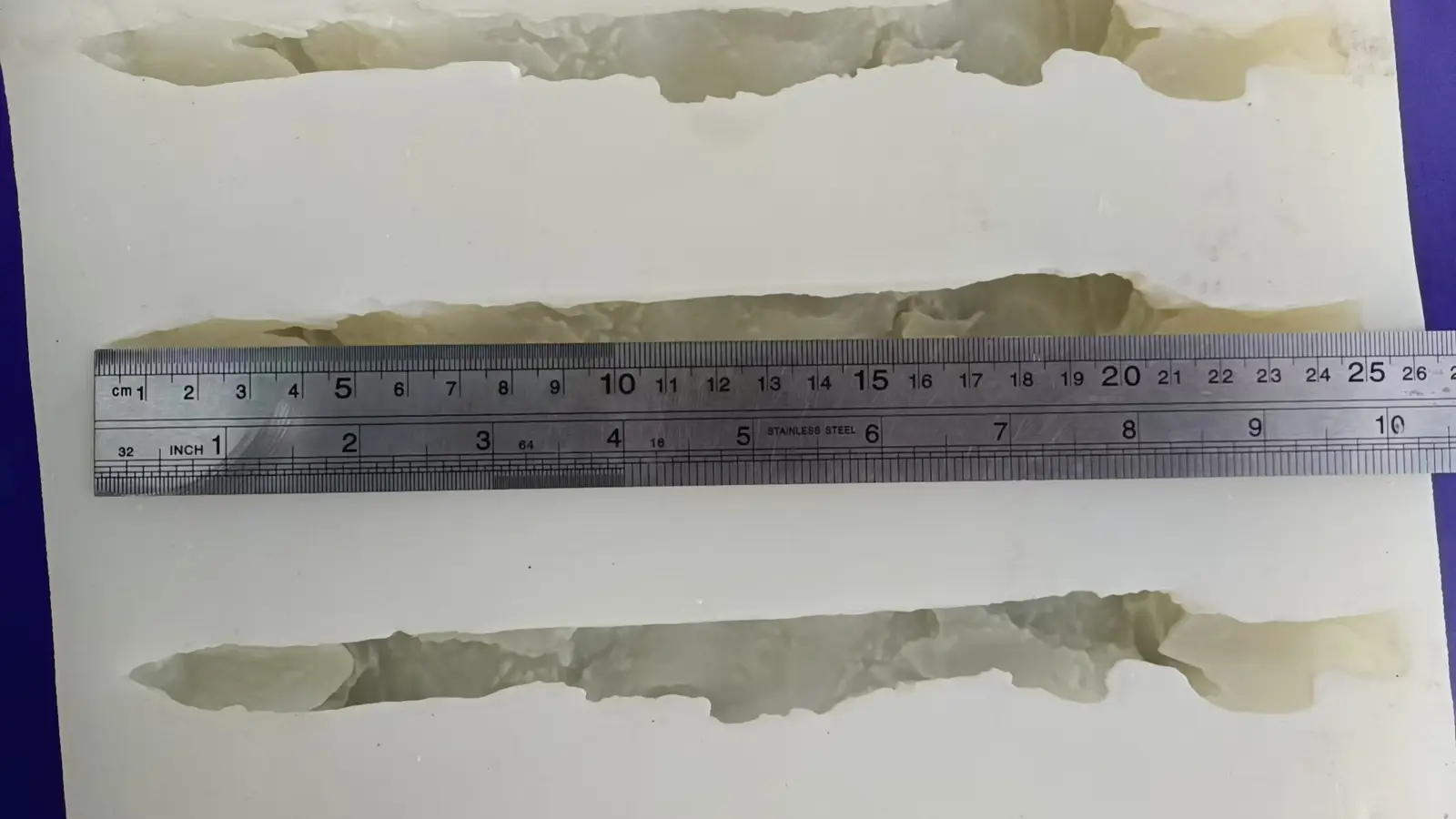
A buyer sent photos of a caulk-smeared logo bar they used for "food-safe chocolate tests," vinegar note still in the well, asked us to pour twenty copies of *that skin*. We declined to copy the caulk as rubber. $50 CAD from photos to a rinseable 0.4 mm logo, lock, sealed master, platinum open-back tray, 3–7 business days, then MOQ 20. Caulk original stayed a warning sample. Tooling charge did not include a food claim on the tube they used in week one.
One procurement mix-up
"100% silicone" on a caulk cartridge equals "platinum food mold." It does not. 100% is a marketing cut line, not 177.2600. A second mix-up is pouring our platinum *against* a caulk master and blaming us when the face stays tacky — acetic inhibition. Seal or replace the master.
We would not recommend
We would not recommend acetoxy caulk as a chocolate or gummy mold.
We would not recommend acetone-thinned caulk as a brush-on production skin.
We would not recommend baking, boiling, or oiling a caulk cavity to "make it food-grade."
We would not recommend using caulk as a mother mold against platinum without a barrier conversation — and usually we would just print or pour a real jacket.
- Hardware caulk tube? - Yes -> We would not — food or production
- We would not — food or production -> Scan or CAD the shape; $50 if we model
- Scan or CAD the shape; $50 if we model -> Sealed master; platinum RTV; lock; 3-7 days; MOQ 20
- Hardware caulk tube? - Named platinum or tin mold rubber -> Real RTV RFQ — still not caulk
- Real RTV RFQ — still not caulk -> Structure Decision plus cabinet
What to ask when you're buying
- Is the current "mold" a caulk smear we must replace, or a named RTV kit?
- Food or craft dump — written?
- Can we scan/photos-to-CAD ($50 when scope applies) instead of pouring against the caulk?
- After lock, 3–7 business days, MOQ 20 per design?
- Who owns the new master so you can recast without the tube?
RFQ copy-pack
[email protected] · +86 135 3006 2969 · Xinhe Blvd, Shajing, Bao'an
RUUIPON replace-a-caulk-DIY RFQ Current object: acetoxy caulk / mystery tube / named RTV kit Dump intended: food / resin / plaster / soap / other We would not keep caulk as the tool: confirm Photos or scan of the shape: CAD: $50 if we must model; then lock; then 3–7 business days Qty: prototype / MOQ 20 per design Docs if food: 177.2600 / LFGB on the new platinum article
Matched next step: send photos of the caulk skin and the dump you actually need. We will quote a platinum RTV tool from a new master. We will not certify the tube. Prototype 3–7 business days after CAD lock. MOQ 20 per design.
Related: custom silicone mold from photos, platinum vs tin for molds, food-grade mold buyer spec, contact.
FAQ
Is vinegar-smell silicone ever OK for chocolate after it stops smelling? We would not treat it as a food-contact tool. Odor fading is not an extraction test.
Can you pour platinum onto my caulk master if I seal it? We would rather scan or remodel. Caulk as a master is an inhibition and dimension risk. Ask; don't assume.
What about neutral-cure "kitchen and bath" silicone? Still a one-part filled caulk, still not vacuumed platinum RTV, still not our food path.
I already sold pieces from a caulk mold. Can you match it? We can match the *shape* from photos or a scan after CAD lock. We cannot inherit the caulk's undocumented chemistry.
Does MOQ 20 apply if I only need one replacement for my DIY? Production lots are MOQ 20 pieces per design. A prototype is the 3–7 business day article after lock; talk to us on qty before you assume a single copy.
Custom silicone development · DFM & prototype support
CAD, drawing, photos or sample details