
How to Inspect Quality on a Custom RTV Silicone Mold
Inspect an RTV mold as rubber hardware: living-mother copy, support-shell fit, bubbles, sticky faces. Then inspect a casting at a named wait.
 Kyler Yang · Founder9 min read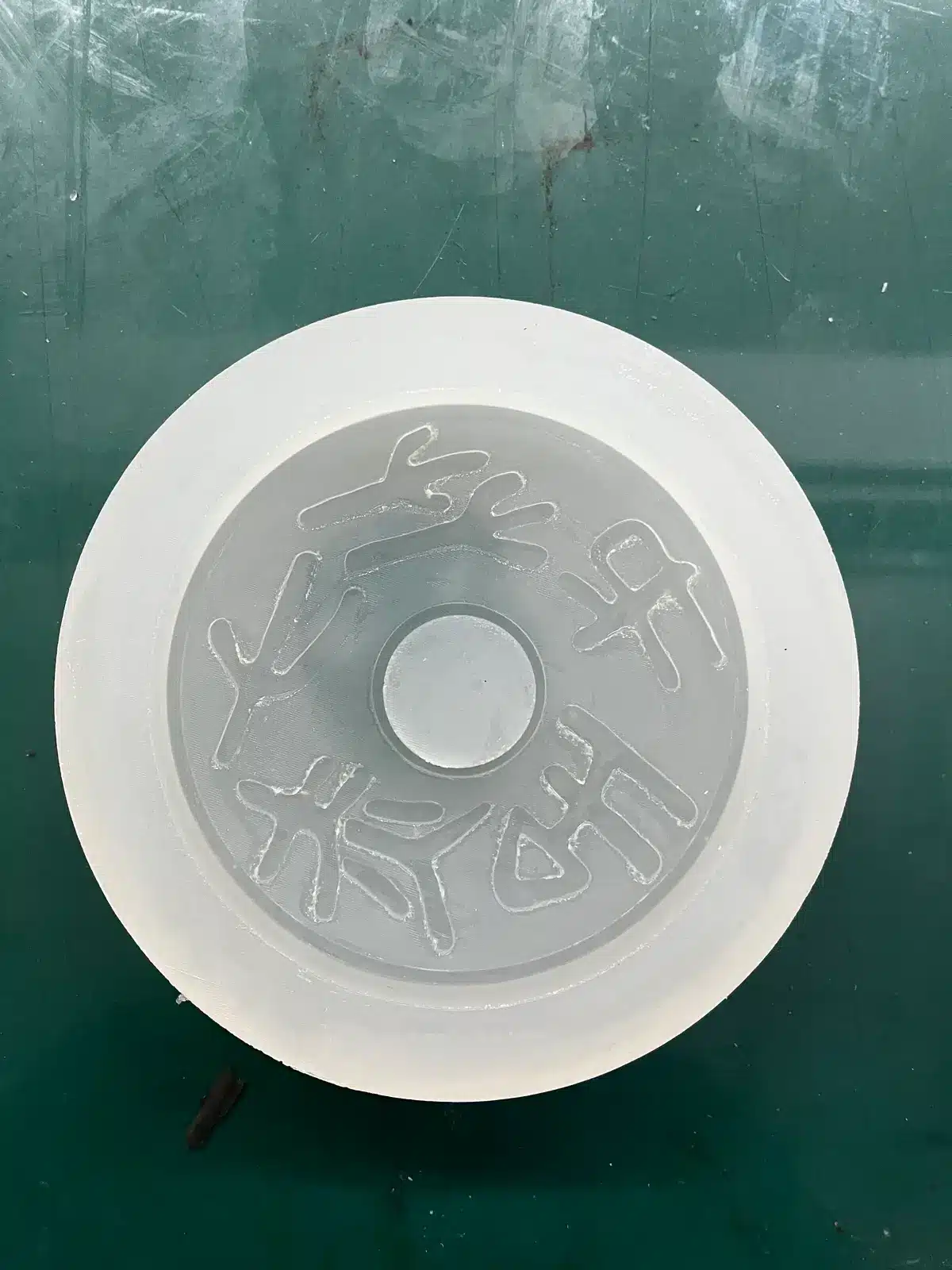
If you are inspecting a custom RTV silicone mold, you are doing two jobs that buyers collapse into one photo. Job one: is the mold the mold you paid for (copy of the living resin production mother, support-shell fit, mix identity)? Job two: do the castings from that mold meet the drawing in a stated wait and temperature? A pretty first chocolate does not prove the jacket / mother-mold support shell is square.
On this site the path is photos, sketch, or CAD, then a 3D-printed pattern, often a temporary silicone flip, a resin production mother, then batch RTV. The mother is not the pattern. Free DFM. HTV/HCR compression mold tooling is also quoted on RUUIPON.
The object on this page
When a mold arrives, inspect rubber as rubber: cavity identity versus the living mother; whether the support shell locates without rocking; incomplete copy of micro-texture; trapped bubbles at the parting; sticky faces (inhibition - a failed mold, not a polish to inspect in); inner core pull path; mix identity on the traveler. When dumps exist, inspect the article as the article. Do not use dump inspection to skip the mold inspection.
The mother can take a scan. The RTV cavity and the dump often cannot, not in the same way. Probe sink, fixture strain, and temperature swamp any ISO 3302-1 conversation on a rubber article. For the dump: define measurement state (23 C after wait X), use optical or dedicated gauges on lips, weigh cavities as a fill-and-flash proxy, durometer on a specified boss of the skin, not on a 0.5 mm membrane. Flash is an inspection item with a location and a method. No flash without a location is not a spec.
Platinum chemistry adds a contamination inspection steel people forget: sulfur, tin-cure residues, some 3D-printed patterns, and dirty gloves inhibit cure. A sticky first dump is a chemistry fail. Do not inspect it in with more oven time until you know the cause. For tin-cure, record the age of the mold when you inspect dimensions of the casting. A good inspection on week one is not a library approval for month six.
Common mix-up
A lot of RFQs treat visual AQL on finished chocolates or gummies as proof the tool is good. A lot can pass cosmetics and still come from a tray with a dying split that will fail next month. Export AQL is a third job. ISO 9001 status of the factory tells you whether they have a record system. It does not replace the traveler for your mold. Multi-cavity inspection must keep cavity identity through the bag. If your email still says "master, box, keys, jacket" as the buy, you are listing shop furniture, not the object. Recut the pattern and cast a new mother only for mother problems. Change mix only for mix. Catalog copy that says cut a resin master skips the pattern-vs-mother split. We will not quote that sentence.
Typical shop values
Reference values only. Confirm material-specific limits against the supplier’s technical data and agree project acceptance criteria before production.
| Item | Typical shop value |
|---|---|
| Mix | Platinum 1:1 or 10:1 by grade; vacuum degas until the foam collapses |
| Cavity Shore | 10A-20A skin; durometer on a specified boss, not a 0.5 mm membrane |
| Platinum shrink after full cure | About 0.1-0.3% |
| Measurement state | 23 C after a named wait |
| Support-shell rock / edge sag | About 0.5-1.5 mm if the shell is missing or warped |
| Outer-row gummy vs center if the tray sags | Edge often 3-6% heavy - weigh cavities as a fill proxy |
| First-article bagging | By cavity; mixed bags average a false pass |
| DFM / CAD / proto / MOQ | Free DFM; USD 50 when we edit 3D; 3-7 days after CAD lock; 20 pcs/design |
Worked example
An 8-cavity hollow chocolate, 55 mm sphere, platinum RTV with a mandrel and a fiberglass support shell, a few thousand dumps a season. Incoming caught a bubble cluster at the equator of cavity 4 and a sticky patch on 7 (SLA residue on the pattern, which had already become a mother). They recast 4 and 7 against a recleaned living mother, then measured sphere OD at 23 C after a 24-hour wait, bagged by cavity. A steel-tool CMM form from another vendor would not have had a line for sticky faces or mandrel pull.
Stay on this page / skip this page
Stay when you need incoming on a poured RTV tool plus first dumps as two jobs.
Skip a steel incoming list (heaters, cold-runner valves) - that is a molded-part tool; finished parts are an HTV product or mold RFQ here, or a different LSR-tool RFQ - ask us. Carton AQL on chocolates is not mold incoming. A 30-piece art run in tin-cure does not need a full multi-cavity traveler; it does need mold age on the size report. One mandrel that will not extract fails the mold even if every other pocket photographs well.
We will not recommend carton AQL as mold incoming. We will not run a contact CMM on every 30 Shore A lip. We will not inspect in a sticky platinum face with more oven time. We will not mix cavities into one bag at first article. We will not cut a resin master as the written shop path.
Related: evaluate mold quality, food-grade molds, contact.
What to send
- Incoming photos you want (support shell in frame, pour face seated)
- Measurement state: 23 C after wait ____, bag by cavity
- Flash limit sample at a named split
- Tin-cure: mold age on the dimensional report
- Food-contact object: article vs grade letter (21 CFR 177.2600 and/or LFGB sections 30/31)
Send the pack to [email protected] or contact.
- Mold: mother copy, shell rock, bubbles, sticky, mix lot -> Support shell dry fit
- Support shell dry fit -> Dumps at 23 C after wait X, bag by cavity
- Dumps at 23 C after wait X, bag by cavity -> Fail type
- Fail type - sticky / inhibition -> Reclean living mother, recast
- Fail type - bubble at split -> Repour that skin
- Fail type - size off -> Check wait, tin age, sag 0.5-1.5 mm
- Fail type - one bad pocket in mixed bag -> Isolate, recast that skin
FAQ
Should I CMM every silicone lip on incoming lots? Usually no. Many lips are too soft for a contact CMM to mean what the print thinks. Use a dedicated gauge, optical method, or a functional fit check at 23 C after the named wait. Save scanning for the living mother.
What is a reasonable flash inspection on an RTV split? A named location, a method, and a limit sample. Flash not to exceed X at the split, no tear-trim into the logo is a spec. Train the inspector on the sample, not on adjectives.
Does a factory ISO 9001 certificate replace mold incoming photos? No. The certificate says a QMS exists. Your mold still needs identity, support-shell condition, and a first-article pack. Ask for the traveler that includes this mold number.
How do I inspect a texture or polish without a chip? You mostly cannot, not in a way two people will repeat. Retain the chip used at first dump. Photograph under agreed lighting. Arguing from a phone screen is not inspection.
Can visual AQL on cartons replace cavity-weight checks? Visual AQL catches gross cosmetics. It misses slow split wear and slow fill changes. Carton AQL is downstream. Wear happens on the mold.
Custom silicone development · DFM & prototype support
CAD, drawing, photos or sample details