
RTV Mold Regulatory Requirements, US vs Germany
Name the market first. US repeated-use rubber is 21 CFR 177.2600. Germany adds LFGB and BfR XV. Factory ISO 9001 does not replace the cavity flask.
 Kyler Yang · Founder6 min read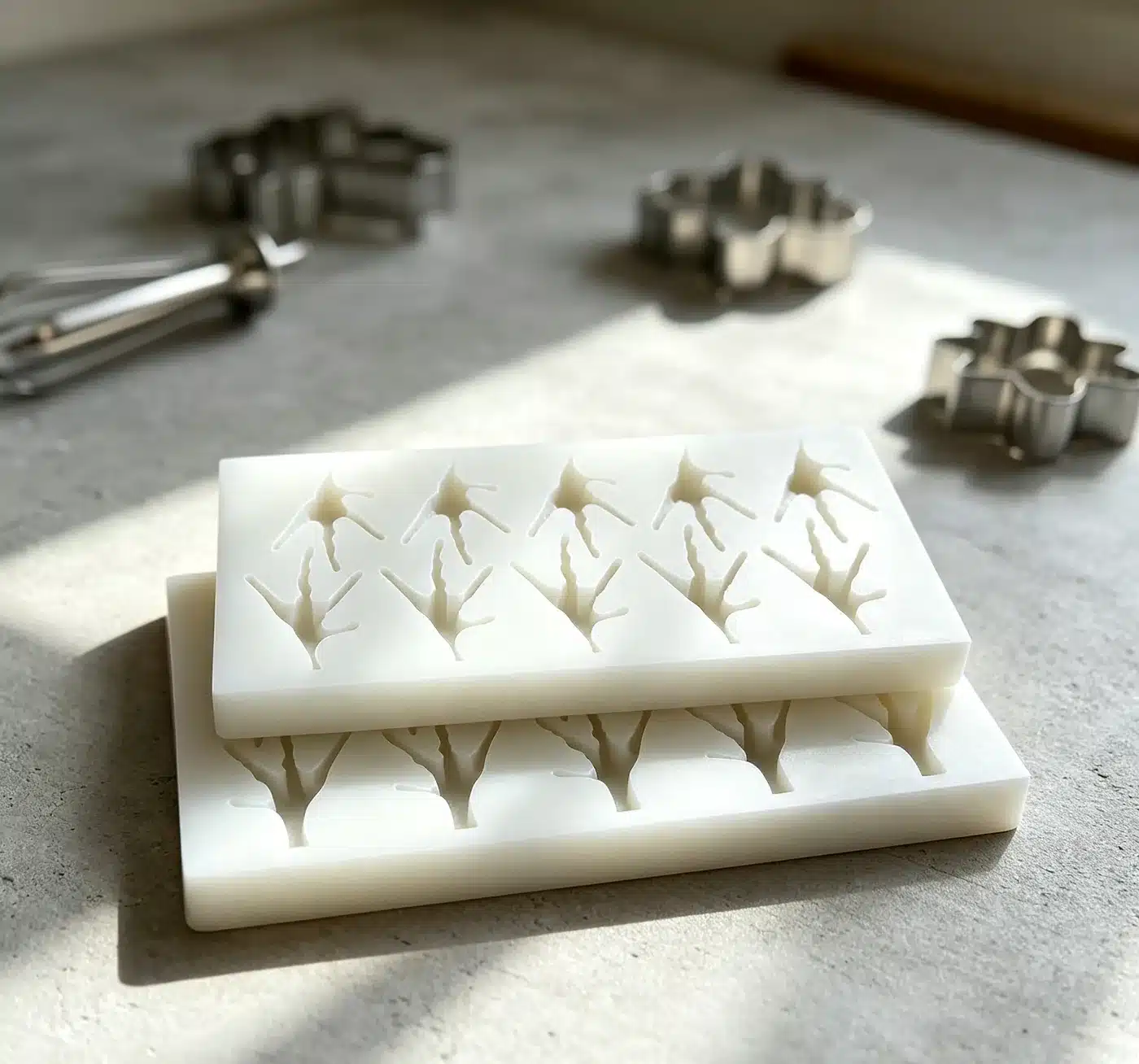
If you're writing regulatory requirements for a custom RTV mold, name the market before you name the test. Requirements depend on whether the mold is the food-contact article, where it will be sold, and what food and temperature it will see. A chocolate tool sold in the US and Germany is regulated as a finished rubber article under 21 CFR 177.2600 and, for German buyers, LFGB with BfR Recommendation XV under Regulation (EC) 1935/2004. Factory certificates sit beside that file. They don't replace it. China export production doesn't create a third food-contact chemistry; it creates a factory that must hit destination rules. HS codes (often 3926.90 or 4016.99) are customs, not safety.
US flasks vs German stacks
US bakery or retail: 177.2600 for repeated-use rubber — water and n-hexane at reflux with section ceilings (20/1 aqueous, 175/4 fatty), composition fit, cleansed article. It isn't "FDA registered factory," isn't ISO 10993, isn't a microwave or BPA standard. Heat limits stay grade-specific.
Germany or LFGB-bar buyers: LFGB plus BfR XV methodizing, plus 1935/2004 and 2023/2006 GMP. Sensory and volatiles are in play. Platinum RTV is the usual dual-market chemistry because odor is controllable after post-cure. Tin-cure RTV isn't the OEM bakeware requirement. If the mold is only for non-food resin, write that on the PO so nobody buys a flask by habit.
Importer of record, not the molder, often holds the legal duty in the destination. The molder still has to produce the specimen the importer can file. Paying a tooling charge doesn't decide who owns that file.
Common mix-up: FDA-registered facility as 177.2600
A lot of RFQs treat "FDA registered facility" as the rubber extraction. In the shop that usually means a slogan with no flask, no ceilings, and no specimen.
What to ask when you're buying against a regulation
- Destination markets, and which method on this cavity after post-cure?
- Is a local Chinese test being offered *instead* of the destination method?
- Platinum RTV or tin-cure, and is this the chocolate tool or a resin mold?
- Who files: importer or molder, and where does the report live?
- Add-ons (PAHs, Prop 65, REACH): named as extra line items with methods?
Worked example: chocolate tool, US plus Germany, made in China
A confectioner exports a 6-cavity 90 x 40 x 10 mm platinum RTV bar tool. Destination rules govern: 177.2600 hexane for the US, BfR XV volatiles/simulants/sensory for Germany, on that production cavity. A local Chinese test can be extra. It doesn't replace the destination method unless the buyer says it does.
When this article is the wrong quote
RoHS is electrical. UL 94 is a burn specimen. ISO 13485 is medical devices. Don't require those for muffins unless you are actually in that product. Children's feeding articles add CPSIA; that still doesn't delete the rubber extraction. Non-food resin molds don't need this regulatory stack.
Related reading: food-contact compliance, safety standards, verify certifications, food-grade molds.
Regulatory block to paste on the contract
- Markets: US / DE-EU / both
- Article: this RTV cavity, color, post-cure
- Methods: 177.2600 and/or LFGB/BfR XV
- Process: platinum RTV (tin-cure only with a stated non-food reason)
- Importer vs molder: who holds the file
- Labeling: fork-and-glass owns a claim — keep the file where sales can find it
- HS code is not a flask
Send the destination markets, the cavity SKU, and who is importer of record. We'll write the method block and keep add-on screens as extra line items so the lab doesn't run the widest package by default.
We would not recommend "FDA registered facility" as 177.2600
We would not recommend citing 1935/2004 alone on a German portal, or treating HS 3926.90 / 4016.99 as a flask. We would not require ISO 13485 for muffins. We would not let a local Chinese test replace the destination method unless the buyer said so.
Market first:
- Destination - DE -> LFGB / BfR XV
- Destination - both -> 177.2600 on this cavity
- Destination - both -> LFGB / BfR XV
- Destination - non-food resin -> Skip food stack
Typical shop values: destination ceilings
| Item | Typical shop value | | --- | --- | | 177.2600 aqueous / fatty | 20 then 1 mg/in² water; 175 then 4 n-hexane | | BfR XV usual simulants | Water, 3% acetic acid, 95% ethanol plus sensory | | Mix / Shore | Platinum 1:1 or 10:1; 10A–20A plus jacket | | Shrink | ~0.1–0.3% platinum | | HS | 3926.90 or 4016.99 as customs, not safety |
Reference values only. Confirm material-specific limits against the supplier’s technical data and agree project acceptance criteria before production.
FAQ
Does exporting from China add a CN food-contact test I must run instead of FDA? Destination rules govern. US buyers want 177.2600. German buyers want LFGB/BfR XV. A local Chinese test can be extra.
Is "FDA registered facility" a 177.2600 requirement? No. 177.2600 is an article extraction regulation. Facility slogans aren't the flask.
Can I cite 1935/2004 alone on a German retailer portal? Usually not. They want methodized silicone data (BfR XV thinking, volatiles, simulants, sensory).
Do HS codes 3926.90 or 4016.99 change the food-contact method? No. They're classification for customs. Neither code is a flask.
Are oven and dishwasher temperatures regulatory requirements? They're claims. If you print them, the food-contact duty should represent them, and the grade must survive them. Keep abrasives off the qualified face.
Custom silicone development · DFM & prototype support
CAD, drawing, photos or sample details