
Silicone Mold Shrinkage: What It Is and How to Account for It
Silicone shrinkage is a critical factor in mold design and production. Understanding how silicone behaves during curing and over time ensures accurate prod
 Kyler Yang · Founder4 min read
Introduction
Silicone shrinkage is a critical factor in mold design and production. Understanding how silicone behaves during curing and over time ensures accurate product dimensions and consistent quality.
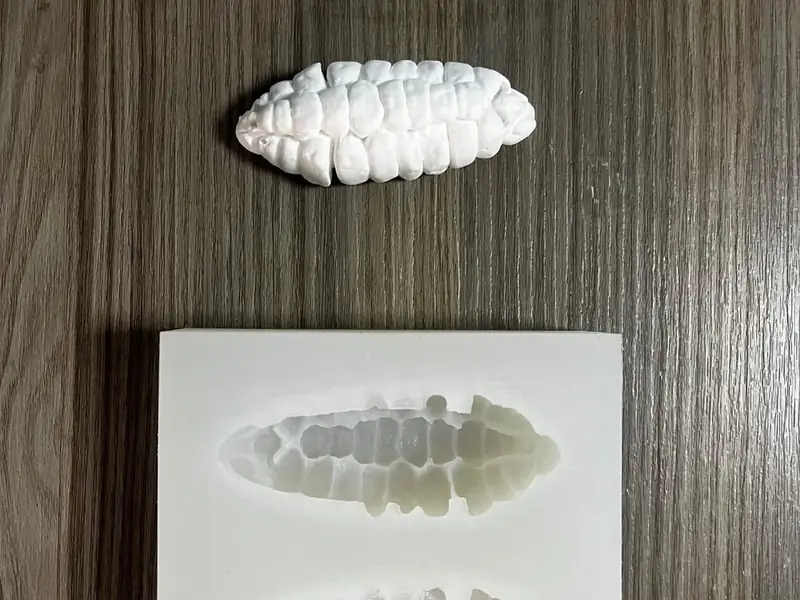
This guide explains silicone shrinkage, its causes, and how to account for it in mold design.
What Is Silicone Shrinkage?
Definition
Silicone shrinkage is the reduction in volume that occurs as liquid silicone transitions to solid elastomer during the curing process.
Shrinkage Rates by Cure Type
| Cure Type | Typical Shrinkage | Notes |
|---|---|---|
| Platinum-cured (Type IV) | 0.05% - 0.15% | Very low shrinkage |
| Tin-cured (Type II) | 0.3% - 0.8% | Higher shrinkage |
| Condensation cure | 0.5% - 1.5% | Highest shrinkage |
Causes of Shrinkage
1. Chemical Shrinkage
During the cure reaction, silicones undergo chemical changes that reduce volume:
| Factor | Effect |
|---|---|
| Crosslinking | Polymer chains form 3D network, reducing free volume |
| Byproduct release | Condensation cures release small molecules (alcohol, water) |
| Bond formation | New bonds are shorter than separate molecules |
2. Thermal Shrinkage
Temperature changes during and after curing cause additional shrinkage:
| Stage | Temperature Change | Effect |
|---|---|---|
| Mixing to pouring | Exothermic reaction | Minimal effect |
| Curing | Temperature rise | Slight expansion |
| Cooling to room temp | 60°C → 22°C | Contraction |
| Post-cure | Extended heating | Additional shrinkage |
3. Post-Cure Shrinkage
Some silicones continue to shrink after initial curing:
| Factor | Effect |
|---|---|
| Continued crosslinking | Slow post-reaction shrinkage |
| Stress relief | Internal stress relaxation |
| Volatilization | Trace volatile release |
Accounting for Shrinkage in Mold Design
The Shrinkage Compensation Formula
`` Master Size = Mold Cavity Size ÷ (1 - Shrinkage Rate) ``
Example Calculation
Given:
- Target cavity size: 25.00mm
- Platinum silicone shrinkage: 0.1% (0.001)
Calculation: `` Master Size = 25.00 ÷ (1 - 0.001) Master Size = 25.00 ÷ 0.999 Master Size = 25.025mm ``
Result: Master model should be 25.025mm to produce a 25.00mm cavity.
Shrinkage Compensation Table
| Target Cavity | Platinum (0.1%) | Tin (0.5%) | Condensation (1.0%) |
|---|---|---|---|
| 10.00mm | 10.01mm | 10.05mm | 10.10mm |
| 20.00mm | 20.02mm | 20.10mm | 20.20mm |
| 25.00mm | 25.03mm | 25.13mm | 25.25mm |
| 30.00mm | 30.03mm | 30.15mm | 30.30mm |
| 50.00mm | 50.05mm | 50.25mm | 50.50mm |
Shrinkage by Silicone Brand
Common Silicone Brands and Shrinkage
| Brand | Product Line | Typical Shrinkage |
|---|---|---|
| Platinum Silicones | GS-20, GS-25 | 0.05% - 0.10% |
| Smooth-On | EcoFlex, Silly Skin | 0.10% - 0.20% |
| Shin-Etsu | X-51-2187 | 0.05% - 0.15% |
| Wacker | ELASTOSIL | 0.05% - 0.10% |
| Atlantic | Food-grade lines | 0.10% - 0.20% |
Factors Affecting Shrinkage
Material Factors
| Factor | Effect on Shrinkage |
|---|---|
| Durometer | Higher durometer = slightly less shrinkage |
| Filler content | More filler = less shrinkage |
| Cure temperature | Higher temp = more complete cure = less post-cure shrinkage |
| Mix ratio | Incorrect ratio = incomplete cure = unpredictable shrinkage |
Process Factors
| Factor | Effect on Shrinkage |
|---|---|
| Mixing quality | Poor mixing = uneven cure = variable shrinkage |
| Degassing | Insufficient degassing = bubbles = volume variation |
| Cure time | Under-curing = continued shrinkage after demolding |
| Temperature control | Temperature fluctuations = variable shrinkage |
Shrinkage vs. Dimensional Accuracy
Understanding the Difference
| Term | Definition | Typical Tolerance |
|---|---|---|
| Shrinkage | Systematic volume reduction | Compensated in design |
| Dimensional accuracy | How close actual size is to target | CAD-locked cavity dimensions typical |
Quality Standards
| Specification | Requirement |
|---|---|
| Shrinkage compensation | Master oversized by shrinkage factor |
| Cavity accuracy | CAD-locked cavity dimensions from target |
| Consistency | Same shrinkage across all cavities |
| Stability | Shrinkage completes within cure time |
Practical Implications
For Mold Manufacturers
| Responsibility | Action |
|---|---|
| Master fabrication | Oversize masters by shrinkage factor |
| Quality control | Measure actual shrinkage for each batch |
| Documentation | Record shrinkage rate for traceability |
| Consistency | Use same silicone batch for multiple molds |
For Mold Users
| Consideration | Impact |
|---|---|
| Product dimensions | Account for shrinkage in product specs |
| Quality control | Measure actual product dimensions |
| Tolerance expectations | a job-specific weight band after DFM weight tolerance accounts for minor variations |
| Consistency | Same mold from same batch = consistent shrinkage |
FAQ
Q: How much does platinum silicone shrink? A: Platinum-cured silicone typically shrinks 0.05% to 0.15%, which is negligible for most applications and compensated during master model fabrication.
Q: Does shrinkage affect product weight? A: No. Shrinkage affects dimensions, not density. Product weight is determined by cavity volume and material density.
Q: Can shrinkage change over time? A: Some post-cure shrinkage may continue for 24-48 hours after demolding. Proper curing minimizes this.
Q: How do you compensate for shrinkage? A: Master models are fabricated slightly oversized (by the shrinkage factor) so the resulting cavity matches the target dimension.
Q: Is shrinkage a problem for food molds? A: No. Shrinkage is accounted for in the design process. Properly manufactured molds produce accurate cavities.
Conclusion
Silicone shrinkage is a predictable, compensatable property. Platinum-cured silicones exhibit minimal shrinkage (0.05-0.15%), which is factored into master model design to ensure accurate cavity dimensions. Understanding shrinkage helps set realistic expectations for mold accuracy and product consistency.
*Published: 2026-08-12 | Category: Technical Guide | Read Time: 7 minutes*
Custom silicone development · DFM & prototype support
CAD, drawing, photos or sample details