
RTV Silicone Molds for Concrete Countertops | RUUIPON
A countertop RTV tool is a jacketed skin for wet kilograms and an edge profile, not a food tray. Abrasive recast, not 177.2600. Typical shop. MOQ 20.
 Kyler Yang · Founder7 min read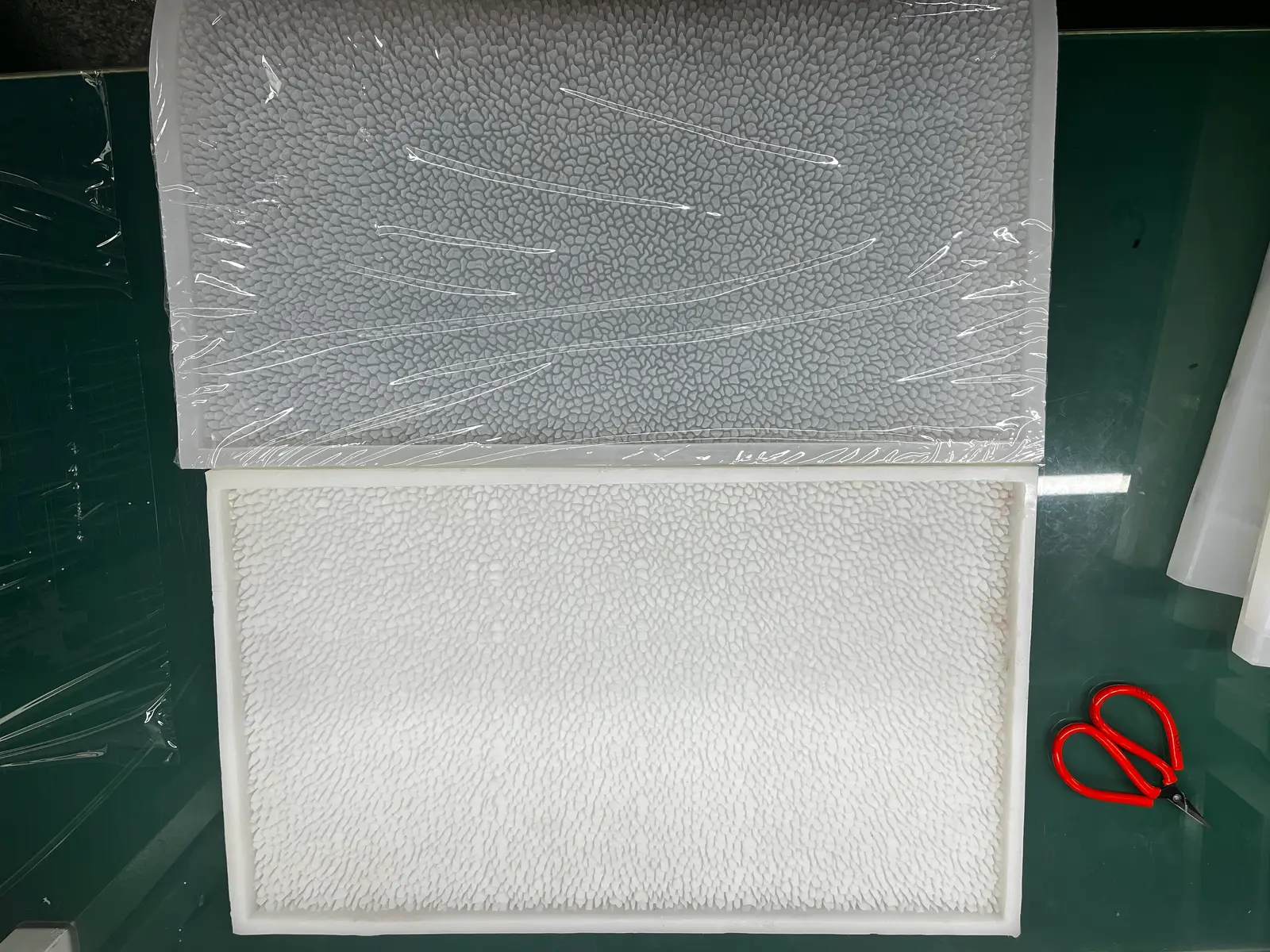
A concrete countertop mold is a wet-slab tool: edge profile, sometimes a sink knockout, texture on the show face, and hydrostatic load that will balloon an unsupported Shore 10A–20A skin. It is not a 400 mm paver tile, not a chocolate tray, and not a food-contact article because it sat in a kitchen. Platinum RTV copies the profile; a rigid mother-mold jacket carries the kilograms. Aggregate scours letters. Budget a recast of the skin against an unsanded master. We would not spec 21 CFR 177.2600 on this PO. Concrete is not food.
RUUIPON pours abrasive-duty platinum tools in Bao'an since 2018. Prototype is 3–7 business days after CAD lock. Production is MOQ 20 pieces per design — for a huge one-off slab that may mean twenty of a *repeatable edge form* or a smaller insert, not twenty full kitchens unless you said so. Simple 3D is USD $50 when that CAD scope applies. Paver-scale concrete: concrete molds. Longer cement explainer: concrete and cement. Jacket: mother-mold shell. LSR *parts*: an HTV product RFQ here.
Does not apply when you are forming a whole island in plywood and only want a silicone *edge liner*, when the mix is gypsum plaster (different chip, different page), or when you wanted a food-contact baking slab. Geometry can override quantity: one 2 m edge form still needs a jacket even if you only want two skins.
Wet kilograms and the edge, not the kitchen story
Write filled mass and pour height, not "kitchen counter" as a vibe. A tall waterfall edge is a hydrostatic wall. Soft RTV without a jacket sags on the order of 0.5–1.5 mm at an unsupported lip; on a 3 m run that is a visible bow. Raising Shore to 40A to skip the jacket usually kills the peel on a bullnose undercut. Jacket first. Structure Decision: open-back for a flat slab face with an edge form; two-part or plug if the profile hooks; mother mold required on the wet dump.
Sink cutouts are cores. A removable plug or a knock-out block is a structure line, not a saw after the pour unless you said drill/cut after. Integral drainboards and grooves copy only if the master has them and the rubber can peel.
Aggregate size scours. Fine letters on a countertop edge die. Recast when the texture washes. Keep the master unsanded. Tin-cure skins that sit in a warehouse keep shrinking; we would not warehouse tin as a countertop spare. Platinum shrink is typically about 0.1–0.3% linear.
Vibration of the mix is a jacket and clamp conversation. A printed jacket that survived a proto tile may not survive a vibrating 80 kg pour.
The photo that would prove the tool is the skin in its jacket, clamps at the edge, a witness pour of the profile, and a scale ticket for wet mass. A lifestyle kitchen photo is not an RFQ.
Typical shop values
Reference values only. Confirm material-specific limits against the supplier’s technical data and agree project acceptance criteria before production.
| Item | Typical shop value |
|---|---|
| Dump | Wet concrete — abrasive, not food |
| Skin Shore | 10A–20A common; jacket takes load |
| Sag if unsupported | about 0.5–1.5 mm at the lip |
| Mix / shrink | platinum 1:1 or 10:1; ~0.1–0.3% |
| Docs | industrial/craft — no 177.2600 |
| Prototype | 3–7 business days after CAD lock |
| Production | MOQ 20 / design (name what the design is: edge, insert, full form) |
| CAD | USD $50 when modeling applies |
| Drawing class | ISO 3302-1 M2 unless the print says otherwise |
Common mix-up: kitchen counter equals food-grade silicone mold
Buyers ask for FDA on the edge form because the slab will hold sandwiches. The *cavity* is a concrete tool. Food-contact would be a different platinum tray with extraction docs, never dual-used with cement. Another mix-up: quoting a paver tile price for a 2 m bullnose. Envelope and jacket dominate. A third: skipping the spare jacket because "we only pour weekends." Wet kilograms still chip plaster.
Worked example (anonymized)
A 2.4 m bullnose edge liner, 40 mm face, wet pour in a fabricator shop with vibration. Photos only. USD $50 CAD to model the profile, CNC master for the show radius, platinum ~15A skin, fiberglass jacket with clamps, no sink core (cut after). Proto 3–7 business days after lock. Production was MOQ 20 of *that edge liner*, not twenty kitchens. Recast planned when aggregate washed the radius. No food pack.
We would not recommend
We would not recommend an unsupported 10A–20A skin for a vibrating countertop pour.
We would not recommend a food extraction PDF on a concrete tool.
We would not recommend raising Shore instead of adding a jacket.
We would not recommend a plaster spare jacket as the only support on a vibrating slab.
- Dump is wet concrete? - yes -> Not food — no 177.2600
- Dump is wet concrete? - baking slab / chocolate -> Wrong page — food cavity
- Not food — no 177.2600 -> Skin 10A–20A + mother-mold jacket
- Skin 10A–20A + mother-mold jacket -> Edge hooks / sink as-molded?
- Edge hooks / sink as-molded? - yes -> Split or plug
- Edge hooks / sink as-molded? - open profile -> Open-back liner in jacket
- Split or plug -> CAD lock → 3–7 days → MOQ 20 of that design
- Open-back liner in jacket -> CAD lock → 3–7 days → MOQ 20 of that design
What to ask when you're buying countertop tools
- Wet mass and pour height, not just finished L×W?
- Edge profile as a liner vs a full slab form?
- Jacket material vs vibration?
- Recast plan and unsanded master archive?
- Confirm concrete is not food?
Related: architectural casting, replacement, contact.
RFQ copy-pack — countertop as wet industrial
Email [email protected]:
Dump: wet concrete, aggregate max size, vibration yes/no Design: edge liner / full form / insert — MOQ 20 of *this* Wet kg and pour height Profile: bullnose / ogee / custom (USD $50 if you model) Jacket: fiberglass / resin / not plaster-only if vibrating Platinum 1:1 or 10:1, vacuum Not food — do not include 177.2600 Prototype 3–7 business days after CAD lock
Send wet kilograms and the profile. We will quote a jacketed skin, not a baking tray. Phone +86 135 3006 2969. Xinhe Blvd, Shajing, Bao'an, since 2018.
FAQ
Do concrete countertop molds need to be food grade? No. Concrete is not food. A kitchen install does not turn the form into a 177.2600 article.
Can I pour a whole island in one silicone skin? Usually you want an edge liner plus conventional slab forming. A giant unsupported glove is a balloon. Geometry overrides a romantic one-piece.
How long will the skin last? Abrasive dumps recast. Cycle life is a wear conversation, not a warranty number we invent. Keep the master.
Is MOQ 20 twenty full countertops? MOQ 20 is twenty of the locked *design*. Say whether that design is a 300 mm insert, an edge liner, or a full form.
Will thicker RTV replace the jacket? We would not spec that as the first move. Extra grams still flex; the jacket carries the kilograms.
Clamp pattern and recast economics
Write clamp spacing on the jacket CAD so a spare jacket matches. A proto that used spring clamps and a production run that uses through-bolts is two jackets. Archive the master unsanded; aggregate will wear the radius before the jacket dies. Mix remains 1:1 or 10:1, vacuum the cup, water-test the dam if you still box-pour a liner. ISO 3302-1 M2 will not hold a 3 m edge straight — the jacket will.
Licheng Technology Industry Park, Xinhe Blvd, Shajing, Bao'an, since 2018. Concrete stays in the industrial cabinet.
Custom silicone development · DFM & prototype support
CAD, drawing, photos or sample details