
Textures and Logos in Custom Silicone Tool Cavities
A logo easy to mill in aluminum can tear a 10A RTV skin. Set depth and draft on the master; laser-EDM in LSR steel is a different parts quote.
 Kyler Yang · Founder9 min read
If you're putting textures and logos in a custom RTV silicone mold, a mark that fills and a grain that tears are opposite cavity problems. Treat them as two drawings.
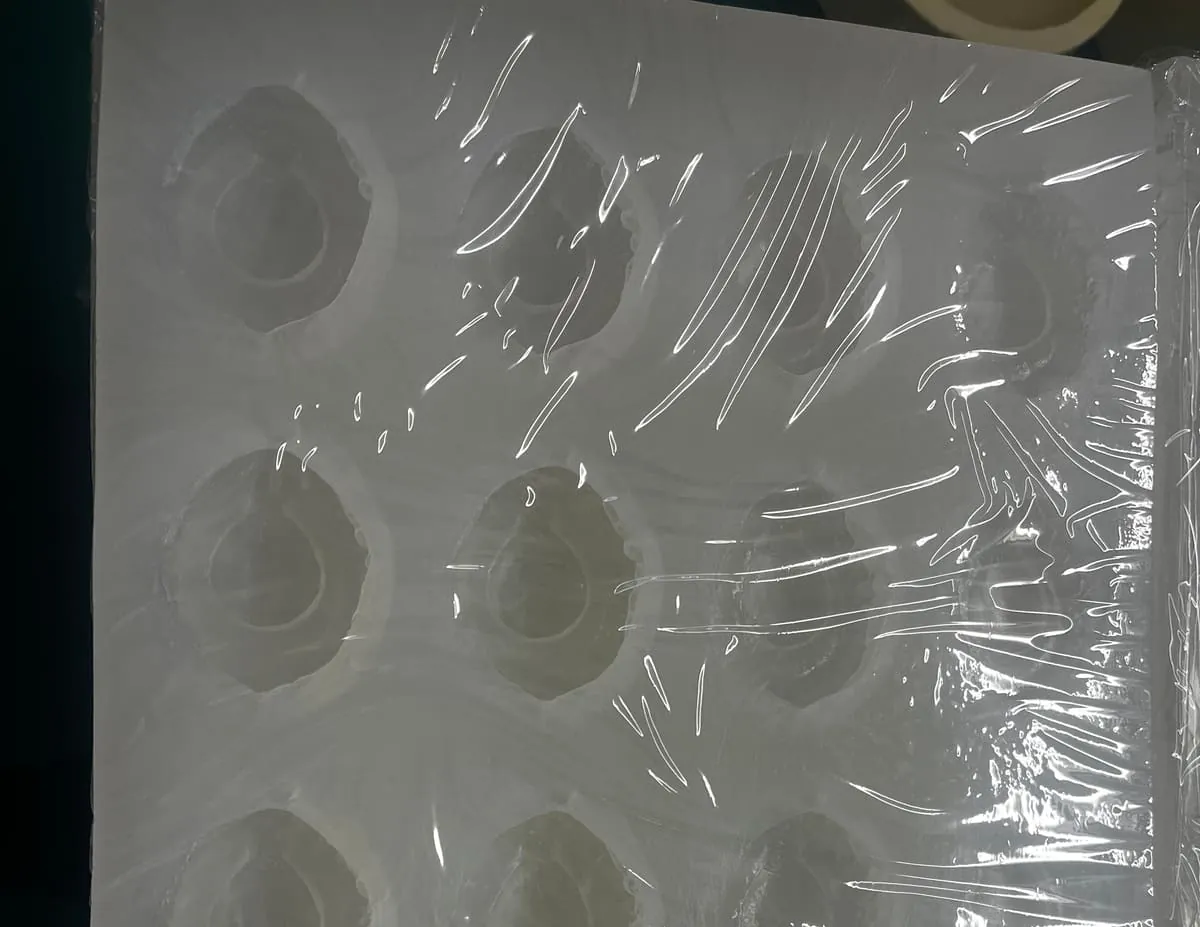
Complex food and industrial RTV loves grain, icons, and raised type. Platinum RTV will copy a fingerprint — and an SLA print’s voxels, and call them texture. A logo that is easy to mill in aluminum can tear a 10A–20A skin on peel. Steel LSR will chip a standing serif and call it wear; that is a different quote.
This is cavity-side design for RTV: finish the master, copy it, and decide raised vs recessed on the dump.
Raised vs recessed on the dump (the mapping people flip)
Decide on the dump, then translate.
| On the dump (chocolate, gummy, resin) | In the RTV mold / on the master | Fills? | Dies by? | | --- | --- | --- | --- | | Recessed logo / engraved look | Standing type on the master (male) | Usually easy | Torn serifs, nicked peaks in the skin | | Raised logo / embossed look | Female sink in the RTV | Can short or trap air | Rounded floors, muddy pits | | Recessed texture (pits) | Male peaks on the master | Easy fill | Strip drag, torn skin if no draft | | Raised texture (bumps) | Female pits in the RTV | Gas in pits, short on fine grain | Muddy grain as pits wear or fill with crud |
Texture draft is not optional because the rubber is soft. Light grain often wants about 3° on the master; medium grain 5°+. Smooth walls can live at 0.5–1°. Do not mix those on one face without a boundary.
If you ignore this: a leather grain at 0° on a 40 mm-deep pocket scores on every pull. You then “polish the texture off” the master and the dumps go glossy in patches.
Common mix-up: a PNG titled “emboss this”
A lot of RFQs treat a screenshot as CAM-ready art. In the shop that usually means someone traces a bitmap, guesses 0.2 mm, and parks it on the split. Send outlined vectors, depth, face, and raised-or-recessed. Then the pour can copy it.
ISO 3302-1 might class a logo *depth* on a rubber article drawing. It is a drawing class, not a promise the serif will fill.
Logos: depth, stroke, and draft on the master
Write numbers on the art, not “crisp.”
- Stroke width vs depth. A deep, skinny trench (raised on the dump = female in the RTV) does not pack, especially in high-viscosity dumps at the end of pour. A standing hairline (recessed on the dump) tears the skin.
- Sidewall draft on letters: 1–3° is a working band on the master; more if the letter is deep. 0° letters are jewelry, not production.
- Fillets at the floor and crest. True sharp is a wear spec. A 0.05–0.1 mm crest radius on standing type is often invisible in the dump and doubles mold life.
- Serifs and micro holes (e, a, 8). These are the first to fill with flash or to tear. Simplify the typeface, or go larger, or recast as a planned spare.
- Location vs pour. Fine female logos opposite a last-fill zone come out rounded. Put critical art near fill, or accept a flow study of the dump.
- Parting line through letters is how you get a step in the brand. Park the split on a border or outside the island.
RTV logos copy the master. Finish the master (full UV post-cure, wash, barrier coat). Do not expect a poured 10A mold to hold a 0.15 mm serif for a production year. Recut art on the master, or recast the skin, if the logo is the product.
Textures that lock the dump
Grain depth is extra undercut, thousands of times.
Rules that belong on the texture callout:
- Name a standard (a plaque ID, a sand grit, a leather sample). “Soft leather” is not a cavity.
- Add draft for that depth.
- Keep grain off shut-offs and seal lands unless you want a leak path or a crushed grain.
- Fade or border the grain so it does not run off a parting line and flash into a fuzzy edge.
- For grippy consumer dumps, a shallower grain you can actually strip beats a deep grain you tear and then polish away.
- In RTV, FDM or voxel noise is a texture whether you specified one or not. Sand or you own it.
Laser and chemical textures on steel are production methods for *part* tools. Etching an RTV mold with a kitchen acid is not. For RTV, texture the master (printed, engraved, or a textured sheet) and copy it.
What to ask when you're buying
- Raised or recessed on the dump, depth, which face?
- Outlined vectors, or are we redrawing a PNG?
- Off the parting and off the sealing lip?
- Master finish: CNC, sanded SLA, or voxel noise you will own?
- Recast path if the letters tear: same unsanded master?
Worked example: 0.4 mm recessed brand on an 8-cavity bar
A confectionery line wanted an 8-cavity bar, 120 × 60 × 12 mm, food-contact, about 500 pours a month, recessed brand 0.4 mm in the pocket, serifs drafted. The art went on a CNC (or fully post-cured SLA) master, platinum 10A–20A skin, mix 1:1, vacuum degas, jacket so the sheet would not sag 0.5–1.5 mm and smear the mark on the outer row. A PNG parked on the shut would have sheared. A parallel LSR engraving quote does not dump chocolate.
First-article coupon, not a philosophical grain
Pour a texture/logo coupon in the real RTV: the actual depth, draft, and hardness, stripped the way production will strip. Photograph it next to the plaque. Check fill at the serifs, drag marks parallel to pull, and whether the grain still reads after the planned dump (hot chocolate can muddy fine pits).
Pass that coupon before you texture twelve cavities. Recasting one skin is DFM. Recasting twelve because the screenshot lied is a second tool.
When this article is the wrong quote
If the mark is pad-print on a catalog tray whose pocket already matches, don't buy a custom master. If you need the logo on a vulcanized silicone *part*, open an HCR or LSR RFQ. A one-off resin figurine can take a shallow peel mark without production draft. Geometry can override quantity: a negative-draft letter at 80 pours still needs the split off the face.
Related reading: custom RTV molds, radii for longevity, DFM checklist, food-grade molds.
Artwork pack to copy onto the freeze
Copy this. A PNG without these lines isn't a mark.
- Process: platinum or tin RTV (art lives on the master)
- Outlined vectors; min feature width; depth
- Raised or recessed in the pocket; which face
- Texture standard + draft; keep-out on seals
- Off parting; recast against unsanded master if letters tear
- Food-contact path if the tray is sold as food-contact
Send the STEP, outlined logo, depth, and dump material. We will mark whether the serif will peel, whether it belongs on the master, or whether it's print.
We would not recommend parking the brand on the shut
We would not recommend a 0.1 mm hairline on a 10A–20A lip. We would not raise Shore A first to “hold the logo.” We would not treat an RTV peel as proof an HCR charge will fill the same serif. We would not sand the master to “clean up” letters you expect to recast. We would not skip the jacket and then blame grain for a smeared outer row.
RUUIPON Mold Structure Decision: art on the master, off the parting. Flat back? open-back. Negative-draft letter that will not peel? move the split or add a core. Soft 10A–20A or wet dump? mother mold so the mark does not smear when the sheet sags.
- Molded-in on RTV? - yes -> Vectors plus depth on the master
- Vectors plus depth on the master -> Peel without tearing 10A-20A?
- Peel without tearing 10A-20A? - no -> Widen serifs, fillet, or move split
- Peel without tearing 10A-20A? - yes -> Freeze face; keep unsanded master
- Molded-in on RTV? - pad-print -> Don't engrave the master
- Molded-in on RTV? - on an LSR or HCR part -> Stop: different part RFQ
Typical shop values
Reference values only. Confirm material-specific limits against the supplier’s technical data and agree project acceptance criteria before production.
| Item | Typical shop value | | --- | --- | | Mix | Platinum 1:1 or 10:1; vacuum degas | | Cavity Shore | 10A–20A skin with jacket | | Platinum shrink | About 0.1–0.3%; tin movement distorts fine marks in storage | | Loaded-tray edge sag without a jacket | About 0.5–1.5 mm — smears outer-row logos | | Min feature conversation | About 0.3 mm width; 0.4 mm recessed brand is a common food-mold start | | Light grain draft on the master | About 3°; medium grain 5°+ |
FAQ
Should a logo be raised or recessed on the dump? Decide on the dump, then translate. Recessed art is standing type on the master and tears the skin; raised art is a female sink that can short or trap air. RTV copies whatever you finished — including voxels.
Why extra draft on grain if RTV is soft? Texture depth is extra undercut, thousands of times. Light grain often wants about 3 degrees, medium grain more. Leather grain at zero draft on a deep pocket scores every pull until someone polishes the texture off the master.
Can the shop mill from a marketing PNG? No. Send vector art at 1:1 with outlined fonts, depth, draft, raised versus recessed on the dump, and a datum that exists on the master. Bitmaps, competitor photos, and wrapped displacements come back as simplified or as whatever was on the last job.
Will a poured 10A RTV mold hold a hairline serif for a production year? Do not count on it. RTV copies the master, including voxels if you printed one. Recut brand-critical art on the master, recast the skin, or finish the master and accept that a soft mold is a short-run copy.
Why pour a texture coupon before texturing twelve cavities? You need the real depth, draft, hardness, and strip path, photographed next to the plaque, including after a hot dump that can muddy fine pits. Recasting one skin is DFM. Recasting twelve because a screenshot lied is a second tool.
Custom silicone development · DFM & prototype support
CAD, drawing, photos or sample details