
Large RTV Trays: Fill Sag vs Storage Set
A tray that is flat on the bench and bananas after fill is a support problem. A tray that is already twisted on the shelf is storage set. If you are diagnosing a large RTV tool, this page is that split. Raising Shore on a 700 mm skin often raises peel force and still leaves the span soft.
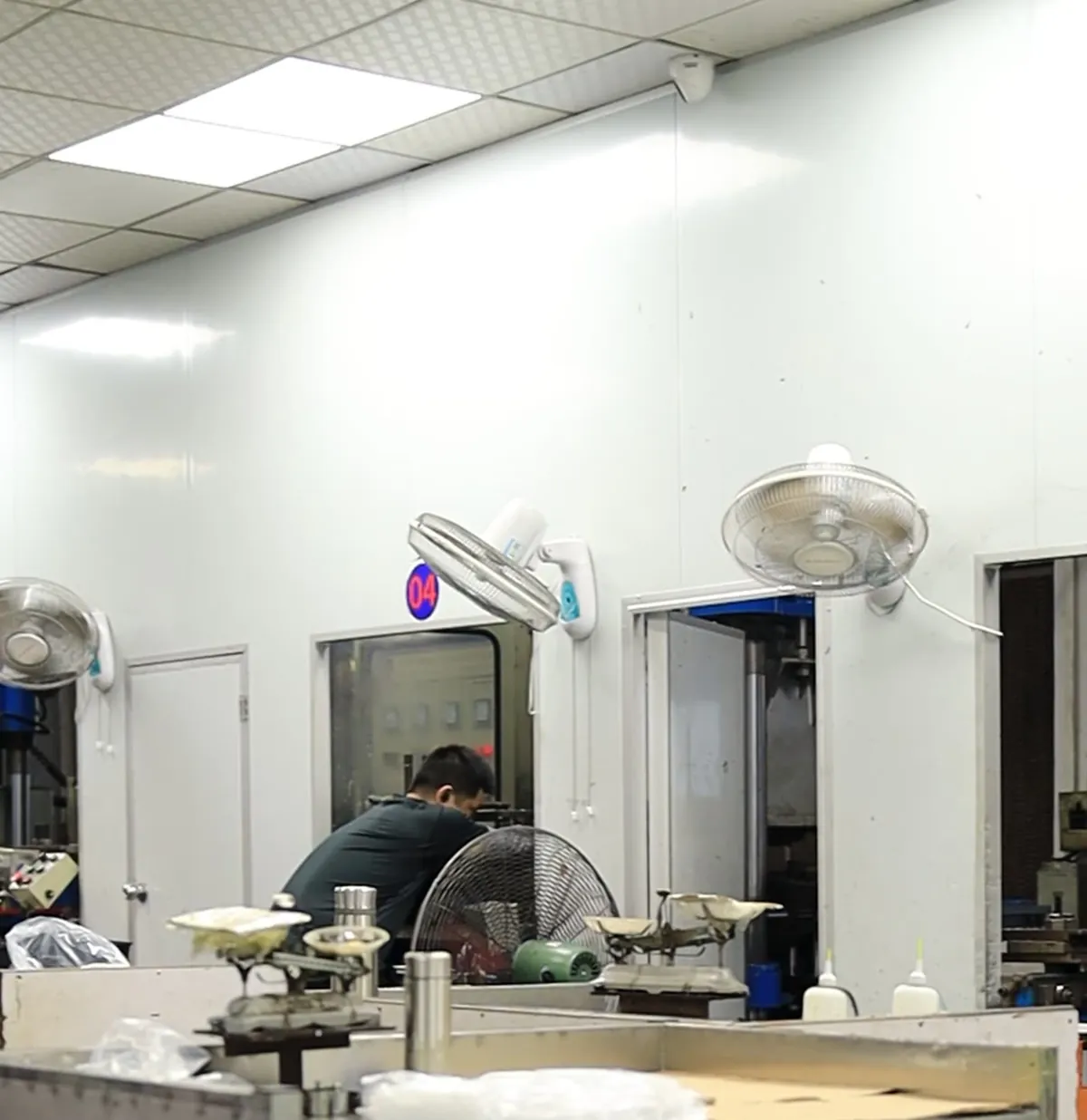
RUUIPON pours large platinum RTV skins in Bao'an, Shenzhen (Licheng Technology Industry Park, Xinhe Blvd, Shajing; USCC 91440300MA5FAXCN9W) since 2018. Simple 3D is USD 50 when that CAD scope applies. Prototype is 3-7 business days after CAD lock. Production is MOQ 20 pieces per design.
Where this page sits
First-tray numbers live on prototype inspection CTQ. Lot inspection lives on silicone mold quality control. Gummy count and loaded flatness live on gummy cavity count and flatness. This page covers why a large skin moves under fill or after storage.
Temporary sag under fill
Flexible rubber resists load through stiffness and geometry. As the mold gets larger, filled mass can sag the center, bulge a wall, tilt an edge, open a seam, or change cavity volume. That matters when the tray controls grams, planter wall, resin size, soap geometry, or a two-part close. Test the filled mold in the support you will actually use, not the empty tray on a bench.
Load path before Shore
Harder rubber can reduce sag and raise demold force. Before you change Shore, ask whether the tray is fully seated, whether a nest or FRP shell exists, and whether the unsupported span is simply too long. A carrier, mother mold, thicker border, real ribs, or a smaller format often beats a global Shore jump. Hold global shape outside the rubber. Keep local peel where you need it.
Typical shop values
Reference values only. Confirm material-specific limits against the supplier’s technical data and agree project acceptance criteria before production.
| Item | Typical shop value |
|---|---|
| First split | Empty-flat vs loaded-flat vs warped-on-the-shelf |
| Unsupported edge sag | About 0.5-1.5 mm on a large food tray is a common shop observation |
| Outer-row drift if the sheet sags | Often 3-6% heavy vs center on gummy / chocolate |
| Stack height | No universal rule - 250 mm gummy and 700 mm sculpture skins do not share one stack |
| 3D / CAD | USD 50 when that modeling scope applies |
| Prototype after CAD lock | 3-7 business days, on the real span |
| Production after written pass | MOQ 20 pieces per design |
| Contact | [email protected] · +86 135 3006 2969 |
Layout can create local sag
Inspect border width, minimum web, long unsupported strips, handle openings, and zones thinned by deep cavities. If one outer row drifts in grams while the center holds, look at support before you recut the master.
Storage set looks different
Permanent set shows after folding, stacking weight on cavity domes, hanging a heavy tray, storing a hot skin, or seating a 3D skin badly in its shell. A corner stays lifted. A twist will not relax. Openings are no longer coplanar. A two-part seam no longer closes. Ask: does it recover when left relaxed and supported? Store the geometry you want to keep. Flat trays flat and fully supported. Large skins in the mother mold. Do not fold across a cavity face.
Measure two states
Write the condition: relaxed on a plate, seated in a nest, in the mother mold, or filled to production mass. Production trays often need both relaxed (storage) and loaded (process). Do not apply uncontrolled heat to "reset" the rubber. If critical geometry is still off after a reasonable rest, replacement is safer than a heat trick.
When deformation means redesign
If every new mold sags in the same production condition, the structure is wrong. Redesign when the span is too large, the filled mass is too high, support is incomplete, or a soft skin needs a rigid shell. Copying the same skin repeats the failure.
Worked example: 600 mm gummy
Typical job, not a named PO. Buyer folded a 600 mm tray to save carton space. It arrived with a permanent twist. We refused a Shore bump as the fix, recast into a nest, and wrote flat storage on the job card. The empty-bench photo had looked fine.
When this page does not apply
This sag / storage page does not replace first-tray CTQ or lot QC. It does not apply to a small 12-up chocolate that already sits in a rigid nest. HCR compression products and molds stay on a RUUIPON HTV RFQ. High-volume LSR cold-runner part tools are a different RFQ - ask us.
RFQs we will not accept as-is
Raising Shore to skip a nest on a long span. Folding a large skin to cheapen freight without a recovery test. Approving only empty-flat. Sending an HCR / LSR part through this RTV sag page.
Matched next step
Send tray size, filled mass, how you store it, and whether the warp is empty or only after fill. We will say nest, shell, smaller format, or recast. "Large mold warped" is not enough.
Send span, load, and how you store it · Prototype CTQ · Gummy count / flatness · Quality control
[email protected] · +86 135 3006 2969 · Licheng Technology Industry Park, Xinhe Blvd, Shajing, Bao'an, Shenzhen. USCC 91440300MA5FAXCN9W.
FAQ
Is empty-flat enough? No. Loaded-flat is the production state.
Will heat reset a folded tray? Do not run uncontrolled heat. Rest it supported. Recast if CTQs stay off.
Is this the QC page? No. Lot inspection lives there.
Can two smaller trays beat one large one? Often, if one operator has to lift the filled sheet.
What is MOQ after a pass? 20 pieces per design.