
Registration Key Shapes on a Two-Part RTV Mold
Pretty keys that squash after ten cycles still flash the face. If you are locking key shape and placement on a two-part RTV, this page is that detail: round vs taper vs tongue, where they sit on the seam, and how they fail. Keys resist shear. They do not rescue a bad parting line.
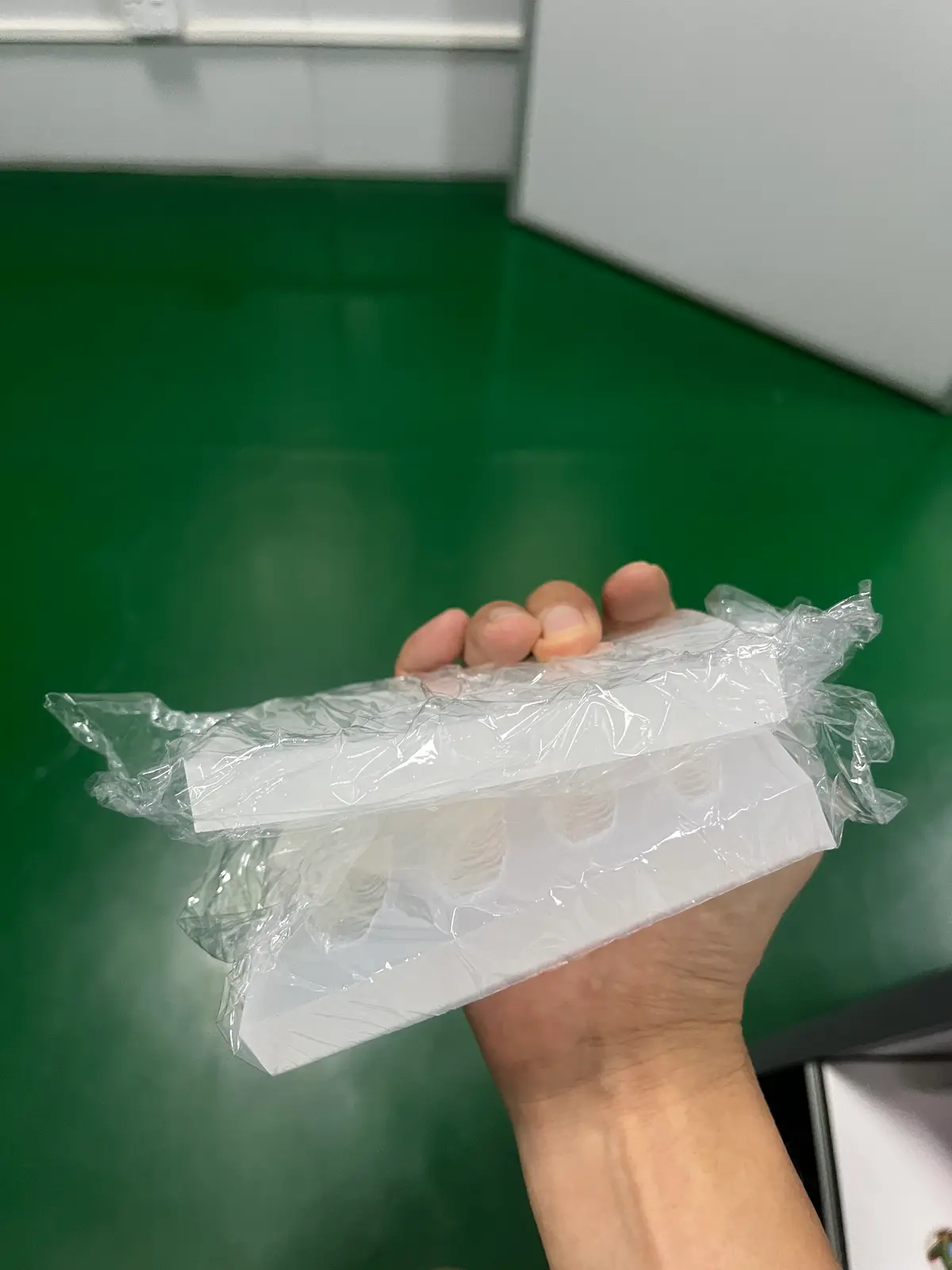
RUUIPON builds keyed two-part RTV in Bao'an, Shenzhen (Licheng Technology Industry Park, Xinhe Blvd, Shajing; USCC 91440300MA5FAXCN9W) since 2018. Simple 3D is USD 50 when that CAD scope applies. Prototype is 3-7 business days after CAD lock. Production is MOQ 20 pieces per design. HCR / LSR part tools are quoted here as HTV products or molds, or as a different LSR-tool RFQ - ask us.
Where this page sits
When a one-piece peel cannot leave, start at split silicone molds. Why keys exist and how they sit in the assembly lives on two-part RTV registration keys. Plug, core, and FRP as a system live on complex RTV structures. This page covers key geometry and failure mode.
Keys control shear
Design around the direction the halves try to slide under fill and close. A tall figurine may want longitudinal lock. A soft flange may stretch before it shears. On a large sculpture the rigid jacket often owns global location; silicone keys only hold the local seam. Decorative equal spacing is not a load plan.
Compare shapes by failure
Round / hemispherical: easy to seat. Small soft keys squash or wear under seam load.
Tapered / conical: self-center. Deep narrow tapers can wedge, stretch, or tear on open.
Tongue-and-groove: controls slide on a long seam. Dirt and a warped skin make it hard to close.
Rigid shell locators: useful when the jacket owns position. A stiff shell can force the skin wrong if skin-to-shell register is weak.
Typical shop values
Reference values only. Confirm material-specific limits against the supplier’s technical data and agree project acceptance criteria before production.
| Item | Typical shop value |
|---|---|
| Purpose | Resist the real slide / stretch at the seam |
| Placement | Long unsupported spans, high-pressure zones, direction changes - not equal pretty intervals |
| Too small | Wear, flatten, slip |
| Too large / deep | Hard assemble, thin root, tear on open, over-constrain a jacketed skin |
| Proof | Castings, not the empty mold - seam step at marked stations |
| Cavity Shore | Often 10A-30A on peel skins; jacket if the dump is wet |
| 3D / CAD | USD 50 when that modeling scope applies |
| Prototype after CAD lock | 3-7 business days |
| Production after written pass | MOQ 20 pieces per design |
| Contact | [email protected] · +86 135 3006 2969 |
Placement follows seam pressure
Review long unsupported seams, high casting pressure, sharp direction changes, plug interfaces, operator pull points, and where the shell is less stiff. Adding ten more keys will not fix a split that wants to slide.
Verify on the casting
Assemble, pour the real dump, inspect the seam at marked stations. If the step walks from pour to pour, the locate system is not repeatable even if the keys look machined. Separate key wear, parting damage, stretch, shell miss, debris, and weak close.
Worked example: handbag candle
Typical job, not a named PO. Soft hemispheres on a tall quilted bag walked after five wax fills. We moved to fewer, larger keys on the pressure edge, put global locate on the jacket, and kept the seam off the logo. The empty-mold photo had looked fine.
When this page does not apply
This shape page does not replace split molds, registration keys, or complex structures. It does not apply to an open-back chocolate bar that does not need a split. It does not apply to HCR / LSR part tools - send an HTV product RFQ here.
RFQs we will not accept as-is
Picking a decorative key pattern with no load direction. Adding keys to rescue a bad split. Approving keys from an empty-mold photo. Sending an HCR / LSR part-tool through this RTV key page.
Matched next step
Send STEP or photos, dump material, where a seam is forbidden, and whether a jacket is in play. We will name key shape and placement, or send you back to the split hub. "Add keys, 20 pcs" is not enough.
Send split, dump, and no-seam faces · Split molds · Registration keys · Complex structures
[email protected] · +86 135 3006 2969 · Licheng Technology Industry Park, Xinhe Blvd, Shajing, Bao'an, Shenzhen. USCC 91440300MA5FAXCN9W.
FAQ
Will more keys stop flash? Not if the split or support is wrong.
Is this the split-mold page? No. Structure first, then key shape.
Can we copy a catalog key? Only if the load matches. Most jobs do not.
Do you key LSR tools here? No. Parts: send an HTV product RFQ here.
What is MOQ after a pass? 20 pieces per design.