
3D-Print Masters for Food-Safe Chocolate RTV | RUUIPON
An SLA master is not a food-safe chocolate mold. Photopolymer can leach; the platinum RTV path is the article you document. Wash, UV, seal, then pour the
 Kyler Yang · Founder9 min read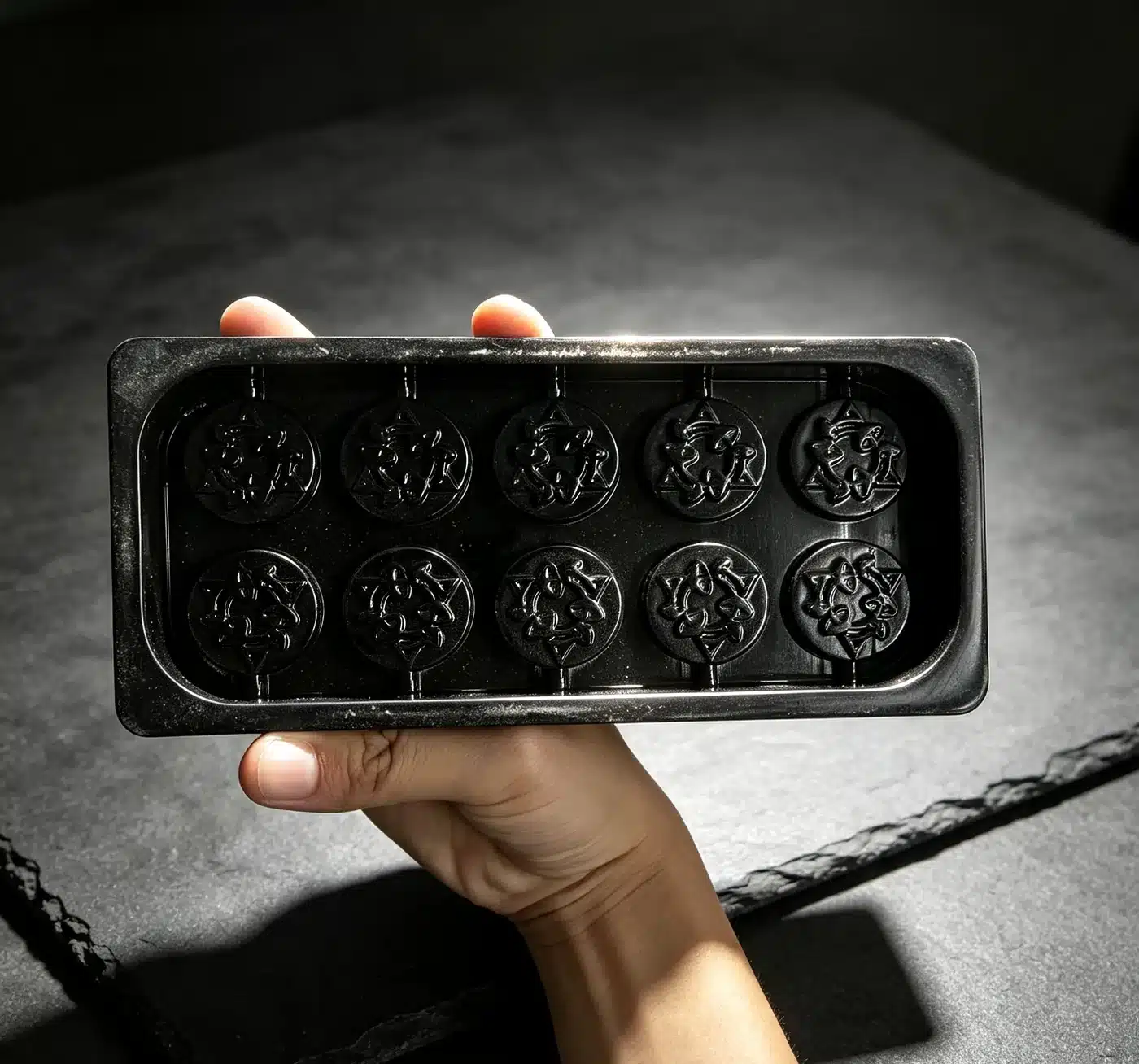
A 3D-printed master is not a food-safe chocolate mold. Photopolymer prints can leach, smell, and inhibit platinum. Chocolate belongs in a platinum RTV cavity that you wash, dry matte, and document as an article (21 CFR 177.2600 / LFGB if that is the market) — not in the SLA. At RUUIPON the print, once washed, UV post-cured, and sealed, is the pattern we pour against. The rubber is the tool. Bao'an since 2018. USD $50 when we still have to model. Prototype 3–7 business days after CAD lock. Production MOQ 20 pieces per design.
If you wanted a 3D-printed *silicone part* from steel/LSR, that is an HTV product RFQ here, or ask us for a high-volume LSR tool. If you wanted to pour couverture straight into an unsealed SLA "because the listing said food-safe resin," stop.
Does not apply when the master is already CNC metal, when the dump is resin craft (still seal the print; skip the chocolate-article story), or when you are shopping a rigid polycarbonate bar mold. This page is the food-contact *path* from a print to an RTV chocolate tool.
The print stays in the pattern room
Chocolate fat is a solvent for a lot of leftover photopolymer. A well that still smells like printer, that fogs a swab, or that was only "cured on the windowsill" is a leach risk into the first bars. We do not write 177.2600 against the print. We write it against the finished platinum article you actually dump into — after *your* wash SOP.
Symptom: first bars taste like resin, or the RTV face against the print is tacky while the jacket back is fine. Cause: leach from an unwashed print into chocolate (if someone dumped in the print), or inhibition into platinum (if we poured rubber on a raw SLA). Confirm: solvent swab on the print comes off colored or smelly; string test on the rubber face. Fix: never dump chocolate in the print. Finish wash → full UV including shadowed undercuts → seal → then our box, A/B, vacuum. Food skin that inhibited is scrap, not a post-cure.
Generic print-master mechanics (FDM stair-steps, nylon powder) live on the printed-master page. Here the extra constraint is food: the sealer's job is to keep photopolymer out of the platinum face so the *tool* can carry the document pack. A craft figurine can survive a slightly risky print. A chocolate well cannot.
What "food-safe chocolate mold" means on this path
Say it in the RFQ as three objects:
- Master — not food-contact. SLA/DLP or CNC. Scale checked (a 98% print stacks under platinum's about 0.1–0.3% shrink).
- RTV tool — platinum, dry face, no oil, Shore typically 20A–40A for bars.
- Article test — 177.2600 water and hexane extractives on the *mold* as used, and/or LFGB / BfR XV. Not a resin bottle that says "food safe." Not a factory FDA stamp. Not "100% silicone" as a sentence.
ISO 3302-1 M2 on the 2D is still a rubber class for the dump. It does not make the SLA "food-grade precision."
We would not pour tin-cure against a dirty print "because tin is more forgiving" and then call that a chocolate tool.
Chocolate-specific master prep (beyond a generic seal)
- Logo lands have to rinse. A 0.2 mm photopolymer serif that looks sharp on the printer will nick the RTV and trap cocoa butter. Lock millimetres.
- Layer lines copy into the bar. Sign that texture or pay for a finished master (sand/fill/seal, or we model for $50 when that CAD scope applies).
- Hollow prints trap wash solvent in a closed counter. Open a drain or we rebuild a solid master.
- Release on the master is a pattern-room chemical. It never migrates onto the chocolate SOP as "season the well."
RUUIPON Mold Structure Decision starts on the print's geometry, not after the first sticky bar:
- Flat-back bar → open-back tray.
- Hemisphere / cocoa-bomb shell that still peels → glove or open-back with a pull path.
- If the shell will not peel, or a two-sided logo, or a stick-in core → two-part / plug / core.
- Large wet dump (a block, not a bar) → mother mold.
Printing a one-piece undercut mascot does not force a one-piece food glove.
The photo that would prove a food-print failure: swab from the SLA next to a tacky RTV face, plus a bar that smells like resin. Not a glossy Amazon-style chocolate hero.
Typical shop values
Reference values only. Confirm material-specific limits against the supplier’s technical data and agree project acceptance criteria before production.
| Item | Typical shop value | Chocolate-print note |
|---|---|---|
| Master | washed, UV, sealed SLA or CNC | Raw print is not the mold |
| Rubber | platinum RTV | Tin is the wrong food start |
| Mix | 1:1 or 10:1 by weight, vacuum | Face bubbles copy print vents |
| Shrink | platinum about 0.1–0.3% | Stacks with a mis-scaled print |
| Bar Shore | often 20A–40A | Gloves 10A–20A if a shell peels |
| Prototype | 3–7 business days after CAD lock | Print prep is *before* lock if you supply the SLA |
| Production | MOQ 20 pieces per design | Recast from the sealed master, not a new random print |
| Simple 3D | USD $50 when that CAD scope applies | STL without shut/logo mm is this fee |
Worked example (anonymized)
Buyer sent a grey SLA of a 42 mm logo bar, "food-safe resin," wanted chocolate next week. Print still smelled; no wash log; windowsill UV. We declined to pour platinum on that master and declined chocolate-in-the-print as a bridge. $50 CAD to rebuild a moldable bar with 0.4 mm rinseable logo, draft on the closed counters, lock, our sealed master, platinum open-back tray in the 3–7 business day window. First couverture witness released without oil. MOQ 20 of that design. The original SLA stayed a display model in the pattern room. Tooling charge ≠ ownership of a food claim on the photopolymer.
One procurement mix-up
Buying a "food-safe 3D printer resin" and treating the print as the production chocolate mold. Even honest marketing on a resin bottle is not 177.2600 on *your* article, and it is not a platinum RTV tool. A second mix-up is emailing the STL and writing "3D printed master, start food RTV" with no shut, no logo depth, and no seal. We will not mix.
We would not recommend
We would not recommend pouring couverture into an SLA.
We would not recommend tin-cure chocolate tools to survive a raw print.
We would not recommend FDM layer lines as a "artisan chocolate texture" unless you signed that look on the lock.
We would not recommend reprinting a new master for every recast — keep the sealed one in archive.
- Dump chocolate in the print? - You asked yes -> We would not — leach / not the article
- Dump chocolate in the print? - No — print is master -> Washed, UV, sealed, scale 100%?
- Washed, UV, sealed, scale 100%? - No -> Finish print or $50 CAD rebuild
- Washed, UV, sealed, scale 100%? - Yes -> CAD lock includes logo mm + structure
- Finish print or $50 CAD rebuild -> CAD lock includes logo mm + structure
- CAD lock includes logo mm + structure -> 3-7 business days: box, platinum A/B, vacuum
- 3-7 business days: box, platinum A/B, vacuum -> Food tray: dry matte, no oil, MOQ 20
What to ask when you're buying
- Is the print a master, or did someone plan to dump chocolate in it?
- Resin name, wash, UV, sealer — written?
- Logo depth that rinses, not only photographs?
- Open-back bar vs shell/core — structure locked?
- 177.2600 / LFGB on the RTV article after your wash, not on the SLA bottle?
- After lock, 3–7 business days, then MOQ 20 per design?
RFQ copy-pack
[email protected] · +86 135 3006 2969 · Xinhe Blvd, Shajing, Bao'an
RUUIPON chocolate RTV from 3D master RFQ STL and/or photos of the actual print Resin name: Wash / UV / sealer done? yes / no Dump: tempered chocolate / compound (food only) Structure: open-back bar / shell / split — or we run Mold Structure Decision Logo land mm: Docs: 177.2600 / LFGB Qty: prototype / MOQ 20 per design CAD: $50 if we must model; then lock; then 3–7 business days Confirm: we will not treat the print as the food mold
Matched next step: send the resin name, a photo of the print's underside, and the logo millimetres. Do not send "can I pour chocolate in this SLA." We will quote a platinum tool. Prototype 3–7 business days after CAD lock. MOQ 20 per design.
Related: 3D-printed masters for RTV, why chocolate sticks to custom RTV, food-grade mold buyer spec, contact.
FAQ
Can I use a food-safe SLA resin as the chocolate mold itself? We would not. The print is the pattern. Photopolymer leftover is a leach and taste risk. Chocolate goes in platinum RTV you can document.
If the print is fully washed, can platinum still inhibit? Yes. Some photopolymers need a barrier even after UV. A tacky food face is scrap. More hours in the box will not save it.
Do you charge $50 if I already printed a pour-ready sealed master? No. $50 is when we still have to model. A raw STL or a smelly windowsill print is not pour-ready.
Will layer lines show on the bar? Yes, if you did not finish the master. Sign that texture at lock or pay for a finished pattern.
Who keeps the sealed master when I reorder chocolate trays? Write archive on the PO. Recast from that sealed master; do not reprint a new SLA each lot. Tooling charge ≠ unrestricted ownership — say who keeps the pattern.
Custom silicone development · DFM & prototype support
CAD, drawing, photos or sample details