
What a Custom RTV Casting Mold Buys You
Custom RTV molds pay off when a catalog tray cannot hold your pocket, logo, or recast plan. They are not automatically cheaper, faster, or a steel part.
 Kyler Yang · Founder7 min read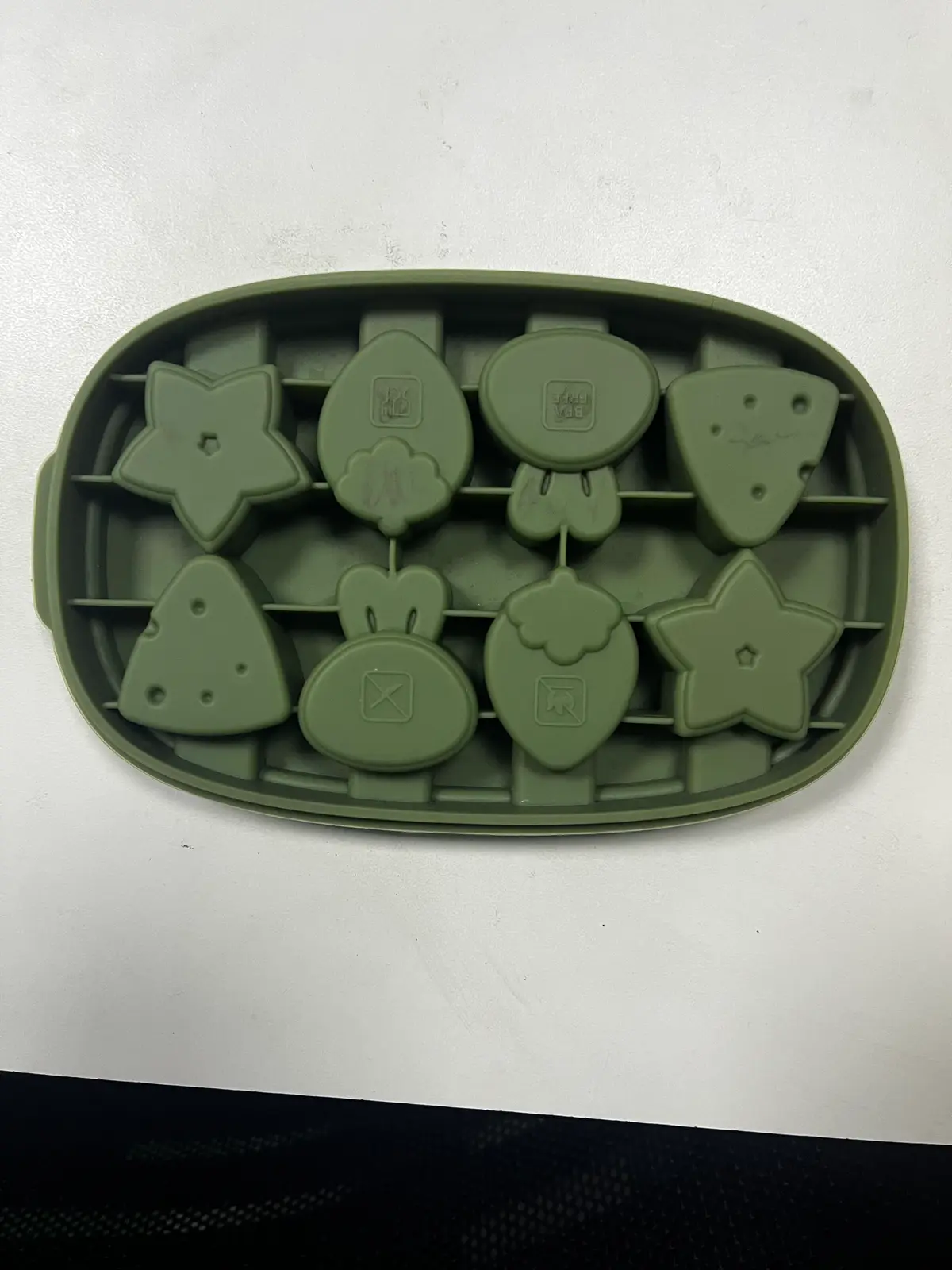
If you are deciding whether to pay for a custom RTV silicone mold, the payoff is a pocket a catalog tray cannot hold: your undercut, your logo depth, your cavity count, and a recast path against a living resin production mother you can still find. Custom is not automatically cheaper, faster, or "more precise," and it is not a steel LSR part tool. A stock ice sheet that already matches the cube is the correct buy. A mascot gummy, a registered chocolate bar, or a hollow sphere with a pull core is not.
On this site that custom tool is photos, sketch, or CAD, then a 3D-printed pattern, often a temporary silicone flip, a resin production mother, then batch RTV. The mother is not the pattern. The flip is not the product. Free DFM. CAD revision about USD 50 when we edit your 3D. Prototype usually 3-7 business days after CAD lock. Production MOQ 20 pieces per design. Bao'an since 2018. RUUIPON also quotes HTV/HCR compression mold tooling. On this site the path is photos, sketch, or CAD, then a 3D-printed pattern, often a temporary silicone flip, a resin production mother, then batch RTV. The mother is not the pattern. Free DFM. HTV/HCR compression mold tooling is also quoted on RUUIPON.
The benefits below are the ones you can inspect on a poured cavity. If a brochure lists "unlimited shapes" without naming platinum or tin RTV, a living mother, and a jacket / mother-mold support shell when the skin is soft, it is not describing a benefit that will show up in the first dump.
Geometry a catalog pocket cannot hold
A custom cavity exists so the article can have this undercut, this logo depth, this membrane, this cavity count, and this outer frame that still nests in your packing line. Catalog tools exist for rectangles, generic animals, and common bakeware. They do not exist for your registered two-sided logo or for a family of sizes that must share one dump nest.
Deep undercuts that must peel belong in platinum or tin RTV, often as a split, sometimes with an inner core. They do not belong as a zero-draft wish on a one-piece LSR steel cavity, which would be a different quote for a molded part. Print the catalog pocket over your CAD. If the pocket already matches, you are shopping color.
Compound, records, recast
Stock molds often ship with one mystery Shore A and a "food grade" sticker. Custom programs can specify platinum RTV for a named 21 CFR 177.2600 extraction path and/or LFGB sections 30/31, or tin RTV when the pattern is dirty and the mold is short-lived on purpose. Shore A still is not a material; the benefit is picking a grade family and a named standard, then keeping that file through sampling. We do not invent an FDA-approved factory badge.
The quiet OEM benefit is documentation: a witness-dump report, a compound lot COC, a shrink note, and a written clause for who archives the living mother and the support shell. Paying a tooling charge still does not, by itself, confer unrestricted transfer rights.
A replacement RTV skin is usually a recast against the same resin production mother, with the same shrink, provided the mother still exists and has not been sanded. That is a different economic object from a new steel LSR tool. Catalog copy that says CAD, then resin, then RTV - skipping the flip - treats the first hard copy as if it were already the production mother. We will not quote that shortened sentence as the shop path.
Common mix-up: custom means "always more accurate / always LSR"
A lot of RFQs treat the word custom as a precision upgrade or as a reason to climb toward LIM steel. In the shop that usually means you paid for a 24-pocket sheet while the mascot was still changing, or you asked an RTV jacket to prove LSR flash. Custom geometry can even shorten RTV life if the tear path is sharp at a logo root. Accuracy is mother finish plus a support shell that stays flat, not the adjective. If your email still says "master, box, keys, jacket" as the buy, you are listing shop furniture.
Typical shop values
Reference values only. Confirm material-specific limits against the supplier’s technical data and agree project acceptance criteria before production.
| Item | Typical shop value |
|---|---|
| What custom buys | A pocket a catalog tray cannot hold, plus a recast path against a living mother |
| Path | Photos / sketch / CAD, 3D-printed pattern, often a flip, resin production mother, batch RTV |
| Custom food or gummy cavity | 10A-20A platinum, jacket / mother-mold support shell behind it |
| Mix / shrink | Platinum 1:1 or 10:1; about 0.1-0.3% after full cure |
| Recast | New skin against the unsanded resin production mother |
| 50 mm hollow ice sphere, about 200 cycles/week | Two-piece platinum, inner core, rigid support shell |
| Loaded-tray edge sag if you skip the jacket | About 0.5-1.5 mm on a large unsupported sheet |
| DFM / CAD / proto / MOQ | Free DFM; USD 50 when we edit 3D; usually 3-7 days after CAD lock; 20 pcs/design |
Worked example: 50 mm ice sphere
A kitchen-goods buyer needed a 50 mm hollow ice sphere, two-piece, food-contact, about 200 freeze-and-peel cycles a week. Catalog trays were hemispheres without a registered equator or a pull path for a core. Free DFM named a two-part skin, an inner core with a planned extract, and a jacket / mother-mold support shell so the equator would not ovalize. After CAD lock: pattern, often a flip, resin production mother, batch RTV. A later color change of the rubber is a recast; a later diameter change is a new mother.
Stay on this page / skip this page
Stay when you are deciding whether custom RTV is earning its keep versus a catalog overlay.
Skip if the catalog pocket already overlays your CAD and you only need color. Skip if you actually need thousands of molded silicone parts - a different RFQ - ask us. Skip if the CAD will change after the first sales meeting - pay for a one-cavity prototype path, not a 24-pocket production sheet. An HTV/HCR compression mold stays on a RUUIPON RFQ.
We will not quote a 24-pocket production sheet while the mascot is still changing. We will not raise Shore A to "get more precision." We will not treat custom RTV as a stepping stone that secretly includes an LSR cold-runner. We will not pay custom for a catalog overlay.
Related: what custom RTV molds are, cost drivers, OEM vs custom ownership, gummy trays, contact.
What to send
| You have | Buy |
|---|---|
| Catalog pocket overlays CAD; you need color | Stock tray |
| Pocket, logo, or undercut is yours; you dump into a flexible cavity | Custom RTV (pattern / flip / resin mother / batch RTV) |
| You need the steel/compression tool for solid silicone | RUUIPON HTV/HCR mold RFQ |
| You need vulcanized silicone parts | RUUIPON / ask us |
| CAD still moving | One-cavity RTV prototype, not production cavity count |
Send the CAD overlay (or photos of the catalog tray next to your sample), monthly dumps, and whether food-contact is 21 CFR 177.2600 and/or LFGB sections 30/31. We will tell you if custom is earning its keep.
- Does catalog overlay CAD? - no, pocket is yours -> Custom RTV: pattern, often flip, resin mother, batch RTV
- Custom RTV: pattern, often flip, resin mother, batch RTV -> Need vulcanized silicone parts?
- Need vulcanized silicone parts? - yes -> an HTV product or mold RFQ here, or ask us if you need a high-volume LSR cold-runner tool: finished parts
- Need vulcanized silicone parts? - no, I need the compression tool -> RUUIPON HTV/HCR mold RFQ
- Need vulcanized silicone parts? - no, pour cavity -> Recast clause against living mother
FAQ
Do custom RTV molds last longer than stock trays? Not as a rule. Life depends on duty, chemistry, and whether a support shell holds the block. Custom geometry can even shorten life if the tear path is sharp at a logo root. Specify dumps and temperature. We do not sell a cycle warranty or a folklore pour count.
Is a custom mold more accurate than a catalog mold? It can be, if the resin production mother is finished to a drawing and the support shell stays flat. A sloppy custom pour is worse than a decent catalog cavity. Accuracy is mother plus process, not the word custom.
Can I get food-contact benefits only by going custom? No. Food-contact is a compound and a test path (21 CFR 177.2600 extraction and/or LFGB sections 30/31). Custom tooling lets you keep that compound on a cavity you own. It does not replace the tests.
When do the benefits of custom show up in the first lot? When geometry, logo, cavity count, or records cannot be bought as a tray. If the first lot is a color change of a standard pocket, you paid for custom without using it.
Does custom tooling let me skip draft, splits, and a jacket? No. Custom is not a physics waiver. You still pick a peel direction, a split if the mold needs one, and a jacket / mother-mold support shell if the rubber is soft enough to slump under the pour.
Custom silicone development · DFM & prototype support
CAD, drawing, photos or sample details