
Candle Wax vs Soap RTV Molds: Heat and Compatibility
Paraffin at pour heat is not lye soap. Match platinum RTV hardness to undercuts, then check heat and alkali. Name the compromise if one rubber serves both.
 Kyler Yang · Founder9 min read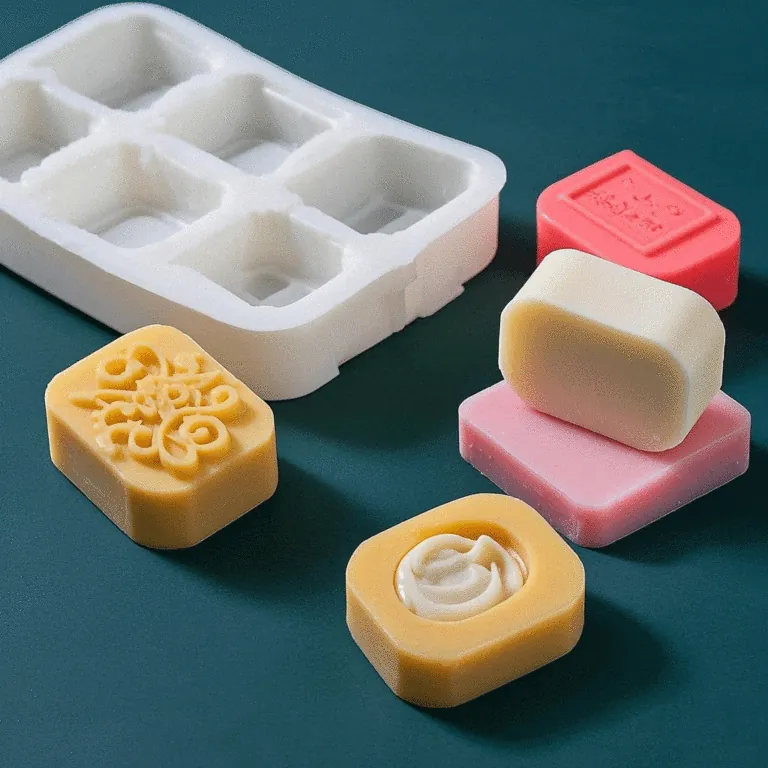
Paraffin at 70 °C is a different chemical attack than sodium hydroxide at 80 °C. One mold compound rarely serves both without a compromise you should name on the order. Candle work is heat, fragrance oil, and a clean peel. Soap work is alkali, heat, and sometimes a sticky gel phase. Treating them as “craft molds” hides those two chemistries.
Default to platinum RTV for both libraries. Tin-cure will copy a master cheaply and then shrink and embrittle on the shelf while your seasonal SKU sits six months. LSR steel tools appear when the volume justifies *parts*, not cavities; the chemistry notes below still apply to the rubber that touches the pour.
Heat thresholds that matter
Silicone as a family handles candle and soap heat. The mold still has a practical ceiling set by grade, thickness, and how long it stays hot.
Container and pillar candles. Typical pours sit from about 55 °C for some soy blends up through roughly 70–85 °C for paraffin and many blends. That is well inside most platinum RTV service ranges. The failures are local: a thin 10A wall in a tall pillar sags while the wax is liquid; a fast, hot pour into a cold, thick block can put enough thermal gradient to print a witness. Support soft molds with a shell. Do not “proof” a candle mold with a kitchen-oven bake at 200 °C unless that grade and geometry were meant for it.
Melt-and-pour soap. Usually poured cooler than hot-process. Heat is modest. Stickiness and fragrance are the nastier variables.
Hot-process and some lye-heavy procedures. The batter can sit hot and alkaline for a long time. That is the case that cooks a cheap tin mold and can swell or dull a poorly post-cured platinum tool. Ask for the peak batter temperature and hold time, not “soap.”
Wax melts in a warmer. The *product* sees a warmer. The *mold* only sees the pour. Do not spec the mold to the warmer temperature unless you are casting in the same cup.
If someone wants one silicone to be a baking pan at 220 °C *and* a candle mold, that is a food-contact plus high-heat article. It is not this spec. Split the SKUs.
Wax-side compatibility
Paraffin, soy, beeswax, and blends are mild for platinum silicone. Problems that get blamed on “incompatibility” are usually:
- Fragrance and essential oils. Some citrus and spice oils swell the surface or leave a tacky film. If a scent line sticks, run a plaque test in that oil at pour temperature before you cut a production block. Do not assume lavender behaves like cinnamon.
- Dye blocks and mica. Can stain. Stain is not always a failure; it is a color-management choice. A dedicated mold per dark dye is cheaper than a restoration ritual.
- Release. Wax usually peels from a glossy platinum cavity without spray. Powder or oil “for luck” contaminates the next pour and the wick. If a candle locks, the geometry is undercut or the pour was stripped too cold, not missing aerosol.
- Additives. Stearic acid, vybar, and similar modifiers change shrinkage of the candle, not the mold chemistry, in normal doses.
A high-gloss master-copied face gives a shiny candle. A texture gives a rustic face. Pick it in the master. Wax will not hide a fingerprint in the RTV.
Soap-side compatibility
Cold-process soap is a sodium hydroxide (or potassium hydroxide) system. Fully mixed batter is not a bottle of lye, but early contact is still alkaline. Platinum RTV is the usual choice because it does not keep emitting condensation byproducts into the bar.
Watch:
- Lye-heavy or super-hot traces. Can dull a surface over many batches. If the shop does lye-in-oil extreme recipes, test a coupon for a week of cycles, not one pretty loaf.
- Salt, sodium lactate, and sugar additives. These change the batter rheology and can increase abrasion on a soft mold as the soap hardens.
- Fragrance in soap. Same plaque test as candles. Some fragrance oils accelerate soap and also attack rubber.
- Gel phase. Heat that develops in the mold can exceed the pour temperature. A thick loaf in an insulated box is a thermal soak. Support the mold. A floppy 10A loaf mold becomes a banana.
Do not put a mold that just ran CP soap into a food or baby-product job. Alkali and fragrance residues are not a kitchen wash away from 21 CFR 177.2600.
Hardness is still a demold choice
Deep undercut tarts, swirled loaf ends, and filigree soap want a stretchy skin (often ~10–20A) in a rigid shell. Simple pillars, clamshell melts, and open-back bars want a firmer cavity (~20–30A) so walls do not belly when the pour is heavy.
That is the same physics as resin work, with a slower, cooler pour. Do not copy a baking-pan 50A thinking it will release a locked soap dragon. Do not copy a 10A glove for a 4 kg loaf without a crate.
A two-coupon test before you commit a master
Cast a 50 × 50 mm plaque in the candidate platinum grade. Pour 1: the actual wax at the actual temperature, with the actual fragrance load, five cycles. Pour 2: the actual soap batter, five cycles. Look for tack, swell (measure thickness), discoloration, and tear at a small undercut you cut into the plaque.
If wax passes and soap swells, you do not have a universal mold rubber. Buy two compounds or two post-cures, or tell the customer the soap line needs a dedicated tool.
Common mix-up: one “craft mold” for wax, lye, and cake
Split SKUs. A 220 °C baking pan is a food-contact article with a different test path.
What to ask when you're buying
- Wax, CP soap, hot-process, or both — peak temperature and hold time?
- Fragrance family, and a plaque test in that oil?
- Platinum vs tin (tin will shrink on a seasonal shelf)?
- Shore band and jacket for the pour mass?
- Who owns the master if the soap line needs a dedicated recast?
Worked example: 4 kg loaf vs clamshell melts
A 4 kg CP loaf, platinum 10A–20A skin, rigid crate, gel-phase heat above pour temperature. Sister SKU: open-back clamshell melts, 20A–30A, no heavy jacket. Same “soap mold” RFQ. The loaf without a crate is a banana. The melt tray with a 10A glove is a floppy waste of rubber.
When this article is the wrong quote
If you need a 220 °C baking pan, use the food-contact article path. If you need LIM *parts*, different OEM. A tiny one-piece tart can skip a mother mold. Geometry can override: a locked filigree dragon is still RTV, not a firmer Shore first.
Related reading: food-contact vs this library, architectural skins for mass, storage of seasonal tools, custom RTV molds.
Put peak temperature, fragrance type, and “wax / CP soap / both” on the RFQ
So the shop does not guess. Send those three lines plus pour mass and undercut photos. We will name platinum, Shore, and whether you need two cavities.
We would not recommend tin-cure for a seasonal SKU that must hold size
We would not recommend proofing a candle mold at 200 °C in a kitchen oven. We would not raise Shore A first to survive a 4 kg loaf — add the crate. We would not spray wax molds so candles release. We would not move a CP-soap mold into a food job after a kitchen wash.
RUUIPON Mold Structure Decision: flat clamshell? open-back. Deep filigree that cannot peel? two-part. Soft 10A–20A plus a heavy wet pour? mother mold.
- Media? - wax 55-85 C typical -> Platinum; plaque-test fragrance
- Media? - CP / lye batter -> Platinum; alkali + gel-phase heat
- Media? - both -> Name the compromise or two tools
- Platinum; plaque-test fragrance -> Undercut / mass?
- Platinum; alkali + gel-phase heat -> Undercut / mass?
- Undercut / mass? - locked filigree -> 10-20A skin + jacket
- Undercut / mass? - simple pillar / bar -> 20-30A so walls do not belly
Typical shop values
Reference values only. Confirm material-specific limits against the supplier’s technical data and agree project acceptance criteria before production.
| Item | Typical shop value | | --- | --- | | Chemistry | Platinum 1:1 or 10:1; vacuum degas; not tin for libraries | | Skin Shore | ~10–20A undercut tarts in a shell; ~20–30A simple pillars | | Wax pour band | About 55 °C soy to ~70–85 °C paraffin blends | | Platinum shrink | About 0.1–0.3% after full cure | | Plaque test | 50 × 50 mm, five cycles each media | | Loaded sag without jacket | About 0.5–1.5 mm on a large floppy loaf |
FAQ
Can one platinum RTV grade be both a candle mold and a lye-soap mold without saying so? Rarely without a named compromise. Paraffin at pour heat is a different attack than sodium hydroxide batter that stays hot. Default platinum for both libraries; tin copies cheaply then shrinks on the shelf. Split SKUs if someone also wants a 220 C baking pan.
Will ordinary candle pour temperatures cook platinum RTV? Typical soy-to-paraffin pours sit well inside most platinum service ranges. Failures are local: a thin 10A wall sagging while wax is liquid, or a thermal-gradient witness from a fast hot pour into a cold thick block. Support soft molds with a shell. Do not proof a candle mold with a 200 C kitchen bake unless that grade was meant for it.
Why do fragrance oils get blamed as wax "incompatibility"? Paraffin, soy, and beeswax are mild for platinum. Citrus and spice oils can swell or leave tack. Dye and mica stain. If a scent line sticks, plaque-test that oil at pour temperature; do not assume lavender behaves like cinnamon. Stearic and similar additives change candle shrink more than mold chemistry at normal doses.
Should I spray wax molds so candles release? Usually no. Glossy platinum peels without aerosol. Powder or oil contaminates the next pour and the wick. If a candle locks, the geometry is undercut or you stripped too cold. Do not move a CP-soap mold into a food job after a kitchen wash; alkali and fragrance are not 21 CFR 177.2600.
What two-coupon test prevents a universal-rubber mistake? A small plaque, five wax cycles at actual temperature and fragrance, five soap-batter cycles. Look for tack, swell, discoloration, and tear at a small undercut. If wax passes and soap swells, buy two compounds or tell the customer the soap line needs a dedicated tool.
Custom silicone development · DFM & prototype support
CAD, drawing, photos or sample details