
CBD Gummy Mold Manufacturing
CBD gummy mold work is tooling: cavity millilitres, dump, and food-contact RTV trays. Finished-gummy rules vary by market. No medical claims or dosing.
 Kyler Yang · Founder8 min read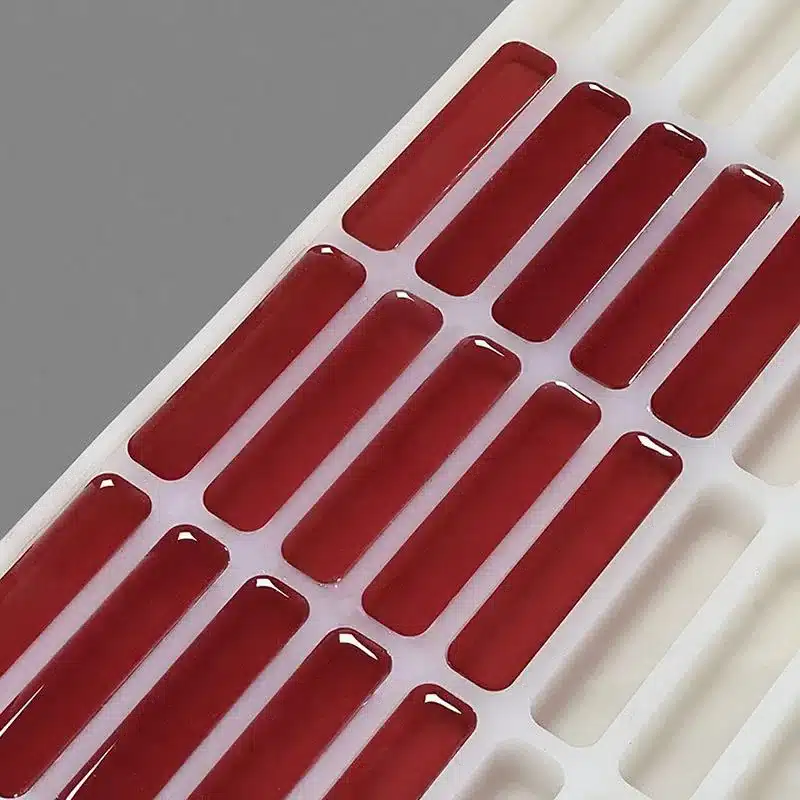
This article is tooling of the mold used to deposit a gummy-shaped piece. It does not cover cannabinoid oils, extraction, medical use, or how much of any ingredient belongs in a piece. Rules for cannabinoid-containing foods and ingestibles vary by market. What we ship is a food-contact RTV cavity tray - not a license, not an oil COA, not a label.

On that tray the path is photos, sketch, or CAD, then a 3D-printed pattern, often a temporary silicone flip, a resin production mother, then batch RTV. The resin production mother is the hard production tool. It is not the pattern. Free DFM. CAD revision about USD 50 when we edit cavity millilitres. Prototype usually 3-7 business days after CAD lock. Production MOQ 20 pieces per design. Bao'an since 2018. Food-contact on the tray is still 21 CFR 177.2600 extractives and/or LFGB sections 30/31 on the finished rubber article after post-cure. Chemistry is platinum addition-cure RTV. Tin-cure is out. Piece-weight is cavity volume plus slurry density - a mechanical fact, not a dosing instruction. We do not invent an FDA-approved factory badge or a "CBD-grade" rubber.
Finished gummy cartons, depositor/mogul lines, and vulcanized silicone parts are an HTV product RFQ here. An HTV/HCR compression mold RFQ stays on RUUIPON. Do not send the mold-tool PO as an HTV product RFQ here, or ask us for a high-volume LSR tool.
Scope: the mold, not the filling
Split the RFQ. In scope: cavity CAD, volume in millilitres, array layout that a platinum skin and a jacket / mother-mold support shell can hold, dump method, wash, platinum food-contact, living mother, first article, recast. Out of scope for the mold shop: milligrams of any cannabinoid, serving size, medical or wellness claims, import permits, hemp vs cannabis definitions, THC thresholds, novel-food status, and stability of an oil in gelatin.
If you need a cavity that fills to 2.5 g at a measured slurry density, that is tooling. If you need "25 mg per bear," that is formulation - we will not quote it as dosing advice.
Manufacturing is the same family as other gummy trays. Oil in the slurry may change viscosity and dump stickiness. Treat that as a process note (higher oil, stickier dump, prove on a one-up), not as a reason to advertise a special CBD compound. There is not a "CBD-grade silicone." An LSR cold-runner quote is a molded part tool.
Fill and dump on an oil-bearing slurry
Lines still deposit, set, and dump. Oil-rich slurries can be more viscous or more lubricating; either can starve ears or smear logos. Prove fill on plant slurry or a viscosity-matched stand-in you accept as mechanical only. Flex dump and polish still beat mystery release. Pitch drawings for a Baker Perkins-class line belong an HTV product or mold RFQ here, or a different LSR-tool RFQ - ask us. Starch may be rejected for the same hygiene reasons vitamin rooms reject it - that is a hall decision, not a cannabinoid endorsement.
Do not ask us for cycle times, dump-count warranties, or lab "CBD resistance" numbers. If the slurry attacks the rubber, that is a plant trial on the actual mix. Kitchen RTV repairs on jackets are still forbidden.
Common mix-up: 177.2600 as approval of the food
A lot of RFQs treat a passed rubber flask as "FDA approved CBD molds." In the shop that usually means you mixed extractives on a repeated-use rubber article with legality of a cannabinoid food. 21 CFR 177.2600 is US extractives on the tray. The tray can pass and the food can still be restricted where you sell. We will not put health claims on a cavity drawing, print milligrams into CAD, or certify "compliant CBD molds."
ISO 10993 and USP Class VI do not replace those flasks. A gummy mold is not a medical device because the listing title contains "CBD." If a market later forbids the food, the trays can still dump pectin candy or a vitamin SKU of the same volume - if you did not engrave a restricted slogan into the cavity.
Typical shop values
Reference values only. Confirm material-specific limits against the supplier’s technical data and agree project acceptance criteria before production.
| Item | Typical shop value |
|---|---|
| Path | Photos / sketch / CAD, 3D-printed pattern, often a flip, resin production mother, batch RTV |
| Rubber | Platinum food-contact RTV; tin out |
| Cavity Shore | Often 10A-20A skin plus jacket / mother-mold support shell; example array at 25A in aluminum when named |
| Example array | 4 x 8 tray, 32 cavities at 2.5 ml - millilitres, not milligrams |
| Food-contact path | 21 CFR 177.2600 extractives and/or LFGB sections 30/31 on the tray |
| DFM / CAD / proto / MOQ | Free DFM; USD 50 when we edit 3D; usually 3-7 days after CAD lock; 20 pcs/design |
Worked example: tooling only
A tooling-only job: 4 x 8 platinum RTV tray, 32 cavities at 2.5 ml, Shore 25A in an aluminum jacket / mother-mold support shell. Free DFM. After CAD lock: pattern, often a flip, resin production mother, one-up first on the plant's oily pectin, then the array. No milligram callout appears on the mother or the PO. Production at MOQ 20 of that design after the weigh-sheet.
Stay on this page / skip this page
Stay when you need a food-contact RTV cavity for a gummy-shaped dump and you will keep milligrams of any active off the drawing.
Skip if you need legal advice on whether a cannabinoid food may be sold, a milligram dose, an oil COA, medical claims, or import permits - we will not quote that work. Skip depositor/mogul / finished-gummy cartons - a different RFQ - ask us. Skip molded silicone parts - a different RFQ - ask us.
We will not quote milligrams of an active on the resin production mother. We will not stamp "FDA approved CBD molds." We will not treat a passed 177.2600 flask as legality of the food. We will not invent a CBD-grade silicone.
Related: vitamin trays (same cavity logic, no actives), material selection, food-contact RTV, contact.
What to send (no dosing fields)
- Cavity millilitres or target grams at a measured slurry density - not mg of cannabinoid
- Sheet size and dump method (hand / flood-scrape / table). Nozzle pitch drawings are an HTV product RFQ here, or a different LSR-tool RFQ - ask us
- Gelatin vs pectin; oil load as a processing remark only
- Shore band; jacket / mother-mold support shell; 177.2600 and/or LFGB sections 30/31 on the tray
- One-up on the oily slurry before the production array
- Who archives the living mother; geometry another same-volume SKU could reuse
Send that pack to [email protected] or contact. WhatsApp +86 135 3006 2969.
- Pattern, often flip, resin mother, one-up on oily slurry -> Batch RTV array, no mg callout
FAQ
Do you make CBD gummies? No. We make the RTV cavity. The food, the oil, and the label are yours and your counsel's.
Is there a CBD-grade silicone? No. Food-contact platinum RTV is the grade. Oil load is a process note for dump, not a compound SKU.
Does a passed 177.2600 flask mean the gummy is legal? No. That flask is extractives on the tray. Rules for the finished gummy vary by market.
Can I put 25 mg in the CAD filename? We will not quote that as a cavity dimension. Send millilitres or grams at a measured density.
What is MOQ and the prototype clock? MOQ 20 pieces per design after approval. Prototype usually 3-7 business days after CAD lock. DFM is free. CAD revision about USD 50 when we edit your 3D.
Custom silicone development · DFM & prototype support
CAD, drawing, photos or sample details