
Logo Depth, Wash-Out and Serifs on Molds | RUUIPON
Logo depth, serif width, and wash cycles decide whether a brand stays in an RTV cavity. How we lock mm, what we would not cut, and the RFQ pack for a
 Kyler Yang · Founder9 min read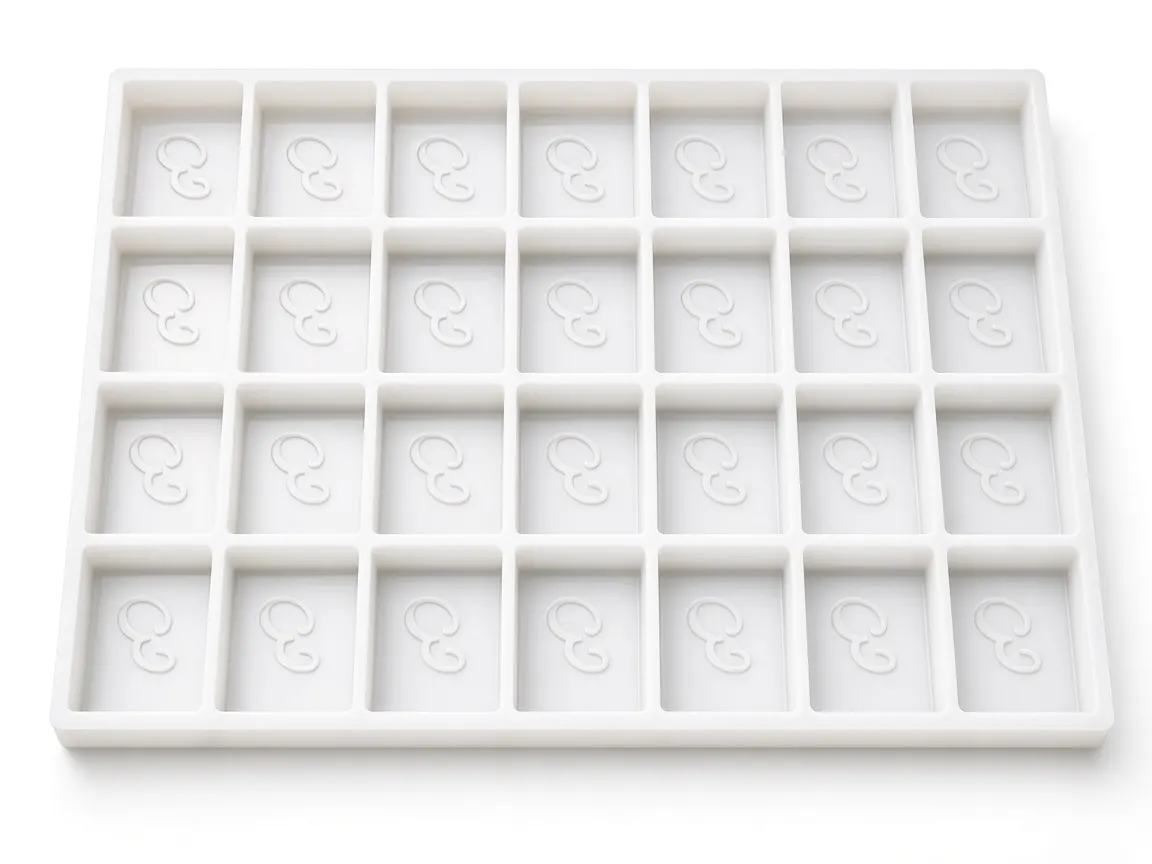
A custom logo in an RTV silicone mold lives on the master as a stated depth, a stroke the dump can fill, and a serif the rubber can peel. Wash-out is the second failure: a hairline that looked sharp on day one rounds off after detergent, a dishwasher cycle, or a resin scrape. At RUUIPON we lock the art in CAD — outlined vectors, raised or recessed on the finished dump, off the parting — then pour a platinum cavity. Prototype is 3–7 business days after that CAD lock. Production is MOQ 20 pieces per design. Simple 3D is USD $50 when we still have to model the mark. Bao'an shop since 2018.
This page is the DFM conversation for a brand in chocolate, gummy, ice, soap, or resin. Pad-print on a carton is a different tool. A logo on a vulcanized silicone *part* is a different RFQ - ask us steel/LSR RFQ, not an RTV cavity.
Does not apply when the mark is ink, when you are buying a stock tray and hoping a sticker reads as embossed, or when the "logo" is a 12-pixel PNG of a competitor bar. We will not guess millimetres from that file.
Where wash-out starts (and it is not always the rubber)
Most logo complaints arrive as "the brand washed off." Three different things get called that.
The dump never filled the serif. High-pectin gel and thick CP soap starve a 0.15 mm hairline. You see a broken letter on first demold. The cavity is still sharp. This is a fill problem, not wash-out.
The cavity lip tore. A closed "A" counter or a "V" that undercuts will rip a Shore 10A–20A glove on peel. The letter looks chewed after a few dozen cycles. Structure is the lever (shallower mark, more draft, or a split off that face), not a harder Shore guessed in chat.
Detergent film and abrasion. A commercial dishwasher plus a micro-texture master will round a shallow brand faster than a hand-wash spec. Recessed marks in chocolate hide some of that wear; raised marks on ice take the scrape. If you need the brand to survive a pit washer, say so before we freeze depth.
Food-contact dumps (chocolate, gummy, ice, baking) can use platinum with a 21 CFR 177.2600 extraction path on the finished article — not an FDA-approved factory stamp. LFGB / BfR is a separate pack. Soap, candle, and resin do not inherit that path. Product pour pages if you already know the dump: chocolate, gummy.
Serifs, counters, and a depth we will actually cut
Hairlines that look expensive in Illustrator become trenches the dump will not enter. We start the conversation around 0.3–0.6 mm of relief on a 15–30 g food piece, with serif width in the same band, and a few degrees of draft so the mark strips. That is a typical shop starting band, not a promise every font survives. Legal marks (®, ™) need enough width to fill or we drop them to a print note.
Closed counters (B, A, 8) need a land the rubber can peel. If the land is a knife edge, the first flex tears it. Fillet the root. Keep the mark off the parting land or the shut shears the letters and you will call it wash-out.
RUUIPON Mold Structure Decision on a logo face: if the back is flat and the mark is shallow, open-back is enough. If a letter has negative draft that will not peel, we do not "just pour softer." We move that face to a split, a plug, or we shallow the art. Large wet resin with a tall stand-up brand still wants a jacket so the skin does not balloon and smear the mark.
A matte master and a glossy master do not produce the same branded chocolate. Freeze finish with the art. If you only have a photo of a competitor bar, that is the $50 CAD scope — we model, you sign millimetres, then we cut. Design help: mold design service.
Typical shop values
Reference values only. Confirm material-specific limits against the supplier’s technical data and agree project acceptance criteria before production.
| Item | Typical shop value | Why logos fail without it |
|---|---|---|
| Rubber | Platinum RTV on food cavities | Tin leftovers taste; we would not spec tin for a food logo well |
| Mix | 1:1 or 10:1 by weight, vacuum degas | Face bubbles become broken serifs |
| Shrink (platinum RTV) | about 0.1–0.3% | Compensated on the master so the brand still reads |
| Logo relief (start) | 0.3–0.6 mm on a 15–30 g piece | Deeper serifs need draft, not a harder Shore |
| Cavity Shore | 20A–40A food trays; 10A–20A gloves | Too soft on a deep mark tears the dump |
| Wash spec | Hand-wash unless the RFQ says dishwasher | Film + abrasion is a depth decision |
| Prototype | 3–7 business days after CAD lock | First dump is the real logo test |
| Production MOQ | 20 pieces per design | One branded tray is a paid sample |
| Simple 3D | USD $50 when that CAD scope applies | PNG is not a cutting file |
Common mix-up: a PNG with no millimetres
Buyers send a logo pack that would be perfect for a carton and ask us to "just add it." In the shop that means we would have to invent depth, raised-or-recessed, and whether the mark sits in the pocket or on a rim. First article then becomes a pride argument. Outline the fonts, state depth, state raised or recessed on the *dump*, and place it on the 3D. Bitmaps become a trace you will hate. If the art cannot survive a 0.3 mm feature conversation, it is print, not mold.
Worked example (anonymized)
A 12-cavity 15 g logo bar. Art came in as a serif wordmark with 0.8 mm intended relief and hairlines under 0.2 mm. First CAD review stopped the pour. We rebuilt the mark at 0.4 mm with opened counters and a touch of draft — $50 CAD because the STEP had the bar but not a moldable brand. Prototype in the 3–7 business day window after lock. First tempered pour filled. After a dishwasher trial the same hairlines would have rounded; the RFQ was switched to hand-wash and the recast was not needed. We would not have cut the 0.8 mm serif and hoped Shore 40A would save it.
- Outlined vectors + depth mm? - No -> $50 CAD / scale lock
- Outlined vectors + depth mm? - Yes -> Serifs fill and peel?
- Serifs fill and peel? - No -> Open counters, add draft, or split that face
- Serifs fill and peel? - Yes -> Dishwasher or hand-wash?
- Dishwasher or hand-wash? - Dishwasher -> Deeper recessed mark or accept wear
- Dishwasher or hand-wash? - Hand-wash -> Freeze 0.3–0.6 mm band on small food pieces
- $50 CAD / scale lock -> Outlined vectors + depth mm?
- Open counters, add draft, or split that face -> Freeze 0.3–0.6 mm band on small food pieces
- Deeper recessed mark or accept wear -> CAD lock → 3–7 business days → MOQ 20
- Freeze 0.3–0.6 mm band on small food pieces -> CAD lock → 3–7 business days → MOQ 20
We would not recommend
We would not recommend greasing a food-contact logo well so the brand "releases." You will fight streaks and a documentation problem.
We would not recommend parking a stand-up brand on a stretchy undercut of a 10A glove. Move the mark or split the mold.
We would not recommend quoting an LSR steel engraving as a RUUIPON logo mold. If the logo sits on a molded silicone *part*, that RFQ an HTV product RFQ here.
We would not recommend sanding the master "to clean the letters" after you approved them. Recast the skin. Keep the unsanded master.
What to ask when you're buying
- Raised or recessed on the finished dump, and depth in millimetres?
- Minimum stroke and how closed counters will peel?
- Hand-wash or commercial dishwasher — have you said it on the PO?
- Platinum food-contact path with 177.2600 / LFGB, or craft-only resin?
- Who archives the unsanded master after you pay tooling? (Charge ≠ unrestricted ownership.)
Logo RFQ copy-pack
Send to [email protected]:
- Outlined vectors (AI, SVG, DXF) plus placement on the 3D
- Depth in mm; raised or recessed on the dump
- Dump material and whether the tray will see a dishwasher
- Destination market if food docs must ship
- Prototype after CAD lock, then MOQ 20 of that design
- $50 CAD if the art still needs modeling
Matched next step: send the outlined file and the depth, not a blank "custom logo quote." We will lock mm or tell you the font will not fill. Phone +86 135 3006 2969. Photos-only path: from photos. RFQ desk: contact.
FAQ
Will my logo wash off a silicone mold? If the serif never filled, it was never there. If a shallow hairline rounds after a pit washer, that is abrasion plus a depth we should have frozen on the RFQ. Recessed food marks hide wear better than a proud ice brand.
How deep should a chocolate logo be? We often start 0.3–0.6 mm on a small bar and talk draft on anything deeper. A 0.8 mm serif without draft tears couverture more often than it reads as "premium."
Can you cut a logo from a phone photo? We can model it. $50 CAD applies when that scope is real. You still sign millimetres before rubber. Production is MOQ 20 per design.
Does a harder Shore keep serifs from tearing? Usually no. Tear at a closed counter is geometry. We recast shallower or we split. Harder Shore is a last lever, not the first email.
Is pad-print the same as a molded-in logo? No. Ink sits on the piece or the carton. A molded-in brand is cut on the master. Mixing "molded look, print if hard" is how you pay for both.
Custom silicone development · DFM & prototype support
CAD, drawing, photos or sample details