
Custom Silicone Gummy Molds: The Complete Buyer's Guide for Commercial Producers
1. Why Choose Custom Gummy Molds? 2. Platinum Silicone vs. Tin-Cured: The Material Difference 3. Understanding Durometer: 10A, 20A, 25A, and Beyond 4. One-
 Kyler Yang · Founder17 min read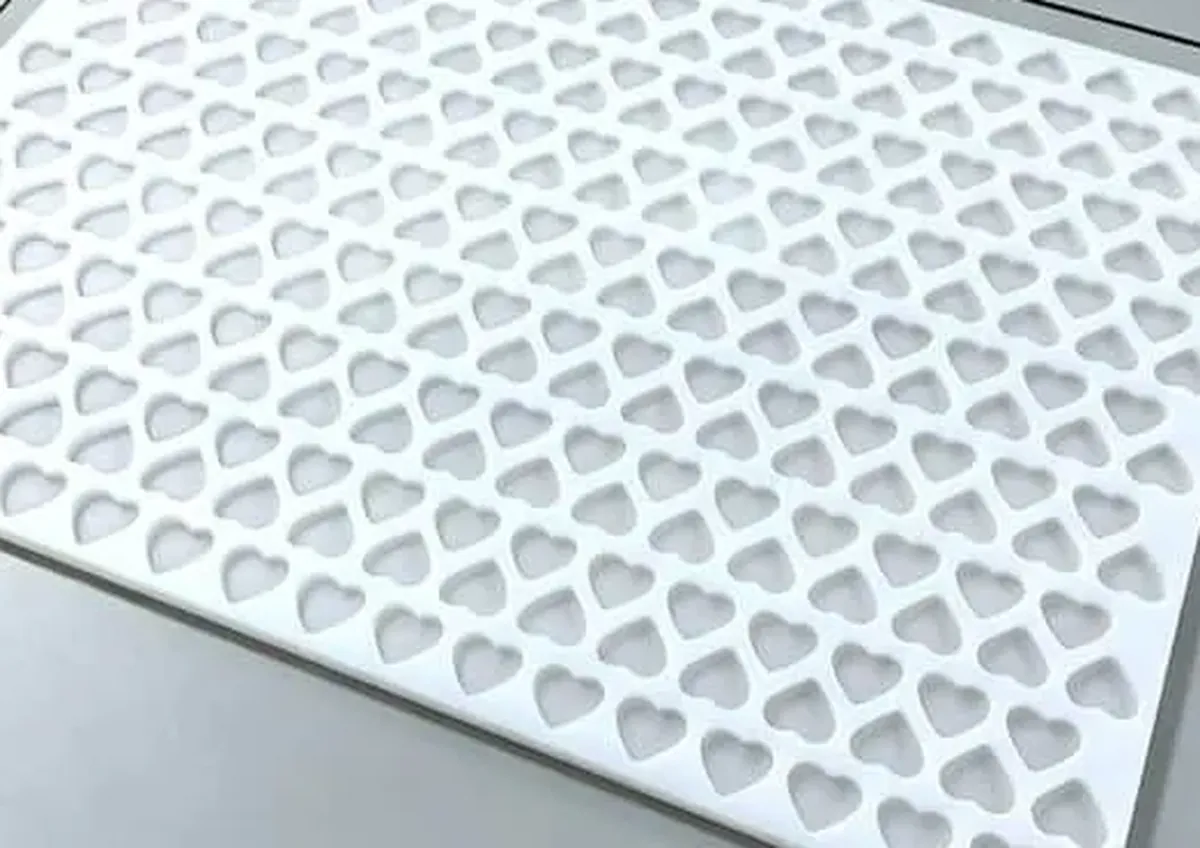
Table of Contents
1. Why Choose Custom Gummy Molds? 2. Platinum Silicone vs. Tin-Cured: The Material Difference 3. Understanding Durometer: 10A, 20A, 25A, and Beyond 4. One-Piece vs. Two-Piece Gummy Molds: Which Is Right for You? 5. Multi-Cavity Layout Optimization for Maximum Output 6. Flood and Scrape Compatibility: Designing for Auto-Depositors 7. State Regulatory Symbols: Precision Requirements for CBD and Edibles 8. From Concept to Production: The Custom Mold Process 9. Common Mistakes to Avoid When Ordering Gummy Molds 10. FAQ: Everything You Need to Know About Custom Gummy Molds
Why Choose Custom Gummy Molds?
If you're producing gummies at commercial scale, off-the-shelf molds rarely meet your specific needs. Custom silicone gummy molds are engineered to match your exact product dimensions, production volume, and equipment compatibility requirements.
Unlike generic molds that force you to compromise on cavity count, shape, or material, custom molds are designed from the ground up for your operation. This means:
- Precise dosing accuracy — Every cavity delivers consistent weight within a job-specific weight band after DFM tolerance
- Equipment compatibility — Molds are sized and shaped to fit your depositor, chiller, and packaging line
- Brand differentiation — Unique shapes, logos, and designs that set your product apart
- Production efficiency — Optimized cavity layouts that maximize output per pour
For cannabis edible manufacturers, nutraceutical companies, and confectionery brands, custom gummy molds aren't just a manufacturing tool — they're a competitive advantage.
Platinum Silicone vs. Tin-Cured: The Material Difference
The single most important decision when ordering custom gummy molds is the silicone material. Platinum-cured silicone is the gold standard for commercial food production, and here's why it matters.
The Chemistry Behind the Difference
Silicone rubber is created through a cross-linking reaction between polymer chains and a catalyst. The type of catalyst determines the cure mechanism:
Platinum-Cured (Type IV) Silicone:
- Uses a platinum catalyst to initiate addition reaction
- No volatile byproducts released during curing
- Near-zero shrinkage (<0.1%)
- Dimensional stability maintained over thousands of cycles
Tin-Cured (Type II) Silicone:
- Uses a tin catalyst that initiates condensation reaction
- Releases alcohol or water vapor during curing
- Higher shrinkage (0.3-0.8%)
- Progressive dimensional drift over time
Why This Matters for Gummy Production
For commercial gummy manufacturers, material choice directly impacts:
| Factor | Platinum-Cured | Tin-Cured |
|---|---|---|
| Weight consistency | a job-specific weight band after DFM across all cavities | Variable, drifts over time |
| FDA compliance | Inherently compliant per 21 CFR 177.2600 | Requires batch verification |
| BPA-free status | Confirmed | Must verify formulation |
| Mold lifespan | 2,000-5,000+ cycles | 500-1,500 cycles |
| Cost per unit | Higher upfront | Lower upfront |
| Total cost of ownership | Lower | Higher (due to frequent replacement) |
The initial investment in platinum silicone pays for itself through consistent product quality, reduced waste, and longer mold lifespan. For commercial producers making thousands of gummies per day, this difference is significant.
Understanding Durometer: 10A, 20A, 25A, and Beyond
Durometer measures the hardness of silicone rubber on the Shore A scale. For gummy molds, the durometer you choose affects demolding ease, detail reproduction, and mold longevity.
The Durometer Spectrum for Food-Grade Silicone
| Durometer | Hardness Level | Best For | Key Characteristics |
|---|---|---|---|
| 10A-15A | Ultra-Soft | Deep undercuts, intricate shapes, minimal demolding force | >800% elongation, easiest release |
| 20A-25A | Standard | Most gummy and candy production | Balanced flexibility and tear strength |
| 30A-40A | Firm | Chocolate molding, structural rigidity | Higher tear resistance, less flexible |
Why 20A-25A Is the Sweet Spot for Gummy Production
For the majority of commercial gummy operations, 20A-25A Shore A is the recommended durometer range. This "standard food-grade" hardness provides:
- Optimal flexibility — Clean release without excessive force that could tear delicate shapes
- Structural integrity — Maintains cavity shape under repeated use
- Tear resistance — Survives thousands of demolding cycles without edge fraying
- Depositor compatibility — Stiff enough to withstand flood-and-scrape forces without deforming
When to Choose Softer or Firmer Formulations
Choose 10A-15A (Ultra-Soft) when:
- Your gummy design has deep undercuts or complex geometry
- You need the easiest possible demolding for high-speed production
- Your gummies are very small or fragile
Choose 30A+ (Firm) when:
- You're producing chocolate gummies that require rigid cavity support
- Your production volume is moderate and mold longevity is secondary
- You prefer a firmer feel during manual handling
One-Piece vs. Two-Piece Gummy Molds: Which Is Right for You?
The mold architecture you choose determines what shapes you can produce and how efficiently you can operate. Understanding the difference between one-piece and two-piece molds is essential for making the right investment.
One-Piece (Open) Molds
One-piece molds feature cavities that are open to the top, similar to an industrial ice cube tray. The gummy is poured, set, and removed from the same side.
Best Suited For:
- Flat-bottomed gummy shapes (bears, squares, ovals)
- High-cavity-count trays (48-144 cavities) for maximum throughput
- Flood-and-scrape depositor workflows
- Products without undercuts
Advantages:
- Faster and less expensive to manufacture
- No parting line on the product surface
- Simpler to use — ideal for hand-pour operations
- Higher cavity density possible due to open design
Limitations:
- Cannot capture detail on the bottom surface of the product
- Deep undercuts risk damaging the mold or gummy during removal
- Limited to designs with a flat base
Two-Piece (Split) Molds
Two-piece molds consist of interlocking upper and lower halves that form a fully enclosed 3D cavity. The gummy is poured into the closed cavity, and the two halves are separated to remove the product.
Best Suited For:
- Complex 3D shapes (characters, letters, spheres)
- Products requiring detail on all surfaces
- State regulatory symbols where every angle must be precise
- Designs with undercuts
Key Engineering Features:
- Registration system — Alignment pins and corresponding holes ensure the two halves always close in the exact same position, preventing misaligned seams
- Lock-and-key geometry — For asymmetric molds, unique alignment shapes prevent incorrect assembly
- Beveled pry edges — Angled edges at the parting line allow clean separation without damaging cavity surfaces
Advantages:
- Captures every angle of the design
- No flat surfaces required — truly 3D replication
- Higher detail fidelity for complex geometries
- Suitable for premium and novelty gummy shapes
Limitations:
- More complex and expensive to manufacture
- Parting line visible on product (strategically placed to minimize impact)
- Slightly lower cavity count due to mold half thickness
Which Should You Choose?
| Your Priority | Recommended Mold Type |
|---|---|
| Maximum production speed | One-piece (open) |
| Flat-bottomed simple shapes | One-piece (open) |
| Intricate 3D designs | Two-piece (split) |
| State regulatory symbols | Two-piece (split) |
| Budget-conscious startup | One-piece (open) |
| Premium brand differentiation | Two-piece (split) |
Many commercial producers use both types — one-piece molds for standard high-volume shapes and two-piece molds for specialty or regulatory products.
Multi-Cavity Layout Optimization for Maximum Output
For commercial gummy production, single-cavity molds are impractical. The key to efficient production lies in multi-cavity tray design that maximizes output while maintaining consistency.
Understanding Cavity Count by Product Size
| Cavity Size | Weight Range | Typical Cavity Count per Tray | Use Case |
|---|---|---|---|
| Small | 0.5g - 2g | 48-144 cavities | Standard gummy bears, small dosed edibles |
| Medium | 2g - 10g | 12-48 cavities | Large gummies, chews, soft chews |
| Large | 10g - 50g | 6-24 cavities | Protein gummies, large chews, novelty shapes |
Layout Optimization Principles
A well-designed multi-cavity tray follows these engineering principles:
Uniform Fill Time: Every cavity must fill at approximately the same rate. Uneven fill times cause partial fills and weight variation. This is achieved through:
- Equal distance from pour gates to all cavities
- Consistent channel diameter throughout the layout
- Symmetric or carefully balanced runner systems
Equal Weight Distribution: For dosed products (especially CBD and nutraceutical gummies), weight consistency is non-negotiable. Production-grade molds maintain a job-specific weight band after DFM volume consistency across all cavities.
Structural Rigidity: Tray rigidity prevents flex during the scraping phase of flood-and-scrape operations. Key design features include:
- Structural ribbing between cavity rows
- Reinforced border frames
- Strategic rib placement that doesn't interfere with depositor nozzles
Depositor Compatibility: The layout must account for your depositor's nozzle spacing, row pattern, and scraper clearance. Our engineering team coordinates with your equipment specifications during the design phase.
Example Layout Configurations
Standard 48-Cavity Tray (2g gummies):
- Dimensions: 40cm × 60cm
- Arrangement: 6 rows × 8 columns
- Cavity spacing: 50mm center-to-center
- Pour gate: Dual gate system for uniform fill
High-Density 96-Cavity Tray (1g gummies):
- Dimensions: 40cm × 60cm
- Arrangement: 8 rows × 12 columns
- Cavity spacing: 40mm center-to-center
- Pour gate: Central gate with radial distribution
Large 24-Cavity Tray (10g gummies):
- Dimensions: 50cm × 70cm
- Arrangement: 4 rows × 6 columns
- Cavity spacing: 80mm center-to-center
- Pour gate: Dual side gates
Flood and Scrape Compatibility: Designing for Auto-Depositors
If your production line uses automatic depositor systems, your silicone gummy molds must be specifically engineered for flood-and-scrape compatibility. This is a specialized design discipline that goes beyond standard mold manufacturing.
What Is Flood and Scrape?
Flood and scrape is a depositing method where molten gummy mass is poured over an open mold tray, filling all cavities simultaneously. A scraper blade then removes the excess material, leaving cavities perfectly filled to the brim. This method is favored for:
- High-volume production
- Consistent weight control
- Speed (filling all cavities in one pour)
- Compatibility with automatic depositor systems
Design Requirements for Flood-and-Scrape Molds
1. Cavity Depth Consistency Every cavity must have identical depth to ensure uniform fill volume. Our CNC machining maintains cavity depth tolerance within CAD-locked cavity dimensions.
2. Surface Flatness The top surface of the mold must be perfectly flat to allow the scraper blade to make clean contact. Warped or uneven surfaces cause inconsistent product weight and excessive waste.
3. Edge Profile Cavity edges must be sharp and well-defined to ensure clean product release. Rounded or damaged edges cause gummies to stick and tear during demolding.
4. Tray Rigidity The tray must resist flexing under the pressure of the scraper blade. Insufficient rigidity causes uneven scraping and variable cavity fill levels.
5. Nozzle Clearance The layout must provide adequate clearance for your depositor's nozzle array. We coordinate with your equipment specifications to ensure optimal nozzle positioning.
Compatible Depositor Brands
Our production molds are designed for compatibility with all major depositor brands:
- Orosuki depositors
- IMA depositor systems
- Romaco depositors
- Fette Compacting lines
- Custom-built depositor systems
Engineering Coordination
To ensure perfect compatibility, we collect the following information during the design phase:
- Depositor brand and model
- Nozzle count and spacing pattern
- Scraper blade width and clearance
- Tray dimension requirements
- Production speed targets (cavities per minute)
State Regulatory Symbols: Precision Requirements for CBD and Edibles
For cannabis edible manufacturers in regulated states, producing compliant gummies requires molds that precisely reproduce mandatory state symbols. This is a specialized niche that demands exceptional detail fidelity.
Required State Symbols by Jurisdiction
| State | Required Symbol | Key Specification |
|---|---|---|
| Colorado | Hexagon Gem | Specific proportional requirements, sharp edges |
| California | Prop 65 Notice | Legible at required minimum size |
| New York | Square Symbol | Exact dimensional specifications per state statute |
| Florida | Square with Markings | Compliance with Florida Statute 510.123 |
| Illinois | Cannabis Logo | Specific design and size requirements |
| Michigan | Cannabis Leaf | State-mandated dimensions and proportions |
Why Standard Molds Don't Work for Regulatory Symbols
State regulatory symbols have specific requirements that generic molds cannot meet:
Fine Line Reproduction: Regulatory symbols often contain thin lines and small text that must remain crisp and legible after thousands of production cycles. Only platinum silicone with appropriate durometer can maintain this level of detail.
Dimensional Accuracy: Many states specify exact proportions and minimum sizes for regulatory symbols. Cavity volume variation beyond a job-specific weight band after DFM can result in non-compliant dosing.
Consistency Across Cycles: A regulatory mold must produce the same symbol reproduction quality for its entire lifespan — not just the first 100 cycles. Tin-cured silicones degrade and lose detail; platinum-cured silicones maintain fidelity.
Our Regulatory Mold Process
1. Symbol Verification — We verify the exact specification requirements for your target states 2. CAD Engineering — Symbols are engineered with precise line widths and proportions 3. Master Fabrication — High-resolution SLA 3D printing at 50μm layer height 4. Prototype Testing — We produce a prototype and verify symbol clarity and dosing accuracy 5. Production — Full production runs with consistent quality control
Compliance Documentation
Every regulatory mold order includes:
- Certificate of Compliance (CoC) confirming FDA 21 CFR 177.2600
- Materials Safety Data Sheet (MSDS)
- Cavity volume verification data
- Symbol fidelity specifications
From Concept to Production: The Custom Mold Process
Understanding the custom mold process helps you set realistic expectations and ensures a smooth collaboration. Here's what happens from your initial inquiry to the delivery of production-ready molds.
Phase 1: Requirements Definition (Days 1-3)
Before any design work begins, we need detailed information about your requirements:
- Product dimensions — Length × width × height per gummy piece
- Target weight per cavity — In grams, for dosing accuracy
- Expected production volume — Pieces per shift, per week, or per month
- Equipment compatibility — Hand pour, flood-and-scrape, or automatic depositor model
- Regulatory requirements — State symbols, labeling, dosing accuracy mandates
- Branding assets — Logo in vector format (.AI, .EPS, or .SVG)
If you have a 3D model, share it in STEP or STL format. If not, detailed technical drawings or hand sketches with annotations are sufficient for our engineering team to begin.
Phase 2: CAD Engineering and Layout Optimization (Days 4-10)
Using SolidWorks, our engineering team designs:
- Cavity geometry optimized for your product shape
- Multi-cavity tray layout maximizing pieces per pour
- Alignment and registration features (for two-piece molds)
- Pour gate and overflow channel design
- Structural ribbing for tray rigidity
You receive a full CAD render for review and approval before any physical tooling begins.
Phase 3: Master Model Fabrication (Days 11-14)
The mold cavity is a negative impression of your product master. Masters are produced via:
- SLA 3D printing — 50μm layer height for exceptional detail, post-cured and IPA-washed
- CNC machining — For larger formats or specific material requirements
- Sculpting — For organic or artistic designs
Surface finish quality on the master directly transfers to the mold cavity. We recommend Clear or Grey General Purpose resin for optimal detail reproduction.
Phase 4: Prototype Mold and Validation (Days 15-21)
We manufacture a prototype mold and ship it for your testing. This phase validates:
- Weight accuracy per cavity (target: a job-specific weight band after DFM tolerance)
- Demolding performance (clean release, no tearing)
- Detail fidelity (logo sharpness, surface texture)
- Equipment compatibility (depositor fit, tray dimensions)
Adjustments are made based on your feedback before full production commences.
Phase 5: Production Run (Days 22-35)
Once the prototype is approved, we manufacture your full order. Typical timelines:
- First mold (prototype): 3-7 business days after CAD lock
- Production molds: after sample approval, depending on the job depending on quantity
- Rush orders: Available for urgent timelines
Every production mold is accompanied by:
- Certificate of Compliance (CoC)
- Materials Safety Data Sheet (MSDS)
- Cavity weight verification chart
Common Mistakes to Avoid When Ordering Gummy Molds
Ordering custom silicone gummy molds is a significant investment. Avoid these common mistakes that can lead to costly production issues, delayed launches, or suboptimal product quality.
Mistake 1: Choosing the Lowest Price Without Considering Total Cost of Ownership
Cheap tin-cured silicone molds may cost 40-60% less upfront, but they degrade faster, produce inconsistent product, and may not meet FDA requirements. A $200 platinum silicone mold that lasts 3 years and produces 5,000 cycles costs $0.04 per cycle. A $50 plastic or tin-cured mold that fails after 100 cycles costs $0.50 per cycle — and produces inconsistent, defective product.
The fix: Evaluate molds based on cost per cycle, not unit price. Request material specifications and lifespan data from your supplier.
Mistake 2: Not Specifying Your Equipment Early in the Process
If you're using an automatic depositor, your mold must be engineered for that specific equipment. Ordering a mold without specifying your depositor model can result in trays that don't fit, nozzle clearance issues, or scraper compatibility problems.
The fix: Provide your depositor brand, model, and specifications during the initial inquiry. Our engineering team will optimize the mold layout for your equipment.
Mistake 3: Skipping the Prototype Phase
Some suppliers offer to skip prototyping and go straight to production to save time. This is a risky approach — without prototype validation, you may receive molds that don't meet your weight tolerance, demolding, or detail requirements.
The fix: Insist on a prototype phase. A 1-2 week delay for prototype testing saves weeks of production disruption if issues are discovered later.
Mistake 4: Not Verifying FDA Compliance Documentation
Not all "food-grade" silicone is created equal. Some suppliers use vague terminology without providing actual documentation. If you're producing regulated products (CBD edibles, nutraceuticals), you need verified FDA compliance documentation.
The fix: Request Certificate of Compliance and MSDS before placing your order. Verify that the documentation confirms FDA 21 CFR 177.2600 compliance and BPA-free formulation.
Mistake 5: Choosing the Wrong Durometer for Your Application
Using a durometer that's too firm for your gummy design can cause tearing during demolding. Using one that's too soft can cause cavity deformation under depositor pressure. Both scenarios lead to product waste and increased labor costs.
The fix: Consult with your mold supplier about durometer selection. For standard gummy production, 20A-25A is recommended. For intricate shapes with deep undercuts, consider 15A formulations.
Mistake 6: Ignoring Cavity Volume Consistency
For dosed products, weight consistency is critical. Molds with inconsistent cavity volumes produce gummies with varying active ingredient content — a serious compliance issue for regulated markets.
The fix: Request cavity volume verification data from your supplier. Production-grade molds maintain a job-specific weight band after DFM volume consistency across all cavities. Ask for a weight verification chart.
Mistake 7: Not Planning for Mold Maintenance and Lifespan
Silicone molds require proper care to maximize their lifespan. Improper cleaning, storage, or handling can significantly reduce mold life and product quality.
The fix: Establish cleaning and storage protocols from day one. Wash with warm water and food-safe detergent, air-dry completely before storage, and store flat on a clean surface. Inspect molds monthly for wear.
FAQ: Everything You Need to Know About Custom Gummy Molds
Q: What durometer do you recommend for gummy production?
A: We recommend 20A-25A Shore A for standard gummy production. This provides the optimal balance between flexibility for clean demolding and structural integrity for multi-cavity tray durability. For intricate shapes with deep undercuts, we offer 15A formulations.
Q: Can your molds work with automatic depositor systems?
A: Yes. Our production molds are engineered for flood-and-scrape compatibility with all major depositor brands. We coordinate with your equipment specifications during the design phase to ensure perfect tray dimensions, pour gate placement, and scraper clearance.
Q: How do you ensure cavity volume consistency across a multi-cavity tray?
A: Each cavity is CNC-machined to specification with CAD-locked cavity dimensions tolerance. We perform volumetric verification on prototype molds and provide cavity weight charts for your quality control records.
Q: What file formats do you accept for custom mold design?
A: We accept STEP, STL, IGES, and OBJ for 3D models. For logo embossing, we require vector files (AI, EPS, or SVG). Hand sketches with dimensional annotations are also acceptable for initial consultations.
Q: Do you provide FDA compliance documentation?
A: Yes. Every production mold is accompanied by a food-contact / compound documentation on request confirming FDA 21 CFR 177.2600 compliance and BPA-free formulation.
Q: What is your typical lead time from order to delivery?
A: Prototype molds: 3-7 business days after CAD lock. Production runs: after sample approval, depending on the job. Rush scheduling is available for time-critical launches.
Q: Can I use the same mold for both chocolate and gummies?
A: Yes — platinum silicone handles the full temperature range. However, we recommend dedicated molds for each product type to prevent flavor cross-contamination, especially for strongly flavored products.
Q: What's the difference between your molds and cheap alternatives on Amazon?
A: Amazon molds are typically tin-cured silicone with higher shrinkage, lower tear strength, and no FDA documentation. They degrade quickly, produce inconsistent pieces, and may not be safe for food contact. Production-grade platinum silicone is an investment that pays for itself in consistency and longevity.
Q: How do I clean and maintain my silicone gummy molds?
A: Wash with warm water and food-safe detergent after each use. Use a soft brush for cavity details. Sanitize by running through a commercial dishwasher (top rack) or using FDA-approved food-surface sanitizers. Air-dry completely before storing flat. Inspect monthly for tears or wear.
Q: Do you ship internationally?
A: Yes. We ship worldwide with standard and expedited options. International orders include all necessary compliance documentation.
*Published: 2026-08-12 | Category: Gummy Molds Guide | Read Time: 12 minutes*
Custom silicone development · DFM & prototype support
CAD, drawing, photos or sample details