
Food-Plant RTV Molds: Bake, Candy, Gummy, Ice
Food plants buy custom RTV cavities for bake, candy, gummy, and ice. Each duty needs its own chemistry, jacket, heat limit, and article test.
 Kyler Yang · Founder6 min read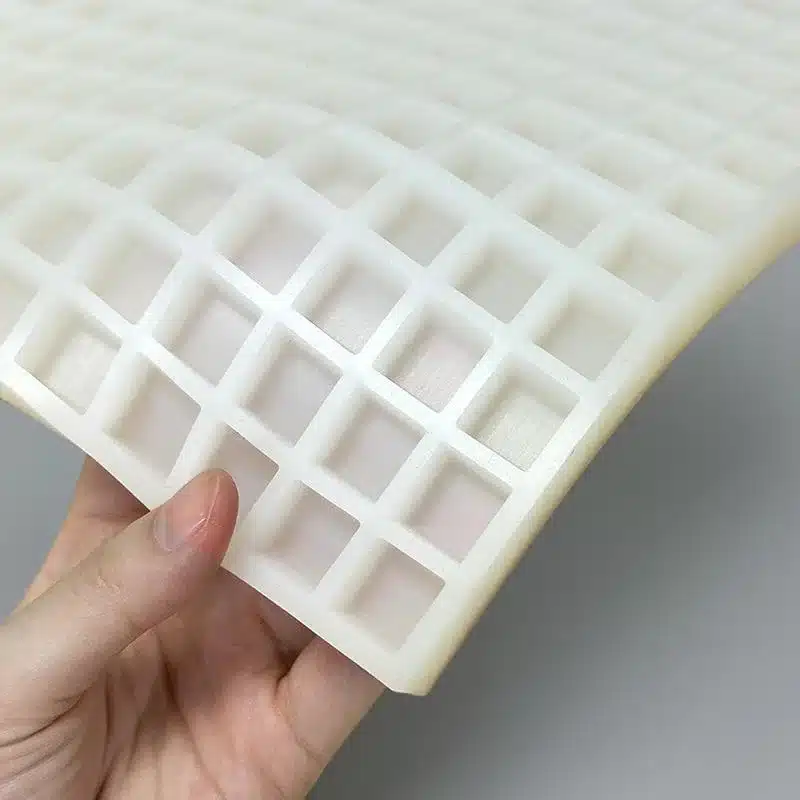
If you're buying silicone for a bakery, a chocolate line, and a dairy filler, you're not buying one "food silicone." You're buying custom RTV cavities that touch named foods at named temperatures, held in mother molds that fit pans or depositors, then a report on those cavities. The US rubber rule is 21 CFR 177.2600. German buyers add LFGB / BfR Recommendation XV. Platinum RTV covers most food-contact skins after post-cure. Tin-cure RTV is for resin and many industrial jackets, not a cooker gasket and not a dual-market chocolate tool. Seals, spatulas, and HCR/LSR *parts* belong on a different quotation.
Four RTV jobs, not one drum
Muffin trays you deposit batter into live in fat at oven heat: flexible skin, rigid jacket, 177.2600 hexane on the cavity. Chocolate wants a gloss face copied from the master, keyed splits, sometimes an inner core for hollow pieces. Gummy adds hot acidic syrup and depositor register. Ice is freeze-and-flex; two-part platinum RTV spheres are how mid plants skip LSR steel. Don't file a muffin oven report on a gummy sheet. Don't copy 230 C onto an ice SKU. Keep tin benches off platinum pours or the next food skin goes sticky.
If the plant wants molded silicone bakeware *cups* as goods, that's LSR with a cold-runner or HCR compression — separate line.
Common mix-up: one platinum grade for the whole plant
A lot of RFQs treat one platinum RTV drum as coverage for muffins, gummies, ice, and a tri-clamp gasket. In the shop that usually means shared chemistry and four different articles, plus a gasket that isn't this product.
What to ask when you're buying plant molds
- Which food, temperature, and dump or bake rate?
- Platinum RTV or tin-cure, and which method on this SKU and color?
- Cavity map or bar size, split, jacket, depositor or pan register?
- Who owns the master, and is a recast included after a logo tear?
- Are seals, spatulas, or LSR *parts* mixed onto this PO?
- Care: soft cloth, dedicated brushes so gloss and matte don't share a scored pad?
Worked example: 36-cavity gummy worm on a depositor
A confectioner wants a 36-cavity worm, 12 mm thick, fruit-acid syrup, about 5,000 dumps a month. Keyed platinum RTV sheet in a rigid frame that registers to the depositor, pigment frozen, 177.2600 aqueous plus BfR XV sensory. Recast the face against the same master unless the PO gave the shop the only copy.
When this article is the wrong quote
Tri-clamp gaskets, tubing, and spatulas are food-plant silicone, but they're extruded or compression *parts* — not poured RTV cavities. Emergency tin-cure smears on a cooker are an untested contact surface; use a specified gasket. If volume later wants consumer ice *trays* as goods, move to LSR injection; geometry and qty can flip the process.
Related reading: gummy trays, food-grade molds, custom RTV molds, ice-mold manufacturing.
Plant-mold RFQ you can copy
- Duty: bake / chocolate / gummy dump / ice — food type and temperature
- Cavity count, size, monthly dumps
- Master, split, core, jacket, depositor or pan envelope
- Platinum vs tin; color freeze; post-cure
- 177.2600 and/or LFGB/BfR XV on this cavity
- Recast and master ownership
- Keep gaskets and LSR parts off this line
Send the food, the depositor or pan envelope, and monthly dumps. We'll pick platinum vs tin, jacket, and which flask belongs with that cavity.
We would not recommend one platinum drum for the whole plant
We would not recommend filing a muffin oven report on a gummy sheet, or smearing leftover tin-cure as a cooker gasket. We would not mix tri-clamp HCR parts onto this RTV PO. We would not tell kitchens to pry ice with a fork.
Plant duty to tool family:
- Duty - chocolate or gummy dump -> Jacketed platinum RTV
- Duty - ice sphere peel -> Jacketed platinum RTV
- Duty - spatula gasket tube as goods -> HCR or LSR part quote
- Duty - resin only -> Tin-cure RTV
Typical shop values: four food duties
| Duty | Typical shop value | | --- | --- | | Mini-muffin grid | 24-cavity, 38 mm cup, ~2,000 dumps/month, 10A–20A plus jacket | | Chocolate bar | 90 x 40 x 10 mm, 6-cavity, platinum RTV two-piece | | Gummy worm sheet | 36-cavity, 12 mm, ~5,000 dumps/month, depositor frame | | Ice sphere | 50 mm two-part, ~500 pulls/month, not-for-oven | | Linear shrink | Platinum ~0.1–0.3% |
Reference values only. Confirm material-specific limits against the supplier’s technical data and agree project acceptance criteria before production.
FAQ
Can one platinum RTV grade cover muffins, gummies, and ice tools? Only if each cavity is tested at its own duty. Shared chemistry helps. Shared geometry, color, jacket, and heat claim don't.
Are tri-clamp gaskets tested the same way as chocolate RTV molds? Same family of rules, different specimen. A brewery gasket is an HCR or extrusion part. Don't mix the POs.
Why is an LSR ice-tray quote listed separately from a custom RTV sphere? LSR is a molded *part*. A platinum RTV two-piece sphere with a jacket is a custom mold.
Do food plants allow tin-cure RTV for emergency gasket repairs? Wrong chemistry for a dual-market food-contact program. Use a specified food-contact gasket.
Is dishwasher-safe a plant requirement for RTV cavities? Rarely as a substitute for a defined wash. Dishwasher claims are grade-specific. Abrasive pads cut the face.
Custom silicone development · DFM & prototype support
CAD, drawing, photos or sample details