
Food-Contact Path After an SLA RTV Master | RUUIPON
A food RTV cavity after SLA needs wash, UV, seal, a 20 g slug, then platinum. Inhibition is scrap, not a bake. Docs on this article. MOQ 20, $50 CAD.
 Kyler Yang · Founder7 min read
A food-contact platinum cavity can start from an SLA master only after the print is washed, fully UV post-cured, sealed, and proven with a 20 g platinum slug on a hidden face. If the slug stays greasy against the print while the slug back snaps, that master is scrap for chocolate, gummy, ice, or batter. Baking the sticky face will not un-poison addition-cure rubber. We then pour 1:1 or 10:1 platinum, vacuum, room-cure, wash, and post-cure the *cavity* before the first food dump. 21 CFR 177.2600 is extraction of that finished article, not an FDA-approved print farm and not a cousin-grade PDF.
RUUIPON pours those food tools in Bao'an, Xinhe Blvd, Shajing, since 2018. Prototype is 3–7 business days after CAD lock — lock includes "this print is pour-ready," not "the STL left the laptop." Production is MOQ 20 pieces per design. Simple 3D is USD $50 when that CAD scope applies. Platinum shrink after a full cure is typically about 0.1–0.3%. LSR kitchen *parts*: an HTV product RFQ here. Print-as-master overview: 3D-printed masters.
Does not apply when the dump is PU, plaster, or a decorative candle with no food claim — still seal for inhibition, skip the food pack. It also does not apply to FDM layer-line masters you hoped to call food-smooth without fill, or to a mystery bottle resin with no wash notes. We would not pour a chocolate logo against a raw SLA and hope.
Seal is a barrier; food docs are a later article
SLA leftover monomer and some photopolymer packages inhibit platinum. A compatible sealer (not hairspray, not random craft spray) goes on *before* mix, after wash and UV. The sealer is there so the rubber cures. It is not a 177.2600 letter. Do not file a sealer TDS as a food pack.
The RUUIPON Mold Structure Decision still runs on the printed shape: flat back → open-back; undercuts that peel → glove; if they will not peel → split/plug/core; large wet casting → mother mold. Printing a one-piece mascot does not force a one-piece food glove.
- Seal the print -> 20 g platinum slug on a hidden face
- 20 g platinum slug on a hidden face -> Slug face tacky?
- Slug face tacky? - yes -> Different sealer or different master — do not pour food
- Slug face tacky? - no, snap-cured -> Pour 1:1 or 10:1, vacuum
- Pour 1:1 or 10:1, vacuum -> Room cure, peel
- Room cure, peel -> Wash + cavity post-cure
- Wash + cavity post-cure -> First food dump
The photo that would prove this path: print with sealer, slug coupon next to it, traveler checking tack, then the platinum tray. A glossy SLA beauty shot is not a food path.
ISO 3302-1 M2 is the dump class you asked for on the candy. It does not bless an unsealed print. CAD lock can be a $50 remodel of the STL into a pour-ready master if the print cannot be trusted.
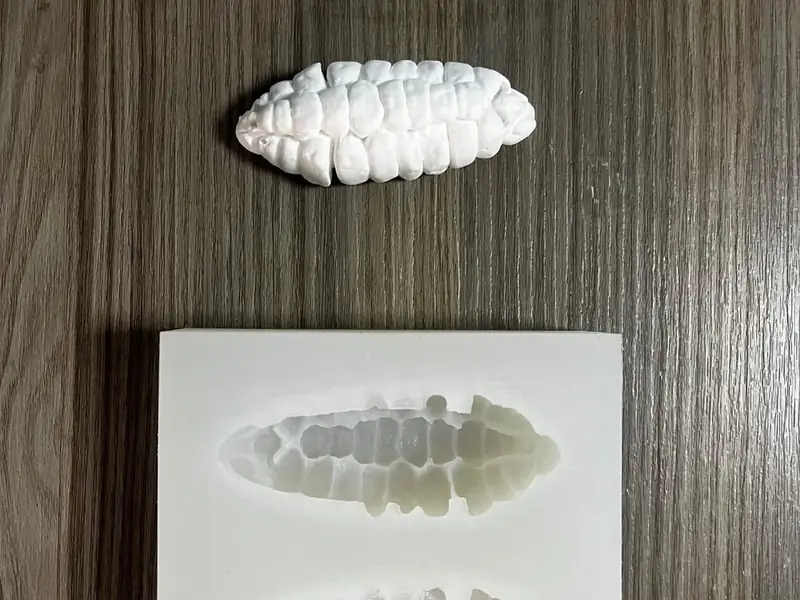
Failure: food tray with a greasy logo well
Symptom: cavity face against the print is greasy; jacket back is fine; first chocolate tastes like shop.
Cause: raw SLA; incomplete IPA wash; UV skipped; latex gloves on the print; tin residue in the box; sealer that itself inhibits.
Confirm: slug on a hidden boss. Tack on the print side only is inhibition. Whole slug soft is a clock or ratio problem.
Fix: remake. Do not wash-and-hope a food cavity. Do not dump cocoa butter as a "seasoning" on a sticky well.
Layer lines that survive seal will show in chocolate. If the brand face cannot wear stair-steps, we machine or $50-CAD a smooth master instead of sealing a coarse print.
Typical shop values
Reference values only. Confirm material-specific limits against the supplier’s technical data and agree project acceptance criteria before production.
| Item | Typical shop value |
|---|---|
| Mix / shrink | 1:1 or 10:1 by weight; platinum about 0.1–0.3% |
| Food chemistry | platinum only — we would not spec tin |
| Cavity Shore | 10A–20A skins; 20A–40A trays |
| Loaded sag without jacket | about 0.5–1.5 mm |
| Prototype | 3–7 business days after CAD lock |
| Production MOQ | 20 pieces per design |
| Simple 3D | USD $50 when that CAD scope applies |
| Drawing class | ISO 3302-1 M2 as a common default |

Paths we would not call food
We would not recommend a food dump against an unsealed SLA "because it looks smooth."
We would not recommend borrowing a spatula LFGB PDF to bless this tray. Wrong object.
We would not recommend tin-cure on chocolate because the print was dirty and tin is "more forgiving." Forgiveness on the master is not a food-contact argument.
We would not recommend calling RUUIPON an FDA-approved factory. We pour a compound path. Extraction is on the article.
A tooling charge is not unrestricted ownership of the sealed print or the slug notes.
Worked example: 12-cavity logo shell, raw SLA, sticky wells
US retail chocolate shell, 12-up, SLA master shipped in the build resin smell. Buyer asked us to "just pour food-grade." Slug on a hidden foot stayed tacky at 24 h; back snapped. We refused the pour, sealed, slug passed, poured platinum 20A open-back with jacket, washed and post-cured the cavity. $50 CAD applied because the STEP had no fill line. Prototype 3–7 business days after that CAD lock. Production MOQ 20 of that design. Related: chocolate molds, food-contact quoting.
Mix-up: sealed print equals food-safe mold
The sealer protects the platinum cure. Food contact is the platinum article after wash and the doc pack you named. Two objects. The other mix-up is treating FDM, SLA, and SLS as one "3D master" for food. Powder and layer lines fail differently.
What to ask when you're buying the food path
- Resin brand and whether wash + UV are done?
- Permission to seal, and a slug before the production pour?
- US 177.2600 and/or LFGB on *this* tray, or craft-only?
- Jacket for a loaded sheet?
- After CAD lock, 3–7 business days, then MOQ 20 / design?
Related: food-grade buyer spec, contact.
RFQ copy-pack — SLA then food platinum
Paste into [email protected]:
Object: platinum food RTV tray from an SLA master (not an LSR part) Print resin / wash / UV status, or send the STL for USD $50 CAD if that scope applies Dump: chocolate / gummy / ice / batter, peak °C Docs: 177.2600 and/or LFGB on this article, or craft-only Structure: open-back + jacket / split File: STEP / STL / photos with a millimetre scale Prototype 3–7 business days after CAD lock, then MOQ 20 per design
Send the print status and the doc pack, not "food-grade STL." We slug before we pour food — not a blank free quote. Phone +86 135 3006 2969. Licheng Technology Industry Park, Xinhe Blvd, Shajing, Bao'an. Shop since 2018.
Layer-line chocolate is a brand decision, not a defect we hide with oil. If the RFQ says "retail shell, glossy," we would rather spend the $50 CAD on a smooth master than seal a coarse SLA and argue about stair-steps after first dump. Say glossy vs as-printed on the same email as the food pack.
FAQ
Can I pour chocolate into a mold made on a raw SLA? Not as a food path here. Wash, UV, seal, slug. Sticky slug means remake.
Does sealing the print make the mold FDA approved? No. Sealer is a barrier for platinum. 177.2600 is extraction of the rubber article. We are not an FDA-approved factory.
Can you skip the slug to save a day? We would not skip it on a food logo. One 20 g coupon is cheaper than a sticky 24-up tray.
What if I only have FDM? Fill and seal, or pay the $50 CAD for a smooth master. Layer lines become chocolate texture.
Is the 3–7 day clock the UV cure on the print? No. 3–7 business days after CAD lock is our shop calendar. Your print must already be pour-ready, or we model it.
Custom silicone development · DFM & prototype support
CAD, drawing, photos or sample details