
Gummy Candy Mold Manufacturer Guide for Plant Buyers
Vet a gummy mold manufacturer on platinum RTV trays, depositor register, and cavity volume. Skip tin-cure shops and spatula certificates.
 Kyler Yang · Founder8 min read
If you're vetting a gummy candy mold manufacturer, you want a shop that can ship a platinum RTV tray your depositor will hit and your dump station will empty.
The buyer is a candy engineer, a vitamin ops lead, or a co-packer — not a home baker. Vet on process identity (platinum RTV with a jacket, or a named plastic), register, cavity volume, and 21 CFR 177.2600 extractives / LFGB as article tests. Don't vet on a catalog of cartoon bears or a printed dump life. Starch mogul OEMs are a different vendor class; include them only if starch is the process.
Questions that sort shops in the first call
Ask these early:
- Will you pour platinum RTV against a master (and jacket it), or are you quoting PC / a hybrid?
- Can you copy this pin pattern and pitch from a drawing, not from a photo?
- How do you prove cavity volume on first article?
- What food-contact methods do you run on this article, not on a spatula?
- Where is post-cure, and do you scale it to floor *and* jacket thickness?
- Who owns the master and the jacket?
- Can we dump our slurry on a one-up before the production array?
If the shop answers with muffin-pan Shore A, kitchen RTV, or "FDA approved silicone" without 177.2600 extractives, you're in the wrong aisle. If they unmix a soft one-up from a jacketed production tray and ask for the depositor envelope, you're in the right aisle. Ask whether they've shipped multi-cavity trays into a washer, not whether they've "done food grade." A gasket shop and a baking-mold shop both touch food-contact; only one of them thinks about dump rollers.
Capabilities that matter
Minimum set for a commercial RTV gummy tray: platinum addition-cure pour, masters with shrink so pitch lands, jackets or dual-pour when you need stiffness plus dump, article testing (21 CFR 177.2600 extractives, LFGB/BfR XV, or both) with post-cure on the specimen, inspection for flash, flatness, and a volume map. Nice to have: in-house CNC masters, texture language if you specify matte, ASTM D624 / D395 screens, clean pack-out, experience with vitamin piece-weight drama.
If your process is starch, you want a mogul stamp specialist, not a silicone shop pretending starch is a Shore A. An LSR injection quote with a cold-runner is a molded *part* shop — different RFQ unless you actually want that.
Common mix-up: a kitchenware factory is a gummy tray OEM
A lot of RFQs treat any platinum food-contact silicone factory as a gummy mold manufacturer. In the shop that usually means they've shown you muffin cups that prove wash and platinum, not a nozzle grid. Qualify on a gummy-like tray dump, not on a spatula. Red flags: tin-cure as production, a 177.2600 report on a different SKU/color/thickness, "50,000 dumps" as a material property, no question about your depositor, glue-gun hybrid frames, ISO 10993 offered as a food-contact substitute, a quote with no cavity count, pitch, or dump method.
Yellow flags: only soft one-ups, no jacket program; only muffin tools; can't explain post-cure; will cut 40 cavities from a PNG with no volume freeze. Those shops can still make a sample if you hold their hand. They shouldn't own a vitamin array unattended.
Sampling path and export packing
A manufacturer you want will insist on CAD freeze (volume, draft, dump, envelope), one-up or two-cavity platinum sample, plant dump and weigh, production master at real pitch with jacket, first-article trays plus food-contact identity, then spare trays for wash. Skipping to the array is how ears tear at scale. Vitamin buyers should send mass range and slurry family, not a milligram assay. Candy buyers should say whether starch is still in play.
Trays crease. Export packing should nest cavities, rigid-pack the jacket, and label revision on a non-food tab. Classification of silicone articles is a forwarder conversation (4016.99 / 3926.90). Food-contact PDFs travel with article identity; they don't travel as a claim that the gummy is legal in the destination.
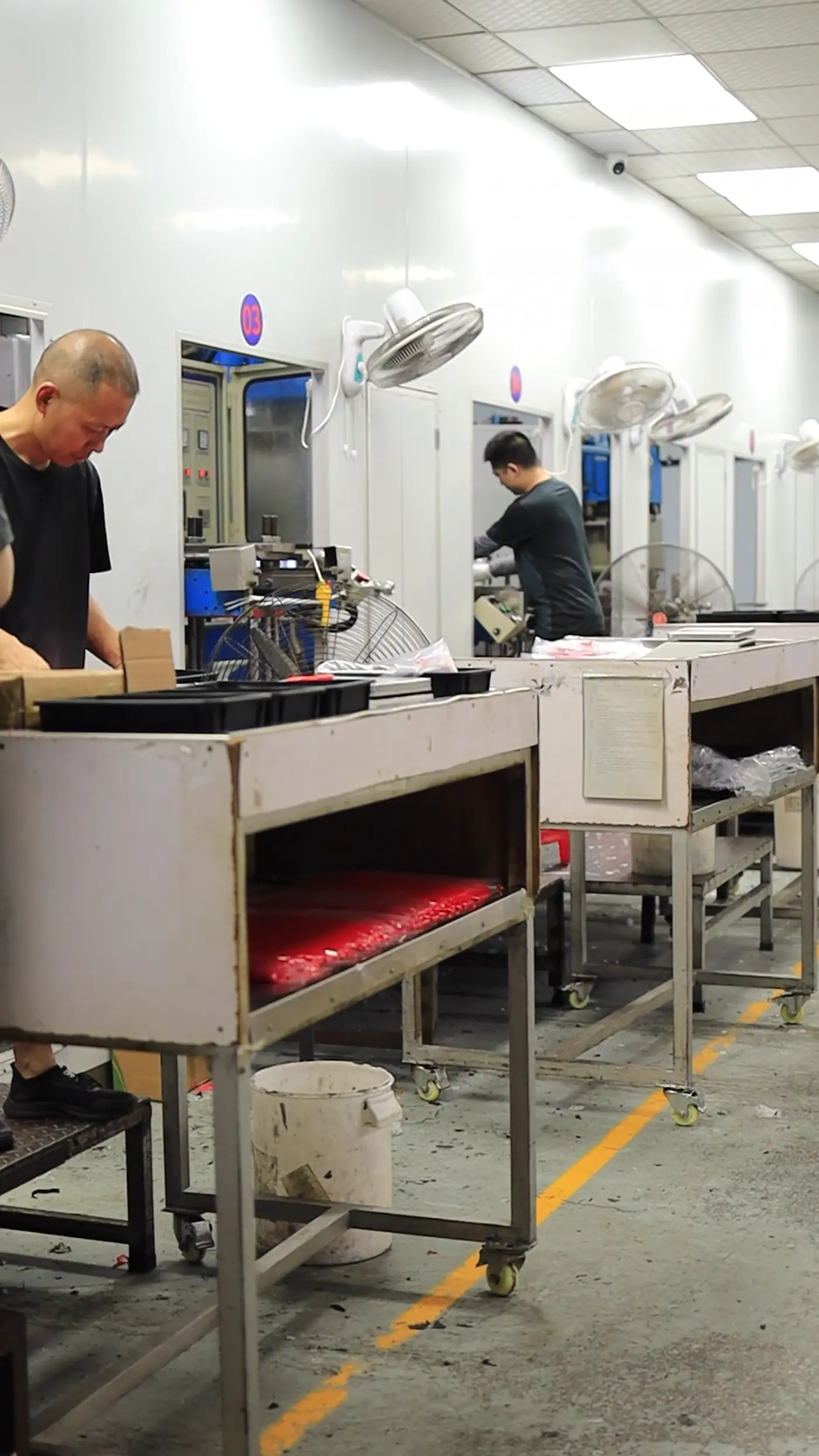
A plant visit still beats a PDF. Watch post-cure ovens, ask where flash is trimmed, ask how customer masters are stored so SKU B can't be cut from SKU A's program. "Are you ISO" is a weaker first question than "show me the last tray that missed pitch and what you changed."
What to ask when you're comparing two manufacturers
- Same print: cavities, pitch, Shore or dual-pour, jacket, test scope, master ownership, spare trays?
- Process named as platinum RTV (not "silicone" and not an LSR cold-runner part tool)?
- Article tests named (177.2600 extractives / LFGB), specimen = this tray?
- Will they run a stand-in gel if your pectin can't ship, labeled mechanical only?
- If you already own a mogul, are starch stamp and RTV tray on separate line items?
Example
A candy co-packer adding a licensed mascot next to an existing mogul might OEM a 28-cavity platinum RTV tray, 2.3 ml, 15 mm dump depth, Shore 25A in an aluminum jacket, one-up first, then two production trays plus a spare. The mogul stamp stays on a different PO.
When this manufacturer guide is the wrong audit
If your process is starch, audit a mogul stamp maker, not an RTV pour shop pretending starch is a Shore A. If you're qualifying a muffin-cup kitchenware factory, muffin wash proves platinum, not nozzle grids. If you need vulcanized silicone *parts*, walk an LSR/HCR press hall. A plant visit still beats a PDF — watch post-cure ovens and where flash trim dust can land in a cavity.
Related reading: OEM mold PO, how trays are poured, gummy trays.
Audit / RFQ list to take on the walk
- Platinum RTV + jacket, or PC / hybrid — say it in the first hour
- Copy nozzle pitch and pins from a drawing?
- Cavity volume method on first article (water-fill map)
- 177.2600 extractives / LFGB on *this* article after post-cure, not a spatula
- Who owns the master? Recast terms?
- One-up dump of our slurry before the production array
Send pin-pattern drawing, target grams, slurry family for a one-up dump, and tray envelope. We'll tell you if we're the right hall — or if you should be walking a mogul OEM instead.
We would not recommend auditing a muffin factory as a gummy tray OEM
We would not recommend vetting on a cartoon catalog or a printed dump life. Muffin cups prove platinum and wash, not nozzle grids. We would not accept "FDA approved silicone" without 177.2600 extractives on *this* article. If the process is starch, walk a mogul stamp hall — not an RTV pour shop pretending starch is a Shore A.
- Copy pins from a drawing? -> Volume method on first article?
- Volume method on first article? -> 177.2600 / LFGB on THIS tray?
- 177.2600 / LFGB on THIS tray? -> One-up of OUR slurry before the array?
- One-up of OUR slurry before the array? - all yes -> Right aisle
- One-up of OUR slurry before the array? - muffin Shore / tin-cure / spatula cert -> Wrong aisle
Typical shop values: commercial RTV tray you should see on the walk
| Item | Typical shop value | | --- | --- | | Piece-weight target | 4.0 g (cavity volume × measured slurry density; fill-to-brim or fill-to-line stated) | | Outer-row vs center | 3–6% heavy if the loaded tray sags under the nozzles | | Loaded-tray edge sag | 0.5–1.5 mm without a flat jacket | | Cavity Shore | 10A–20A platinum RTV skin + rigid jacket | | Platinum linear shrink | 0.1–0.3% (cut the master so poured pitch lands) | | Mix | Platinum 1:1 or 10:1; post-cure scaled to floor and jacket | | Red flag | 50,000 dumps as a material property; no question about your depositor |
Reference values only. Confirm material-specific limits against the supplier’s technical data and agree project acceptance criteria before production.
FAQ
Should we audit a kitchenware silicone factory for gummy trays? Only if they can show depositor register, multi-cavity pitch, and article tests on a tray like yours. Muffin cups prove platinum and wash, not nozzle grids. Ask for a gummy-like sample dump.
Is a starch mogul builder a gummy mold manufacturer? Yes for starch processes. No for reusable RTV arrays. Put the process on the RFQ so you audit the right hall.
What certificate is a hard requirement? The food-contact method that matches the tray's markets, on that article, after post-cure. 21 CFR 177.2600 extractives and/or LFGB/BfR XV for silicone. A generic "FDA" logo isn't a method.
Can we use one manufacturer for vitamin trays and candy trays? Yes if hygiene and geometry fit. Keep starch out of a vitamin hall if QA says so. The manufacturer can still ship two tray fleets.
How do we compare two quotes without a fake dump life? Same print: cavities, pitch, process, Shore or dual-pour, jacket, test scope, master ownership, spare trays. Then the money difference is master work and lab, not a slogan.
Custom silicone development · DFM & prototype support
CAD, drawing, photos or sample details