
How Much RTV Silicone You Need for a Mold | RUUIPON
Rubber volume is flask minus master plus waste and pour head — not dump grams. RFQ fields, typical shop waste, mix 1:1 or 10:1. MOQ 20, $50 CAD when it
 Kyler Yang · Founder7 min read
How much silicone you need to make a mold is a volume problem on the tool, not on the dump. Weigh the flask as a box: inside length × width × pour height, subtract the master volume, add pour head, add waste for the cup, the vacuum, and the leak you hope not to have. Dump grams (a 4 g gummy, a 40 g soap bar) do not tell you the rubber mass. A 4 g cavity in a 3 mm skin with a jacket uses far less platinum than the same cavity in a 25 mm block.
RUUIPON sizes shots in Bao'an / Shajing since 2018. Prototype 3–7 business days after CAD lock. Production MOQ 20 pieces per design. Simple 3D is USD $50 when that CAD scope applies. Mix 1:1 or 10:1 by weight; platinum shrink after a full cure typically about 0.1–0.3%. LSR shot size in a cold-runner tool is a different quote.
Does not apply when you are asking how much *resin or chocolate* the cavity holds. That is dump volume. It also does not apply to a brush-on glove on a statue: that shot is coat area × thickness, not a box. See pour-on vs brush-on.
Box volume minus master plus waste is the RFQ field
Inputs we actually want on the RFQ:
- Flask inside mm — or permission to build the flask. See mold box.
- Master envelope — STEP is best; a water-displacement note on a sealed master is a shop backup, not a lab certificate.
- Sequence — pour-on block, open-back tray, or detail-coat glove plus jacket.
- Waste — cup cling, vacuum overflow, a second shot if the first dam fails.
Density of platinum RTV sits near 1.1 g/cm³ on many unfilled grades (typical shop value, not a named COA). Convert cm³ to grams only after you lock the cubic millimetres. Then split grams into A and B at 1:1 or 10:1 by weight.
Why "one kit" is not a quote: kits are 500 g, 1 kg, 5 kg. Your flask might need 1.4 kg plus 10% waste. Buying two 1 kg kits and mixing them as one cup can be fine; buying one kit and stretching it with leftover tin is not.
- Subtract master volume -> Add pour head above high point
- Add pour head above high point -> Add waste: cup, vacuum, dam risk
- Add waste: cup, vacuum, dam risk -> cm3 to grams using grade density
- cm3 to grams using grade density -> Split A/B 1:1 or 10:1 by weight
- Split A/B 1:1 or 10:1 by weight -> Shot larger than one kit?
- Shot larger than one kit? - yes -> Plan two weighed batches or a larger drum
- Shot larger than one kit? - no -> Mix, vacuum, pour
The photo that would prove a volume call: flask with a millimetre stick in three axes, master in place, calculated grams written on the traveler next to the scale. A shopping-cart screenshot of "1 kg kit" does not prove the box was sized.
A sibling calculator page will ask the same inputs; this article is the procurement meaning of those fields. If your purchasing sheet only has "silicone kg," we will still ask for flask millimetres.
Water-fill the flask to check STEP volume
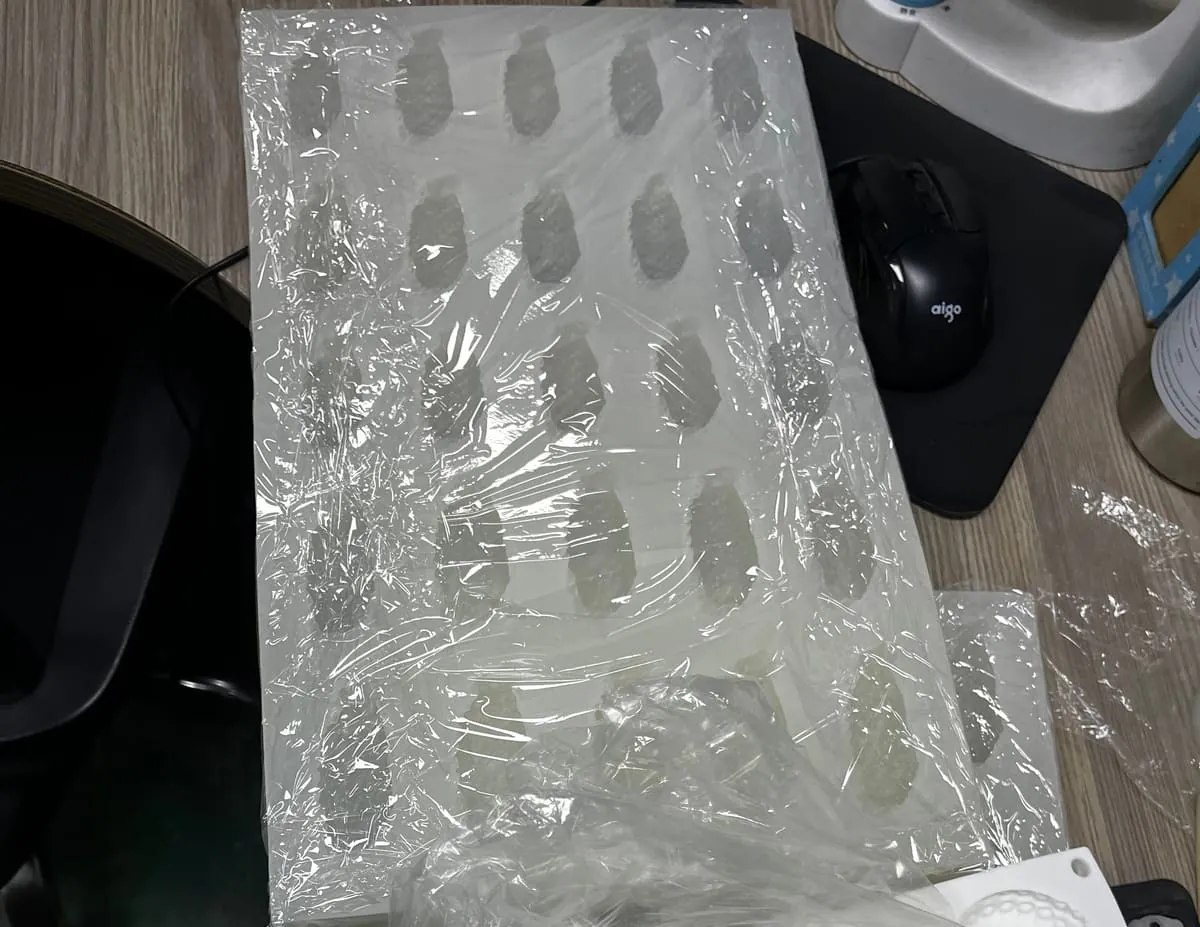
Fill the empty flask with water to the pour-head line, weigh it, then put the sealed master in and weigh again. The difference is master volume in grams of water, which is cubic centimetres. Subtract that from the flask fill. Convert remaining cm³ with the TDS density. We do not publish a named PO from this method; it is how we check a STEP that looks hollow or a photo pack with no millimetre cube. If the master is porous, seal it first or the water number is a lie.
Do not skip the waste line because the water test "came out exact." Cup cling and vacuum foam are not in the flask.
Why dump grams mislead purchasing
A 12-up 4 g pectin sheet can sit in a thin jacketed skin (modest rubber) or in a 15 mm block (expensive rubber, more sag). Rubber mass follows the tool family, not the candy mass. Concrete is the same trap: a 2 kg paver dump does not mean 2 kg of platinum.
ISO 3302-1 M2 is a drawing class on the dump. It does not size the shot.
Shop numbers for shot size
Reference values only. Confirm material-specific limits against the supplier’s technical data and agree project acceptance criteria before production.
| Item | Typical shop value |
|---|---|
| Mix | 1:1 or 10:1 by weight after you have grams |
| Platinum shrink | about 0.1–0.3% after full cure |
| Unfilled RTV density (start) | near 1.1 g/cm³ — check the TDS |
| Loaded sag without jacket | about 0.5–1.5 mm |
| Prototype | 3–7 business days after CAD lock |
| Production MOQ | 20 pieces per design |
| Simple 3D | USD $50 when that CAD scope applies |
Shot plans we would not run
We would not recommend ordering "one Amazon kit" as the BOM for a 400 mm tray.
We would not recommend thinning a short shot with leftover tin to finish the corner. Chemistry mixing is a later failure.
We would not recommend sizing rubber from dump grams.
We would not recommend skipping waste on a leaky foam-board box. Size the flask properly or reprint it.
A tooling charge is not unrestricted ownership of leftover drums on our shelf. If you need unused platinum returned, write that before mix day.
Worked example: wax tray sized from flask millimetres
Open-back wax tray, flask 220 × 140 × 12 mm inside, master volume from STEP, pour head 3 mm, platinum 1:1. We computed box minus master plus head plus ~10% waste, weighed A/B, vacuumed, poured. Prototype 3–7 business days after CAD lock. $50 3D did not apply. Production MOQ 20 of that design. The buyer's first email said "the melts are 30 g so send 30 g of silicone." That number never entered the shot.
Mix-up: quoting grams from the dump, not the tool
Purchasing copies the finished-goods gram weight into the rubber line. Those units are unrelated. The other mix-up is using water-fill of the *cavity* as the rubber volume — that is dump volume again.
Questions that size the shot
- Flask inside mm, or should we build the flask?
- Master file in mm, or a sealed master we can displace?
- Skin-and-jacket or block?
- Grade 1:1 or 10:1, and may we pick the drum?
- First qty (prototype) then MOQ 20 per design?
Related: thin vs thick, contact, mold quote.
RFQ copy-pack — rubber volume
Paste into [email protected]:
Object: RTV mold I pour into, not an LSR/HCR part Flask inside L x W x H mm (or build flask: yes) Master: STEP in mm / sealed sample Sequence: block / open-back skin / glove + jacket Dump material and peak °C (for Shore, not for rubber grams) CAD: mold-ready STEP OR USD $50 3D if that scope applies Prototype 3–7 business days after CAD lock, then MOQ 20 per design Mix 1:1 or 10:1 by weight on a gram scale
Send flask millimetres and the master. We return a shot plan — not a blank "free quote." Phone +86 135 3006 2969. Licheng Technology Industry Park, Xinhe Blvd, Shajing, Bao'an. Shop since 2018.
FAQ
Can you quote rubber from my 4 g gummy weight? No. That is dump mass. We need flask millimetres and master volume.
Should I buy two kits "just in case"? Better to size the shot and waste, then buy the drum that covers it. Random extra kits go stale and invite off-ratio mixing.
Does a jacket reduce how much silicone I need? Usually yes: a thin skin plus a plaster or resin shell uses less gum than a solid block of the same envelope.
Is density always 1.1 g/cm³? It is a typical shop start for unfilled platinum. Filled grades differ. We read the TDS for the drum on the floor.
If I pay tooling, do leftover kilos ship to me? A tooling charge is not unrestricted ownership of leftover rubber. Write return of unused drums on the PO if that matters.
Custom silicone development · DFM & prototype support
CAD, drawing, photos or sample details