
How to Calculate Gummy Mold Cavity Size and Weight
Getting cavity size right is essential for:
 Kyler Yang · Founder4 min read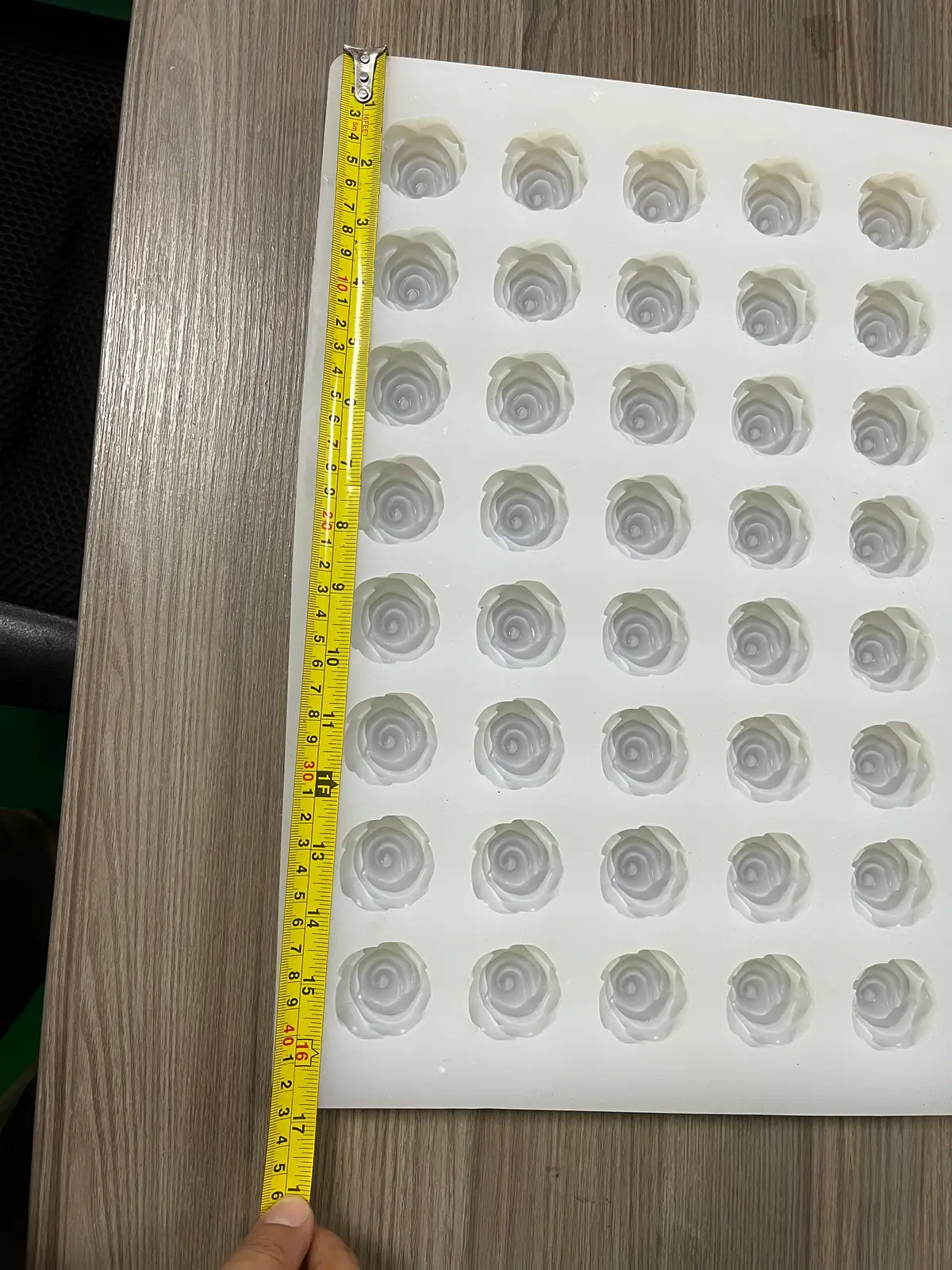
Why Cavity Sizing Matters
Getting cavity size right is essential for:
- Accurate dosing — Critical for regulated products like CBD edibles
- Consistent production — Uniform weight across all cavities
- Cost control — Avoiding over or under-filling
- Customer satisfaction — Products that match label claims
This guide explains how to calculate the right cavity size for your gummy production.
The Basic Formula
Weight-to-Volume Relationship
`` Weight (g) = Volume (mL) × Density (g/mL) ``
For gummy mass, the typical density is 1.2-1.4 g/mL depending on formulation.
Solving for Cavity Volume
`` Volume (mL) = Weight (g) ÷ Density (g/mL) ``
Example: Target weight = 2.0g, Density = 1.3 g/mL `` Volume = 2.0 ÷ 1.3 = 1.54 mL per cavity ``
Cavity Dimension Calculation
For Simple Geometric Shapes
Square/Cuboid Cavity: `` Volume = Length × Width × Depth ``
Example: 2.0g gummy, target dimensions 25mm × 20mm × 8mm `` Volume = 25 × 20 × 8 = 4,000 mm³ = 4.0 mL Density check: 2.0g ÷ 4.0mL = 0.5 g/mL (too low — adjust dimensions) ``
Revised example: 2.0g gummy, target volume 1.54mL `` If length = 25mm, width = 20mm: Depth = 1,540 ÷ (25 × 20) = 3.08mm ``
Round/Cylindrical Cavity: `` Volume = π × r² × h ``
Example: 2.0g gummy, diameter 20mm `` Radius = 10mm 1,540 = 3.14159 × 10² × h h = 1,540 ÷ 314.159 = 4.9mm ``
For Complex Shapes
For irregular shapes (bears, characters, custom forms): 1. Create a 3D model of the desired shape 2. Calculate the volume using CAD software 3. Adjust dimensions to achieve target volume 4. Account for material shrinkage (silicone expands slightly during cure)
Accounting for Silicone Expansion
The Expansion Factor
Platinum silicone expands approximately 0.1-0.3% during cure. This means:
- A 2.0g target cavity will produce slightly less than 2.0g
- You need to account for this in your cavity design
Adjustment Formula
`` Adjusted Volume = Target Volume × (1 + Expansion Factor) ``
Example: Target 2.0g, expansion factor 0.2% `` Adjusted Volume = 1.54 mL × 1.002 = 1.543 mL ``
For most commercial applications, this adjustment is negligible. However, for ultra-precise dosing (±1% tolerance), factor it in.
Multi-Cavity Tray Design
Uniform Fill Considerations
When designing multi-cavity trays, ensure: 1. Equal cavity volume — All cavities must have identical volume 2. Uniform fill time — All cavities fill simultaneously 3. Consistent wall thickness — Prevents weight variation
Cavity Count Optimization
| Target Weight | Recommended Cavity Count | Tray Size |
|---|---|---|
| 0.5g - 1g | 96-144 cavities | 40×60cm |
| 1g - 2g | 48-96 cavities | 40×60cm |
| 2g - 5g | 24-48 cavities | 40×60cm or 50×70cm |
| 5g - 10g | 12-24 cavities | 50×70cm |
| 10g - 20g | 6-12 cavities | 50×70cm |
Practical Calculation Examples
Example 1: Standard 2g Gummy Bear
Given:
- Target weight: 2.0g
- Shape: Bear (approximated as ellipsoid)
- Density: 1.3 g/mL
Calculation: `` Volume = 2.0 ÷ 1.3 = 1.54 mL Bear approximation: 25mm × 20mm × 12mm (with rounded features) Actual volume: ~1.5 mL (accounts for bear shape curvature) ``
Result: Cavity depth of 12mm with 25mm × 20mm footprint produces approximately 2.0g gummies.
Example 2: CBD-Infused 10mg Gummy
Given:
- Target weight: 2.5g
- CBD dose: 10mg per gummy
- Dosage tolerance: a job-specific weight band after DFM
- Density: 1.3 g/mL
Calculation: `` Volume = 2.5 ÷ 1.3 = 1.92 mL Required tolerance: a job-specific weight band after DFM of 2.5g = ±0.05g Cavity volume tolerance: a job-specific weight band after DFM of 1.92mL = ±0.04mL ``
Result: CNC-machined cavities with CAD-locked cavity dimensions tolerance achieve the required a job-specific weight band after DFM weight consistency.
Example 3: Large Protein Gummy (15g)
Given:
- Target weight: 15g
- Shape: Rectangular bar
- Density: 1.4 g/mL (denser formulation)
Calculation: `` Volume = 15 ÷ 1.4 = 10.7 mL Bar dimensions: 60mm × 30mm × 6mm Volume check: 60 × 30 × 6 = 10,800 mm³ = 10.8 mL ✓ ``
Result: 60mm × 30mm × 6mm cavity produces 15g protein gummies.
Using Our Cavity Size Calculator
For accurate cavity sizing, provide us with: 1. Target weight per piece (in grams) 2. Product shape (square, round, bear, custom) 3. Approximate dimensions (if known) 4. Production volume (pieces per week) 5. Equipment compatibility (depositor model, if applicable)
We'll calculate the optimal cavity dimensions and provide a detailed specification sheet.
FAQ
Q: How accurate are your cavity weight calculations? A: Our CNC-machined cavities maintain CAD-locked cavity dimensions tolerance, achieving a job-specific weight band after DFM weight consistency across all cavities.
Q: Can I adjust cavity size after ordering? A: No, cavity size is determined during the design phase. However, we offer redesign services if your requirements change.
Q: What if my gummy density varies by batch? A: We recommend testing with a prototype mold first. If density varies significantly, we can adjust cavity dimensions for your specific formulation.
Q: Do you provide weight verification data? A: Yes, every production mold includes a cavity weight verification chart documenting weight consistency across all cavities.
*Published: 2026-08-12 | Category: Production Engineering | Read Time: 8 minutes*
Custom silicone development · DFM & prototype support
CAD, drawing, photos or sample details