
Multi-Cavity Gummy Molds for Pitch, Fill, and Dump
Multi-cavity gummy molds copy depositor pitch and equal cavity volume. Balance is fill and dump across the RTV array, not LSR runner math from a part tool.
 Kyler Yang · Founder7 min read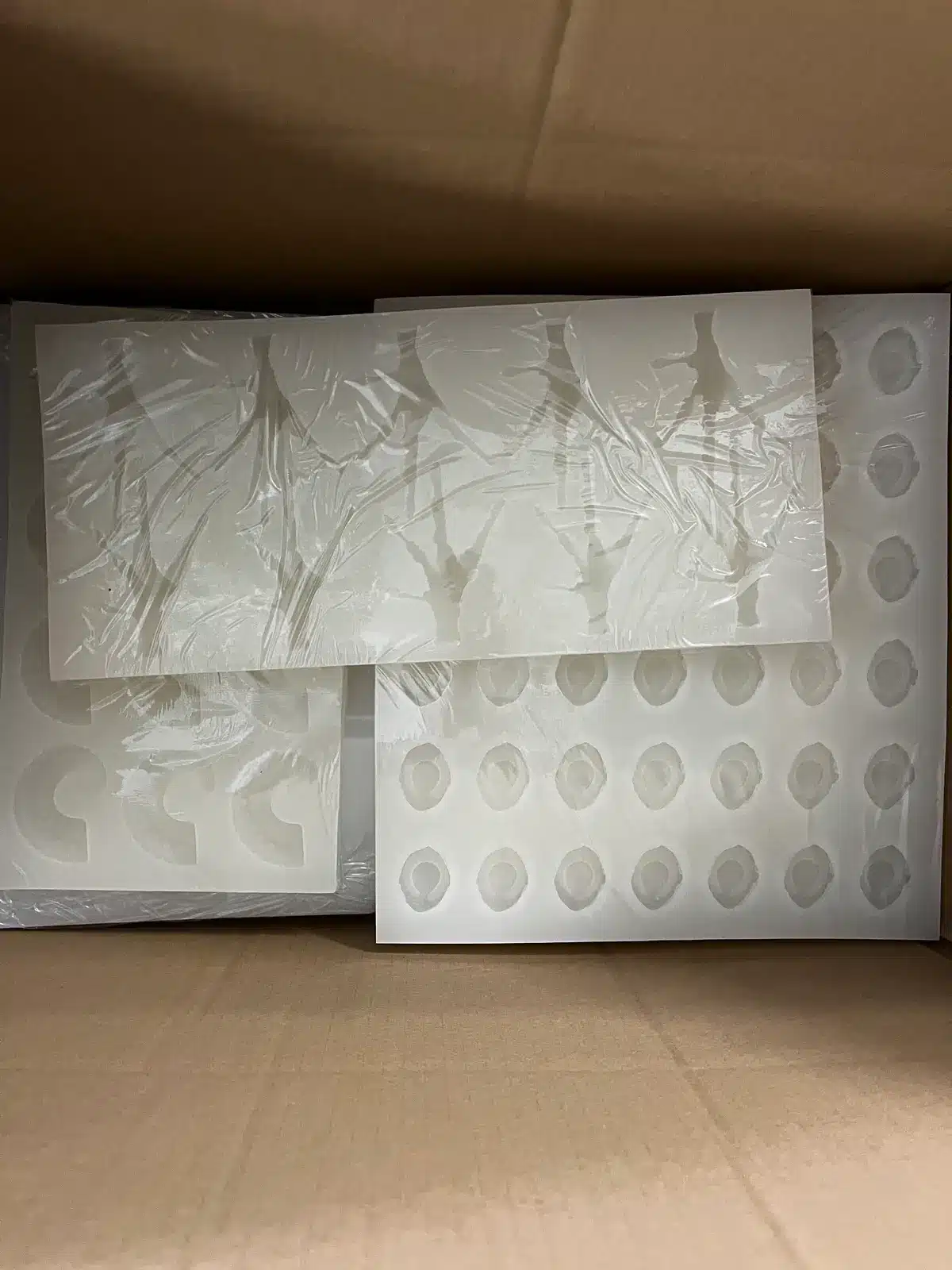
A multi-cavity gummy mold is a tray of equal cavities on a pitch the depositor already uses.
Cavitation is a throughput buy. It isn't a way to hide a bad one-up. Every cavity has to fill to the same volume, dump without tearing, and sit on the same grid as the nozzles. The product here is a platinum RTV tray, usually jacketed; the "runner" is the depositor. Food-contact is still 21 CFR 177.2600 extractives / LFGB on the whole article.
Pitch is depositor geometry
Copy center-to-center nozzle spacing, tray envelope, and locating pins. A 2 mm error is a miss. If you're designing a new depositor and a new tray together, freeze the grid before the mascot. RTV shrink compensation lives in the master: we cut the pattern so the poured array lands on the drawing after the grade's shrink.
If the head indexes, the array still has to match belt pockets and the dump roller. Cavities the head never hits are wash burden.
Balancing fill across a 4×10
Equal master cavities can still fill unequally if one nozzle lane is short, the tray isn't flat (jacket stiffness), flash or dirt steals volume, or SKU B's logo trench is deeper than SKU A while you promised the same mass. Measure water fill or a check slurry on corners and center, not only cavity 1. After wash, measure again — ovaling is a multi-cavity defect because the stacker presses the middle. Tight pitch plus overfill bridges land; leave width the dump and the wash can actually clean.
Jacket stiffness versus cavity flex
You need a flat register under 40 shots *and* enough local flex to dump an undercut. Mid Shore plus back thickness, dual-pour (firmer chassis, softer face), a rigid jacket with RTV faces, or a designed flex axis for roller dump — not a random thin web that tears. A floppy 40-cavity sheet is a kitchen tray at scale. ASTM D395 screens set; your hot stack is the plant test.
One-piece RTV trays: fewer crevices, one specimen, faster wash. Family faces: one jacket, several RTV sets at the same pitch and volume. Each touching face is an article. Don't glue them with tin-cure. A torn face can be cheaper than a torn 40-cavity one-piece *if* the seal is real.
Common mix-up: more cavities is LSR runner balance
A lot of RFQs treat a 40-cavity gummy tray like a 16-cavity LSR nipple tool. In the shop that usually means you've asked for gate-balance lore that doesn't apply to gelatin nozzles. Don't import that math. Equal milliliters and equal aim point are the balance. An LSR injection tool with a cold-runner is a molded *part* quote.
Useful RFQ numbers: cavities per tray and trays on the line including wash spares; annual impressions as a planning figure for master class and recast cadence, not a printed dump rating; piece-weight reject cost if one cavity is small; changeover time if the tray won't fit the washer. Useless: "this silicone lasts 50,000 dumps." Food-contact doesn't get cheaper per cavity in a way that skips the article test.
Map cavities (row/column) so QC can point at C7. Handles or a jacket lip that never sit in the food area keep a 60-cavity sheet from folding on the way to the head. Adding cavities later is a new master or face set, not stretching rubber. A second tray with the same envelope is a cleaner scale-up than a wider tray the washer can't hold.
What to ask when you're buying the array
- Exact nozzle pitch and locating hardware — can we copy a drawing, not a photo?
- Cavities equal to nozzles, or are extras just wash load?
- Water-fill map at corners and center, repeated after wash?
- Shore of the face, jacket stiffness, flex axis if dump is a roller?
- One-piece tray vs family faces, and how do seals stay food-contact?
- Spare count vs washer takt, and a path to a second tray of the *same* width later?
Example
A working 4×10 is 40 cavities at 2.2 ml, 18 mm dump depth, Shore 25A platinum RTV in an aluminum jacket, water-filled at four corners and center before the first pectin dump. Spare count is three trays so the washer isn't the depositor's clock.
When more cavities is the wrong buy
If the depositor is a single-head indexer that never hits extra pockets, extra cavities are wash load. If you only need to freeze fill and dump of a new mascot, a 1- or 2-cavity one-up is enough for *shape*; it isn't enough for flatness and stacking — but jumping to 60 cavities on a unique width the washer can't hold is worse. LSR runner-balance lore from a nipple tool doesn't apply to gelatin nozzles.
Related reading: cavity DFM, automation / register, gummy trays.
Array RFQ you can copy
- Nozzle pitch and locating hardware from a drawing (not a photo)
- Cavities equal to nozzles? Spare trays vs washer takt?
- Target grams / ml, water-fill map at corners and center (repeat after wash)
- Dump height / roller diameter if flex dump; Shore + jacket stiffness
- One-piece tray vs family faces; food-contact seals (no tin-cure)
- Same envelope if you'll add a second tray later — don't unique-width yourself
Send nozzle pitch, tray size, cavity count vs nozzles, and target grams. We'll check land width, jacket stiffness, and whether a 2-cavity dump should land before the 40-cavity master.
We would not recommend extra cavities the nozzles never hit
We would not recommend importing LSR runner-balance lore onto a gelatin array, or stretching rubber to add cavities later. We would not jump to a unique-width 60-cavity tray the washer can't hold. Prove equal milliliters at corners and center — including after wash — before you celebrate cavitation.
- Cavities equal to nozzles? - extras -> Wash load — cut them
- Cavities equal to nozzles? - yes -> Jacket stiffness vs local flex
- Jacket stiffness vs local flex -> Water-fill map: corners + center
- Water-fill map: corners + center -> Repeat map after wash
- Repeat map after wash -> Spare trays of the SAME envelope
Typical shop values: 4×10-class jacketed array
| Item | Typical shop value | | --- | --- | | Piece-weight target | 4.0 g (cavity volume × measured slurry density; fill-to-brim or fill-to-line stated) | | Outer-row vs center | 3–6% heavy if the loaded tray sags under the nozzles | | Loaded-tray edge sag | 0.5–1.5 mm without a flat jacket | | Cavity Shore | 10A–20A platinum RTV skin + rigid jacket | | Platinum linear shrink | 0.1–0.3% (cut the master so poured pitch lands) | | Mix | Platinum 1:1 or 10:1; shrink compensation lives in the master | | Balance | Equal milliliters + equal aim point — not a cold-runner |
Reference values only. Confirm material-specific limits against the supplier’s technical data and agree project acceptance criteria before production.
FAQ
Does doubling cavities cut piece cost in half? It can raise throughput if the depositor and washer keep up. It also raises stiffness problems, wash load, and the cost of one bad cavity on a vitamin scale. Size cavitation to the head you have.
How do we check multi-cavity volume without weighing 40 gummies every hour? Water-fill or a check slurry on a map (corners, center, a logo-heavy pocket). Correlate to piece weight in the plant. After wash, repeat. One golden cavity isn't a map.
Can a dual-pour RTV face fix a floppy array? Often that's why a firmer back exists: pitch on the jacket side, dump on the face. Both pours still need to be food-contact platinum and post-cured as the article.
Is a 1-cavity prototype enough before a 40-cavity master? It's enough to freeze fill and dump of the shape. It isn't enough to freeze tray flatness, land width, and wash stacking. Plan a small array or a jacket mockup for those, then pour production.
Do we food-contact test every cavity? You test the article construction (process, thickness, color, post-cure). You inspect cavities for volume and defects. You don't run 40 flasks without a reason. Identity is the tray, not cavity 17.
Custom silicone development · DFM & prototype support
CAD, drawing, photos or sample details