
When UV Resin Yellows the RTV Silicone Mold | RUUIPON
UV dumps can stain a platinum cavity. That is cast chemistry, not the same as a window-sill clear mold going straw. Confirm, then recast. MOQ 20.
 Kyler Yang · Founder7 min read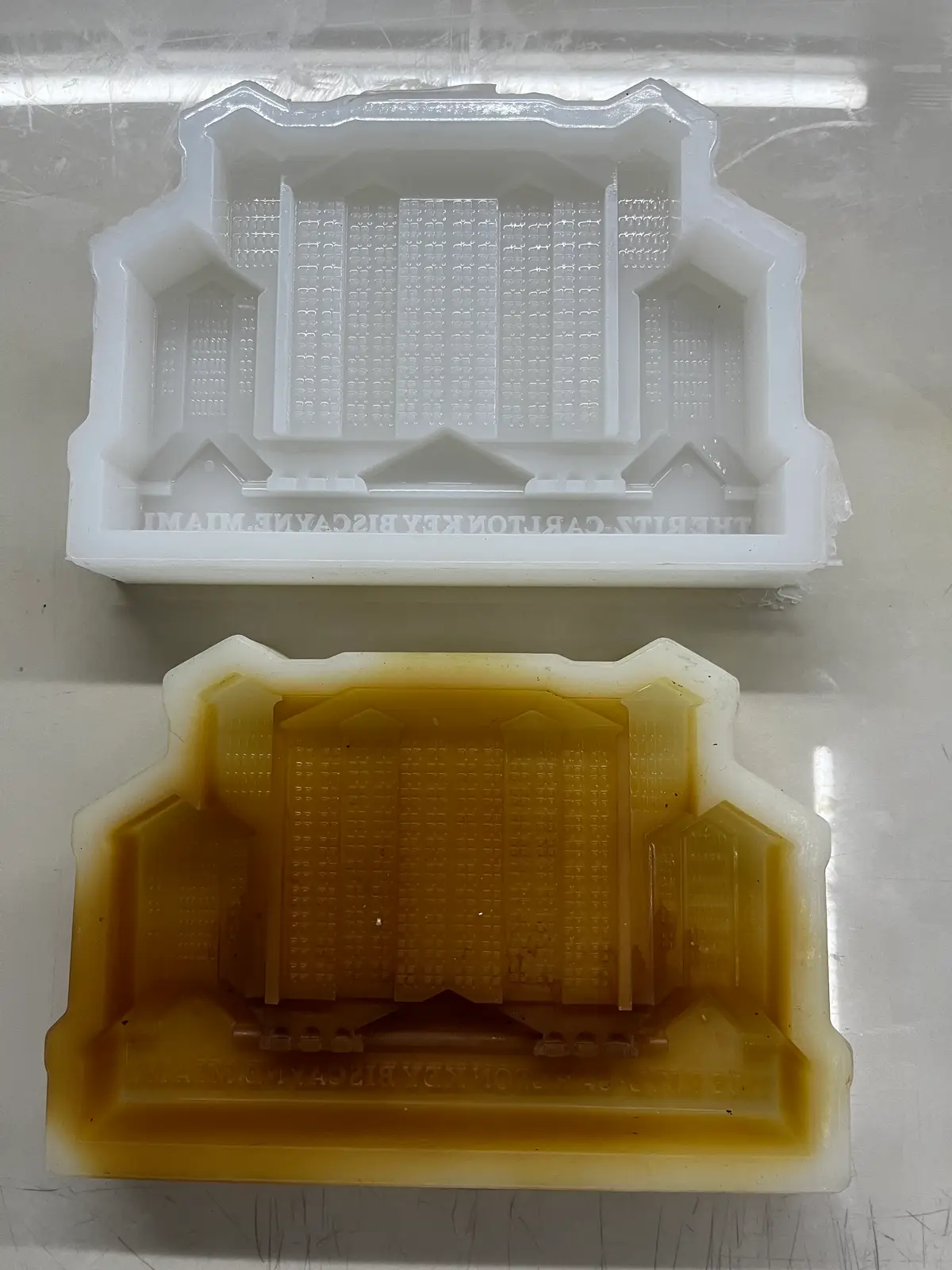
If the *cavity face* went yellow only where UV or epoxy resin sits, and a spare skin from the same pour stored in a drawer is still water-clear, you are looking at dump stain — not the generic "clear silicone yellows in sunlight" story. Photo-initiators, amines, and some pigments in UV resin can tint platinum. Heat from a high-power lamp can add a thermal yellow on top. Confirm with a cut through the wall: a stained skin with a clearer core is the dump; a uniform straw through the sprue is bulk aging or the wrong chemistry on day one. Recast the skin if cosmetics or release suffer. We would not bleach-soak a food cavity to "whiten" it — and jewelry UV tools are not food.
RUUIPON pours platinum RTV in Bao'an since 2018. Prototype is 3–7 business days after CAD lock. Production is MOQ 20 pieces per design. Simple 3D is USD $50 when that CAD scope applies. Window-sill / tin / peroxide yellowing of a *clear tool* is a different article. LSR *parts*: an HTV product RFQ here. Resin hub: resin molds.
Does not apply when the yellow is only in the *casting* (resin mixed wrong, leftover UV), when the mold was tin-cure and already amber at demold, or when chocolate fat bloom is sitting in a food well. Also does not apply to peroxide HCR parts yellowing in an oven.
Cast UV versus a mold that aged in the window
Yellow map matches the resin fill, spare in the dark is clear. Cause: dump stain / lamp heat on the face. Confirm: unused cavity on the same plaque still clearer; cut wall shows a skin. Fix: change resin or lamp schedule; recast if the face is tacky or copies stain onto parts. A craft barrier coating is sometimes a conversation. Food-contact: we would not paint a coating and keep 177.2600.
Whole mass straw, including the jacket sprue, even unused. Cause: light aging of a clear platinum, tin-cure, or a kit that was never water-clear. Confirm: spare stored in the dark is also yellow, or paperwork says tin. Fix: store in the dark; recast in named platinum if clear-for-photo is the spec. Do not dye it back.
Yellow plus tack on the face, back cured. Cause: inhibition leftover or resin attack, not pigment. Confirm: sticky contact face. Fix: remake; do not UV-blast the mold to "finish the cure."
Parts yellow in the cavity but the empty rubber looks fine. Cause: the resin, not the mold. Confirm: raking light on the dry well. Fix: resin TDS, lamp, and thickness. Recasting RTV will not bleach your charms.
Coupon a new UV resin in a sprue slug before MOQ 20. Jewelry UV is still not food. Concrete stains are abrasive gray, a different dirt.
The photo that would prove dump stain is a cut wall, a dark-stored spare, and the working well side by side. A sunlit window shot of a clear glove is the other yellow.
Typical shop values
Reference values only. Confirm material-specific limits against the supplier’s technical data and agree project acceptance criteria before production.
| Item | Typical shop value |
|---|---|
| Tool chemistry | platinum 1:1 or 10:1 |
| Clear tool storage | dark; UV lamps are for the *dump* |
| Confirm stain | cut wall + spare comparison |
| Food path | we would not bleach or coat a food well |
| Jewelry / resin | craft — not 177.2600 |
| Shrink | platinum ~0.1–0.3% on a recast master |
| Prototype recast | 3–7 business days after CAD lock if CAD moves; recast of same rev is a skin line |
| Production | MOQ 20 / design |
| CAD | USD $50 when modeling applies |
Common mix-up: all yellow is UV light on silicone
Buyers throw a stained UV plaque in a drawer and order "UV-stable silicone." If the spare in the same drawer is clear, the drum was not the lamp over the shop window. The cousin mix-up is turning up the UV lamp to "cure the tacky mold." That cooks the face. Another: forwarding a food extraction PDF to prove the yellow resin tool is still edible-contact. Jewelry resin is not food.
Worked example (anonymized)
A 24-up earring plaque, clear platinum, UV resin dump. After two weeks the wells were tea-colored; a spare plaque from the same pour, never used, stayed clear in a box. Cut wall showed a stained skin. We recast skins against the unsanded master (jacket reused), recommended a cooler lamp schedule and a coupon of a different resin. No extra $50 CAD. Turnaround followed the recast queue, not a new CAD lock unless the logo changed. MOQ 20 on the reorder of that design. No 177.2600 line.
We would not recommend
We would not recommend bleach or oven-scorch to reverse dump stain.
We would not recommend coating a food cavity to hide yellow and keeping the extraction story.
We would not recommend UV-blasting a tacky face.
We would not recommend blaming platinum shrink (~0.1–0.3%) for a color change.
- Spare in the dark still clear? - yes, stain maps to resin fill -> Dump stain — change resin/lamp or recast skin
- Spare in the dark still clear? - no, whole mass straw -> Bulk aging / tin / never-clear kit
- Mold looks yellow -> Empty well smooth, only parts yellow?
- Empty well smooth, only parts yellow? - yes -> Your resin — do not recast RTV for this
- Dump stain — change resin/lamp or recast skin -> Jewelry/resin is not food
- Bulk aging / tin / never-clear kit -> Jewelry/resin is not food
What to ask when you're buying a clear UV tool
- Will you keep a dark-stored spare as a control?
- Which UV resin and lamp will we coupon?
- Recast vs barrier — and no barrier on food?
- Archive the unsanded master?
- After any CAD change, 3–7 business days then MOQ 20?
Related: epoxy resin molds, jewelry resin, contact.
RFQ copy-pack — yellow as a dump diagnostic
Email [email protected]:
Symptom: wells yellow where resin sits / whole mass yellow / only parts yellow Spare stored in dark: still clear / also yellow / no spare Dump: UV resin name / epoxy / PU — not food Need: recast skin / new CAD / coupon protocol Master: archived unsanded? Platinum 1:1 or 10:1 If CAD moves: USD $50 if you model, then 3–7 business days after lock Production MOQ 20 / design
Send the spare comparison. We will recast a stained face or tell you the resin is the yellow — we will not invent a "UV-proof food" drum. Phone +86 135 3006 2969.
FAQ
Does UV resin ruin silicone molds? It can stain or tack a face. Many plaques run fine after a coupon. Confirm with a spare and a cut wall before you throw the master out.
Is this the same as a transparent mold yellowing on a windowsill? Sometimes both happen. The map tells you. Fill-shaped stain is the dump. Uniform straw on unused rubber is storage or chemistry.
Can I put the yellowed mold in the dishwasher? Heat and detergent can worsen yellow and do not undo resin stain. Recast. Food dishwashers are a food-tray SOP, not a jewelry plaque trick.
Will a new Shore stop staining? No. Chemistry of the dump vs the face, not durometer.
If I recast, do I pay MOQ 20 again? A recast of the locked design is a skin order under that design's terms. A new logo is a new design and another twenty if it goes to production.
Coupon protocol you can copy (method, not a result)
Pour a sprue slug from the same RTV cup as the plaque. Cure, then dump your UV resin at the lamp distance and time you actually use. After demold, compare slug face, unused plaque well, and working well. Fill the table; do not invent a lab number.
| Check | Pass / fail | Notes |
|---|---|---|
| Unused spare still clear | Dark storage | |
| Working well maps to fill | Dump stain if yes | |
| Cut wall: skin vs core | Skin = dump | |
| Tack on face | Inhibition or attack — remake | |
| Parts yellow, well OK | Resin, not RTV |
Licheng Technology Industry Park, Xinhe Blvd, Shajing, Bao'an, since 2018. Mix 1:1 or 10:1, vacuum, jewelry UV stays off the food cabinet.
Custom silicone development · DFM & prototype support
CAD, drawing, photos or sample details