
Same RTV Mold for Food and Soap or Resin | RUUIPON
A food-contact RTV cavity is retired after soap or resin. Split cabinets, recast the food skin, and send the pour list — do not wash-and-switch the same
 Kyler Yang · Founder9 min read
Do not run food and soap, or food and resin, in the same RTV cavity. Once a well has seen fragrance oil, lye leftover, epoxy amine, or PU isocyanate, that skin is a craft tool. Wash does not put it back on a 21 CFR 177.2600 / LFGB path. Split cabinets, recast a dedicated food tray from a clean master, and keep the soap or resin skin in its own tote with its own rags. RUUIPON pours those tools in Bao'an since 2018. Production is MOQ 20 pieces per design. Simple 3D is USD $50 when that CAD scope applies. Prototype is 3–7 business days after CAD lock.
Steel/LSR *parts* (a spatula, a gasket, an LSR kitchen article from a cold-runner) are a different RFQ - ask us. Don't call either route a "LIM hot tool."
Does not apply when both dumps are already craft (soap + wax is still two chemistries, but it is not a food-contact argument), when you are asking about a molded silicone *part* that never dumps anything, or when the "food" use is a one-off kitchen experiment you will never document. This page is the procurement split for a custom RTV tool that has to live next to a HACCP sink.
Why a wash-and-switch is not a food-contact path
Soap and resin do not leave "dirt." They leave a film chemistry the next chocolate or pectin dump will taste, stain, or extract against.
Symptom: bars pick up perfume; pectin skins smell like epoxy; a swab after "thorough wash" still smells like the last craft pour. Cause: fragrance oils and some resin systems soak platinum micro-texture. Detergent removes the smear you can see, not the reservoir in the face. Confirm: unused spare from the same PO stays odor-neutral; the used well does not, even after the food wash SOP. A cool-breath fog test only tells you wet vs dry — it does not prove food-cabinet status. Fix: retire that cavity from food. Recast a food skin from a master that never sat in the soap room. Keep the old skin if you still want soap. Do not "season" the well with oil to hide the smell.
A document pack (177.2600 water/hexane extractives on the *article*, LFGB / BfR XV if that is the market) is written for a named pour family. Crossing into soap or resin after that test is a new article, not a new wash. We would not stamp the old COA onto the mixed-use tray.
ISO 3302-1 M2 on the 2D is a rubber class for the dump. It is not a hygiene class and it does not make a dual-use well "precise enough to share."
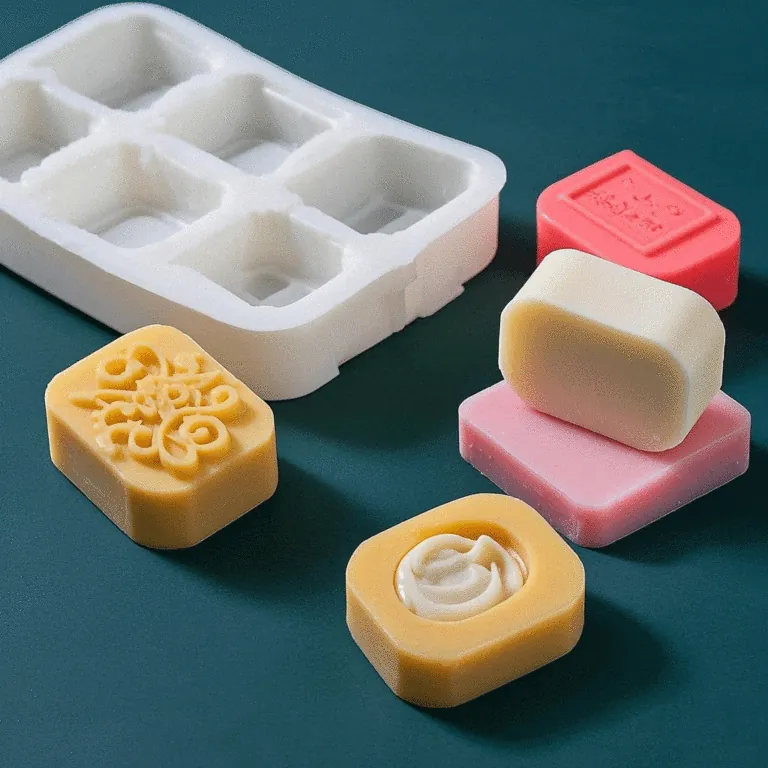
What soap and resin leave that water does not remove
| Pour that already happened | What stays in the face | Why food next is a bad idea |
|---|---|---|
| Cold-process or melt-and-pour soap | Fragrance, colorant, residual alkali | Taste, odor, and a pH argument on the next chocolate |
| Epoxy / UV resin | Amine blush, pigment, sometimes a sticky inhibition skin | Extraction pack no longer matches the article you ship |
| PU resin | Isocyanate leftovers, mold-release you sprayed | Food well now has a release film you cannot document |
| Wax / candle | Fragrance oil, dye | Same odor transfer as soap; still not food |
Caption above is a chemistry map, not a lab report. We do not invent extractives milligrams for a mixed tray.
The photo that would prove a cabinet failure: two wells from the same SKU, same lighting, a paper towel wipe from each. Food spare is dry and odorless. Craft well wets the towel and smells like the last pour. No hero product shot.
Two cabinets in a mixed building
A soap brand that also wants a chocolate bar is two RFQs, two travelers, two drying racks.
- Food cabinet: platinum food-contact RTV, no oil, no craft solvent, cavity-up dry until matte, stored away from sulfur rubber and latex.
- Craft cabinet: resin/soap/wax tools, named solvent if the vendor allows it, never the food rag.
If the geometry is the same mascot, you still buy two skins. Recast from one master is fine *if* that master never lived in the soap room and never got sprayed with release. Paying a tooling charge does not mean you may run both dumps in one well; archive rights and cabinet rights are separate lines.
Shore and jacket follow the dump, not the mascot. A 20A–40A chocolate tray and a 10A–20A resin glove that peels a figurine are not interchangeable just because the logo matches.
Mold Structure Decision is not a cabinet decision
Run RUUIPON Mold Structure Decision once per geometry, then duplicate the structure into the right cabinet:
- Flat back → open-back tray.
- Deep undercuts that still peel → glove / open-back skin.
- Undercuts that will not peel → two-part, plug, or core.
- Large wet casting (soap loaf, resin block) → mother mold / jacket so the skin does not sag 0.5–1.5 mm.
A split chocolate bar and a split soap loaf can share a *CAD* and still cannot share a *cavity*. Structure answers "how does it demold." Cabinet answers "what is allowed to touch this face." Mixing those two questions is how a buyer asks for one 8-up "for everything."
Typical shop values
Reference values only. Confirm material-specific limits against the supplier’s technical data and agree project acceptance criteria before production.
| Item | Typical shop value | Cabinet note |
|---|---|---|
| Food trays | platinum RTV, often 20A–40A | No oil, no craft solvent |
| Resin gloves | 10A–20A skin + jacket | Release on the *master* at pour, not on a food well |
| Soap loaf | firmer tray or jacketed skin | Fragrance stays; retire from food |
| Mix | 1:1 or 10:1 by weight | Off-ratio tack is scrap, not a wash problem |
| Platinum shrink | about 0.1–0.3% | Unrelated to odor transfer |
| Prototype | 3–7 business days after CAD lock | Lock includes the pour list |
| Production | MOQ 20 pieces per design | Two cabinets = two SKUs, each MOQ 20 |
| Simple 3D | USD $50 when that CAD scope applies | Geometry fee is not a dual-use waiver |
Worked example (anonymized)
A 12-cavity bear, 28 mm, requested as "chocolate and melt-and-pour soap, one tray, we'll wash." First chocolate witness released. Buyer then poured soap with a strong essential-oil blend. Next chocolate pick-up smelled like the soap. They asked for a harder Shore and a "food-safe coating."
We recast a *food* skin from the archived master (master had stayed in the food room). Old skin stayed a soap tool, labelled, own tote. Shore unchanged. $50 CAD was not charged — millimetres were already locked. Next PO: two line items, two cabinets, still MOQ 20 per design. Tooling charge on the original job did not include a right to dual-use the first skin.
One procurement mix-up
"Food-grade silicone" on a marketplace listing is not a license to dump resin on Monday and ganache on Tuesday. Food-grade, if it means anything here, is an article test for a named contact. A platinum catalyst is not a stamp. Tin-cure craft rubber that survived soap is the wrong start for the chocolate recast — we would not spec tin for the food cabinet just because the shape already exists.
We would not recommend
We would not recommend washing a soap or resin cavity back onto a chocolate or gummy line.
We would not recommend a spray coating to "reset" food contact.
We would not recommend one 16-up tray "for the whole catalog" when two of the SKUs are food and one is resin.
We would not recommend storing both cabinets in one polyethylene bag "to save space."
- Food only so far? - Yes -> Stay food cabinet: water, rinse, matte dry
- Food only so far? - Soap / resin / wax / unknown spray -> Retire from food
- Retire from food -> Keep as craft tool or scrap
- Retire from food -> Recast food skin from clean master
- Recast food skin from clean master -> New traveler, new rag, new tote
- Stay food cabinet: water, rinse, matte dry -> Need soap or resin too?
- Need soap or resin too? - Yes -> Second skin — same CAD, other cabinet
- Need soap or resin too? - No -> One SKU, food docs only
What to ask when you're buying
- Every pour this cavity will see in year one — food, soap, resin, wax — written, not implied.
- Two skins if two cabinets, or a written "food only" lock?
- Who keeps the master, and does it sit in the soap room?
- 21 CFR 177.2600 / LFGB on the food article after *your* wash, not a factory FDA stamp.
- ISO 3302-1 class if the drawing has one.
- After CAD lock, 3–7 business days, then MOQ 20 per design per cabinet?
RFQ copy-pack
[email protected] · +86 135 3006 2969 · Xinhe Blvd, Shajing, Bao'an
RUUIPON cabinet-split RFQ Pour list year one: food / soap / resin / wax / other If food + craft: two skins, two travelers? yes / no Master location: food room / craft room / us Docs: 177.2600 / LFGB / craft-only Structure: open-back / split / glove / jacket — or we run Mold Structure Decision Qty: prototype / MOQ 20 per design CAD: STEP locked / $50 3D if scope applies
Matched next step: send the pour list with the drawing. We will quote two SKUs if the list crosses food and craft. We will not write a wash SOP that makes one well legal for both. Prototype 3–7 business days after CAD lock. MOQ 20 per design.
Related: how to clean a custom RTV mold, food-grade silicone mold buyer spec, custom silicone resin molds, contact.
FAQ
Can I use a chocolate RTV mold for melt-and-pour soap if I wash it twice? No. Retire that cavity from food. Recast a food skin from a clean master if you still need chocolate.
Is platinum-cured the same as dual-use? Platinum is the usual food-start chemistry. It is not a permit to dump epoxy and then ganache.
We only did one resin test in one well — can we tape that well off? Tape is not a food-contact control. Scrap or recast the food SKU. Keep the test skin in craft.
Does MOQ 20 apply twice if I need food and soap? Yes. Two designs from a procurement view — two cabinets — even if the CAD is shared. Each is MOQ 20 pieces per design.
Will the $50 CAD cover converting my soap mold into a food mold? $50 is when we still have to model. A soap-used *cavity* is not converted by CAD. You need a new food skin from a master that never saw soap.
Custom silicone development · DFM & prototype support
CAD, drawing, photos or sample details