
How Custom RTV Kitchen and Food Molds Are Poured
Kitchen and food mold production here is pattern, often a flip, resin production mother, then batch RTV. Finished kitchenware goods may sit an HTV product or mold RFQ here, or a different LSR-tool RFQ - ask us.
 Kyler Yang · Founder8 min read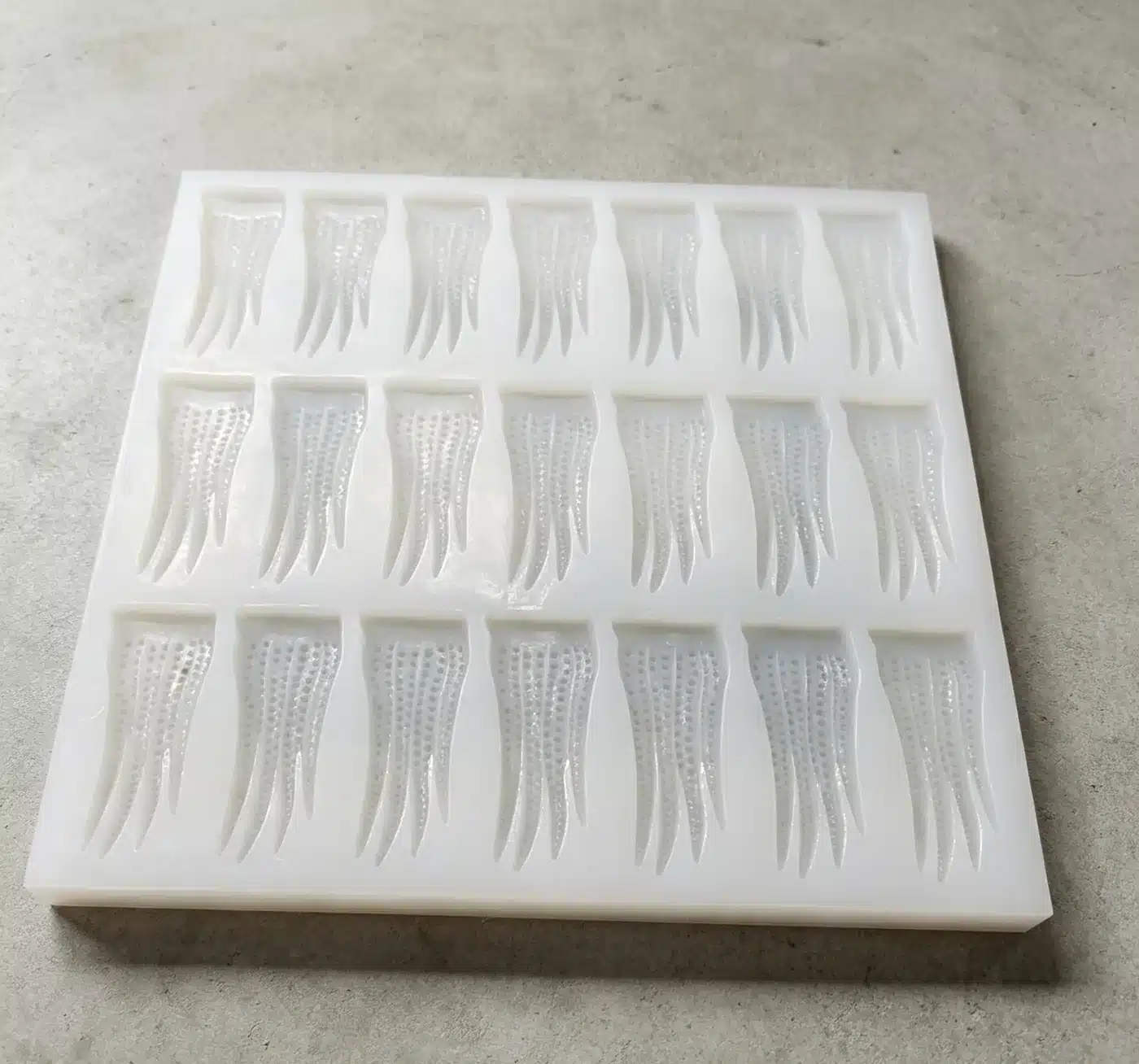
If you are quoting kitchenware mold production on this site, you are quoting a poured RTV tool, not one press family. Spatula parts, steamer parts, and tong overmolds belong on HCR compression or LSR injection. What ships here is the cavity you deposit into or freeze in. Food SKUs need platinum RTV, post-cured, cleaned, and tested to 21 CFR 177.2600 and/or LFGB sections 30/31. Tin-cure is not dual-market muffin chemistry. Heat limits are grade-specific. We do not invent an FDA-approved factory badge.

On this site the path is photos, sketch, or CAD, then a 3D-printed pattern, often a temporary silicone flip, a resin production mother, then batch RTV. The mother is not the pattern. Free DFM. HTV/HCR compression mold tooling is also quoted on RUUIPON.
The object on this page
After CAD lock we typically 3D-print a pattern, often flip a temporary silicone tool, cast a resin production mother, then pour batch RTV. Undercured print resin inhibits platinum - sticky face, failed lot. The mother is not the pattern. Inner cores need a pull path or you designed a cut mold. Soft RTV without a jacket / mother-mold support shell slumps. Flash at the split is a trim-and-wash step; 177.2600 expects a cleansed article. A 1 mm ice web and a 12 mm Bundt do not share a post-cure bake. Keep tin benches, sticks, and gloves off the platinum line. If your email still says "master, box, keys, jacket" as the buy, you are listing shop furniture, not the object.
Common mix-up
A lot of RFQs treat muffin trays, scraper blades, and overmolded tongs as one cycle. In the shop that usually means you have mixed an RTV pour, an HCR compression part, and an LSR overmold on one traveler and sent the wrong specimen to the lab. Catalog copy that says cut a resin master skips the pattern-vs-mother split. We will not quote that sentence.
Typical shop values
Reference values only. Confirm material-specific limits against the supplier’s technical data and agree project acceptance criteria before production.
| Item | Typical shop value |
|---|---|
| Path | Photos / sketch / CAD, 3D-printed pattern, often a flip, resin production mother, batch RTV |
| Envelope (mini-Bundt set) | About 180 mm across an 8-cavity set |
| Monthly bakes on a banquet tool | A few hundred |
| Shore / support shell | 10A-20A platinum RTV, fiberglass jacket / mother-mold support shell |
| Mix | Platinum 1:1 or 10:1; vacuum degas |
| Shrink | About 0.1-0.3% platinum |
| Post-cure | Ventilated; not shared with a 1.5 mm ice web |
| DFM / CAD / proto / MOQ | Free DFM; USD 50 when we edit 3D; 3-7 days after CAD lock; 20 pcs/design |
Worked example
A bakery wants an 8-cavity mini-Bundt, 180 mm across the set, food-contact, a few hundred bakes a month. Free DFM named a two-piece platinum cavity and a support shell. After CAD lock: pattern, often a flip, resin production mother, batch RTV, post-cure scaled to the thickest wall, wash, 177.2600 on that cavity. Molded scraper blades, if they want them as goods, are a separate an HTV product or mold RFQ here, or ask us if you need a high-volume LSR cold-runner tool traveler. An HTV/HCR compression mold for those blades, if they need the tool itself, stays a RUUIPON RFQ.
Stay on this page / skip this page
Stay when you need a poured kitchen or food cavity - muffin, Bundt, chocolate, ice.
Skip overmolded nylon tongs, mesh baking mats, and high-cavity consumer cups as goods - that carton can be an HTV product or mold RFQ here, or ask us if you need a high-volume LSR cold-runner tool. A shallow one-piece ice grid can skip a heavy support shell. A three-piece hollow chocolate with a stuck core is a cut mold - redesign the pull path before you pour.
We will not quote one cycle time for kitchenware molding. We will not mix muffin RTV pours, HCR scraper blades, and LSR overmolds on one traveler. We will not pour platinum against an undercured SLA pattern. We will not post-cure a 1 mm ice web in the same bake as a 12 mm Bundt. We will not cut a resin master as the written shop path.
Related: what tooling means, food-grade molds, contact.
What to send
- SKU (muffin, Bundt, chocolate, ice) vs finished kitchenware goods
- Photos, sketch, or CAD
- Monthly dumps or bakes
- Food-contact path: 21 CFR 177.2600 and/or LFGB sections 30/31
- Whether you also need finished parts (an HTV product or mold RFQ here, or ask us if you need a high-volume LSR cold-runner tool) or a compression mold (RUUIPON RFQ)
Send the pack to [email protected] or contact.
- CAD lock + free DFM -> 3D-printed pattern
- 3D-printed pattern -> Often: temporary silicone flip
- Often: temporary silicone flip -> Resin production mother
- Resin production mother -> Batch RTV + support shell
- Batch RTV + support shell -> Post-cure scaled to thickest wall
- Post-cure scaled to thickest wall -> Wash then food-contact pack if needed
FAQ
Can one RTV family run muffin trays and molded spatula blades? Muffin trays as custom molds are platinum RTV pours on RUUIPON. Spatula blades as goods are usually HCR or LSR an HTV product or mold RFQ here, or a different LSR-tool RFQ - ask us. Mixing families on one PO puts the wrong specimen in the lab.
Why do jacketed molds fail in the dishwasher when the rubber flask passed? The flask was the RTV face. The dishwasher attacks the support shell and any plastic frame. Qualify the assembly only if you claimed dishwasher.
Is trim flash a food-contact issue? Yes. 177.2600 expects a cleansed finished article. Wash after trim.
Do we post-cure thin ice tools in the same oven cycle as thick Bundts? Not as a default. A 1.5 mm web and a 12 mm Bundt are different bakes.
May we print use steel wool for burnt sugar on an RTV mold? No. Abrasive that cuts the food-contact face ends the qualified surface.
Custom silicone development · DFM & prototype support
CAD, drawing, photos or sample details