
Custom Silicone Molds for UV Resin Dumps | RUUIPON
UV resin in RTV is a light-cure dump, not epoxy amine stick. Inhibition of the dump, yellowing the cavity, open-back vs split. Typical shop. MOQ 20, $50
 Kyler Yang · Founder7 min read
A UV-resin RTV mold is a cavity you flood with a light-cure dump and hit with a lamp - not an epoxy well that stuck because of amine, heat, or a missed release. UV resin is thinner, cures from the light path, and can leave a tacky skin where the lamp never saw (a deep undercut, a tinted pour, a mold that shades the back). The rubber still wants platinum 1:1 or 10:1, vacuum, and a structure that peels or splits. Epoxy stick is a different failure page. We will not spec the same SOP for both just because both are "resin." Food cavities and UV jewelry do not share a well.
On this site the path is photos, sketch, or CAD, then a 3D-printed pattern, often a temporary silicone flip, a resin production mother, then batch RTV. The mother is not the pattern. Free DFM. HTV/HCR compression mold tooling is also quoted on RUUIPON.
Does not apply when the dump is 2-part epoxy or PU, when the well is chocolate, or when you wanted a steel tool. We would not UV-cure inside a 40 mm-deep block and blame Shore when the lamp never reached the core. CBD/THC: tooling only, no product claims.
Light path is the fill path
UV dump cures where photons arrive. A deep, tinted, or glitter-loaded pour skins on top and stays wet against the rubber. That wet layer can swell or smear a 10A-20A face over repeats even when epoxy would have gone rigid. Open-back trays help because you can lamp from the back through a thin skin *if* the rubber is not heavily pigmented. We usually keep the *tool* unpigmented or lightly tinted so you can see fill; coloring the mold rubber is a different article.
Split vs open-back: flat charms and coasters → open-back. Domed cabochons and rings → two-part with a sprue, and you still need a lamp angle into the split or a cure outside the mold. Structure Decision: if it will not peel, do not force a glove and then under-cure the hook.
Platinum food-grade rubber is still a *craft* tool once it sees UV resin. Do not wash-and-switch to gummies.
The photo that would prove a UV-mold spec: lamp distance noted, cavity depth in millimetres, open-back vs split, a witness charm with a fully cured back. A purple-glow lifestyle shot is not a light-path spec.
- Depth vs lamp? - deep / tinted -> Open-back thin skin or cure outside
- Depth vs lamp? - shallow clear -> Open-back tray often enough
- Open-back thin skin or cure outside -> Undercuts peel?
- Open-back tray often enough -> Undercuts peel?
- Undercuts peel? - no -> Two-part + sprue
- Undercuts peel? - yes -> Glove or open-back
- Two-part + sprue -> Platinum 1:1 or 10:1, vacuum
- Glove or open-back -> Platinum 1:1 or 10:1, vacuum
Yellowing, swell, and stick that is not epoxy
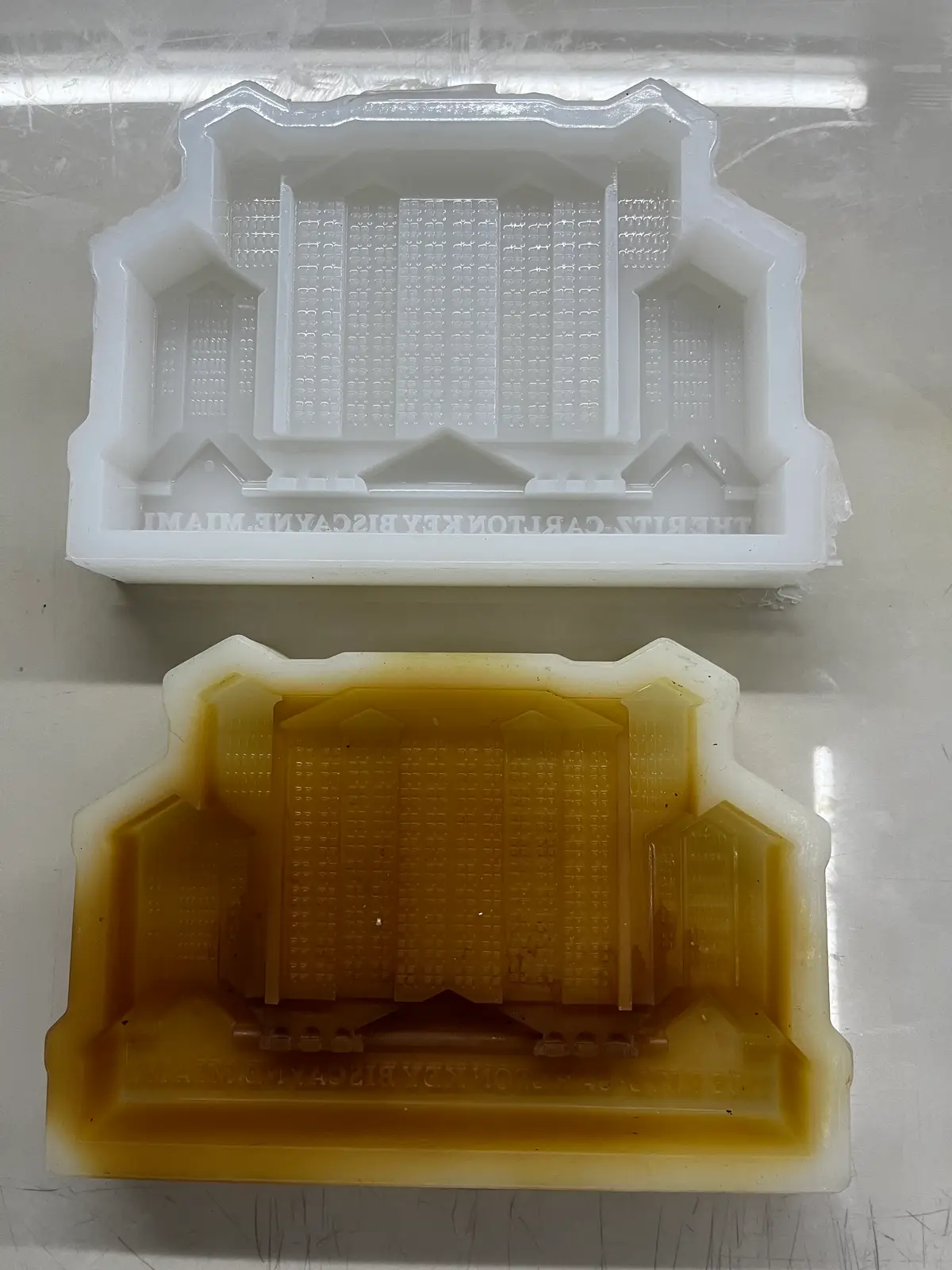
Some UV systems yellow or embrittle the cavity over repeats. That is dump chemistry, not "cheap silicone." PU still usually kills rubber faster than UV; epoxy heat can cook a well. Rank the dump on the RFQ so we do not promise a food-tray life number on a jewelry SKU.
Stick in UV is often: undercured dump (lamp), sharp undercut, no draft on the master, or a still-green platinum face. It is less often the amine story from 181. Confirm: does the dump still smear? Lamp longer *outside* the well, then demold. Do not torch the rubber.
ISO 3302-1 M2 is a rubber class on the charm if you spec it. It is not a UV hardness.
Pressure-potting UV in the mold is a cousin of pressure-casting, not a substitute for a lamp path. A pot can collapse bubbles in a still-liquid dump; it cannot finish a cure in a shadowed undercut. If you pressure and then lamp through a thick steel-lid pot, you just shaded the dump again. Lamp in air after demold when the geometry is thick.
Failure: tacky back on a 12 mm dome
Symptom: face hard, back against the rubber wet; cavity starts to feel greasy after a week of SKUs.
Cause: lamp never reached the back; pigmented dump; thick open-back that you treated like a 3 mm coaster.
Confirm: a thin-film coupon of the same UV on a polypropylene sheet under the same lamp. If that coupon snaps and the dome back smears, the mold shaded the light.
Fix: thinner dump, lamp from both sides, or demold early and post-cure the charm in air. Recast the tool if the face is already swollen. We would not raise Shore A first.

Typical shop values
Reference values only. Confirm material-specific limits against the supplier’s technical data and agree project acceptance criteria before production.
| Item | Typical shop value |
|---|---|
| Mix / shrink | 1:1 or 10:1 by weight; platinum about 0.1-0.3% |
| Cavity Shore | 10A-20A for peel; 20A-40A trays |
| UV vs epoxy | light path vs amine/heat stick |
| Prototype | 3-7 business days after CAD lock |
| Production MOQ | 20 pieces per design |
| Simple 3D | USD $50 when that CAD scope applies |
| Drawing class | ISO 3302-1 M2 as a common default |
Stay on this page / skip this page
Stay when the dump is a light-cure UV resin and you need a platinum well that the lamp can actually see.
Skip if the stick is epoxy amine or heat - that is a different page. Skip sharing a UV well with chocolate. Skip finished jewelry parts - a different RFQ - ask us.
We will not quote a 20 mm-deep one-piece block for a tinted UV pour. We will not share a UV well with chocolate. We will not copy an epoxy release SOP onto UV without a light-path check. We will not pigment the rubber so heavily the lamp cannot see through an open-back. We will not raise Shore when the dump is still wet on the shaded side.
Related: epoxy resin molds, custom resin molds, contact.
Worked example: UV cabochon, 14 mm dome
Jewelry cabochon, 25 mm wide, 14 mm dome, buyer poured tinted UV in a one-piece open-back and lamped 60 s from the face. Back smeared; cavity went tacky by dump 8. We cut a two-part with a hidden sprue, thinner first fill, lamp, then back-fill, platinum 1:1. Prototype 3-7 business days after CAD lock. $50 CAD applied because the dome was a photo. Production MOQ 20 of that design.
Mix-up: all resins stick the same way
Epoxy stick, PU life-kill, and UV undercure are three diagnostics. Related: products - resin molds, contact.
What to ask when you're buying a UV-resin tool
- Peak thickness of the dump, and lamp type/distance you actually run?
- Clear, tinted, or glitter (light block)?
- Open-back vs split - can you lamp the back?
- Will this well ever see epoxy or food? Split those cabinets.
- After lock, 3-7 business days, then MOQ 20 / design?
RFQ copy-pack - UV resin RTV
Paste into [email protected]:
Object: RTV mold for UV resin, not an LSR/HCR part Dump: UV brand family if known, tinted? glitter? Max dump thickness mm and how you lamp Structure: open-back / two-part / you decide File: STEP / STL / photos with a millimetre scale CAD: mold-ready STEP OR USD $50 3D if that scope applies Prototype 3-7 business days after CAD lock, then MOQ 20 per design Who keeps the master
Send dump thickness and lamp path, not "resin mold please." We will not treat UV as epoxy - not a blank quote request. Phone +86 135 3006 2969. Xinhe Blvd, Shajing, Bao'an. Shop since 2018.
FAQ
Can I use a silicone mold for UV resin? Yes - a platinum RTV cavity sized to the light path. Deep tinted dumps need a split or a thin open-back, not a dark block.
Why is my UV still sticky in the mold? The lamp likely never reached that surface. Cure a coupon in air. If the coupon snaps, change geometry or lamp angle, not Shore first.
Is this the same as an epoxy mold? Same rubber family, different dump failure. Epoxy stick is not UV undercure. Do not copy the SOP.
Will UV resin ruin a food mold? Treat it as a cabinet split. Recast food from a clean master. Wash is not a reset.
Do you need $50 CAD for a simple charm? USD $50 when we must model. A mold-ready STEP with thickness locked can skip it. Clock is 3-7 business days after CAD lock; MOQ 20 per design.
Custom silicone development · DFM & prototype support
CAD, drawing, photos or sample details