
Food-Grade RTV Production: Inhibition, Bake, Face
Food-grade RTV production breaks on SLA inhibition, short post-cure, dirty pigment, tin benches, and abrasive wash. Don't score the food-contact face.
 Kyler Yang · Founder6 min read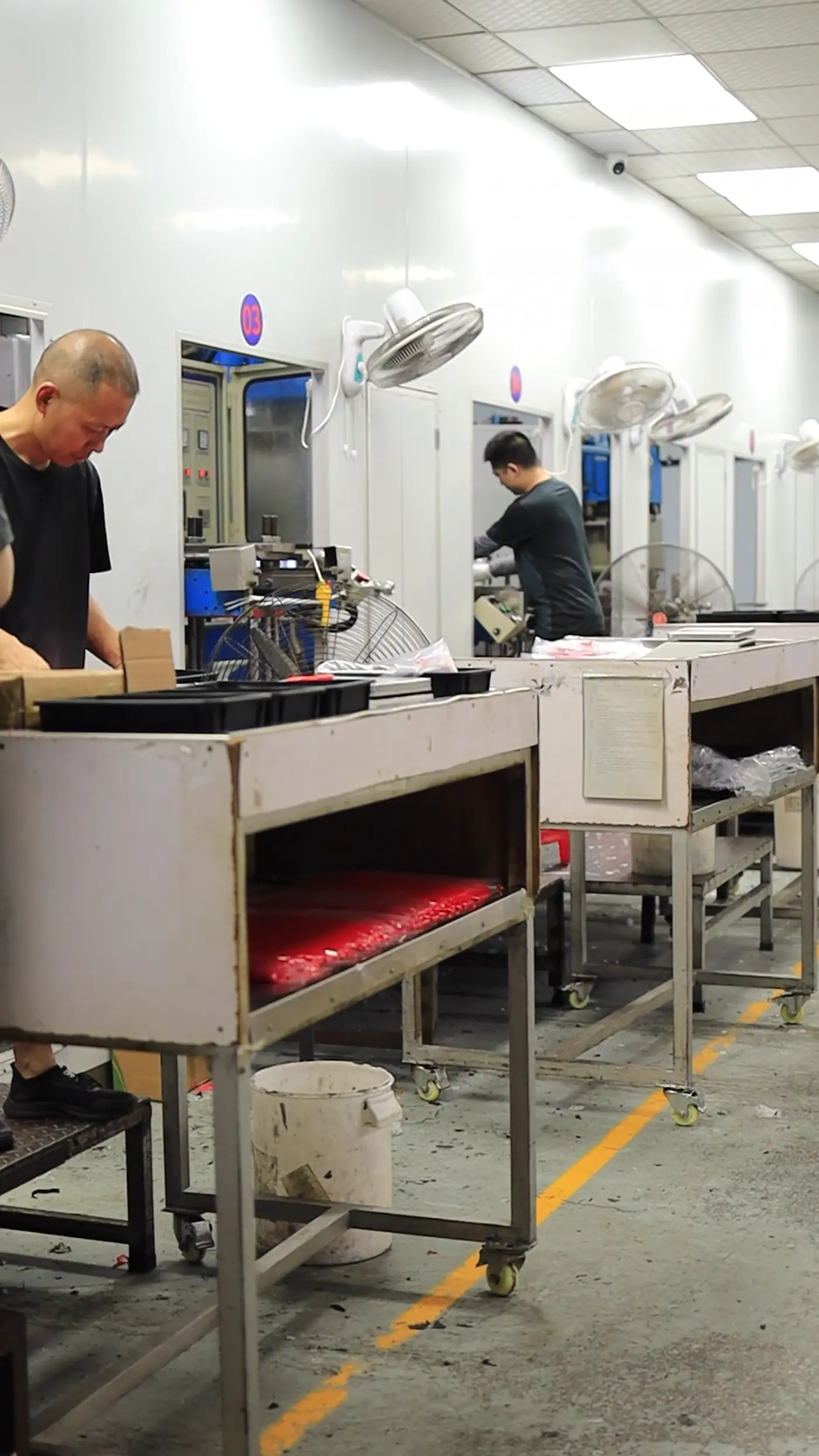
If you're troubleshooting a food-grade RTV pour, the hard parts aren't mysterious polymers. They're platinum inhibition on an undercured SLA master, a post-cure oven shared with the wrong thickness, a red masterbatch that was never food-contact, flash crumbs in a cake, tin soaps on the same bench, and a wash instruction that lets someone cut the face. Chemistry for dual-market cavities is platinum RTV. Methods are still 21 CFR 177.2600 and LFGB / BfR XV. Tin-cure RTV sitting on the same bench is a contamination challenge, not a backup compound. LSR sticky faces belong to a parts press; here the sticky object is the poured cavity.
Shop-order failures: inhibit, bake, pigment, flash, wash
Platinum addition-cure stops at sulfur, some tin soaps, certain amines, some 3D-print resins, and leftover latex. Tin on gloves from an industrial mold job is enough to leave a sticky platinum food skin. A sticky face is under-crosslinked; it will fail extractables and sensory.
Post-cure must be ventilated and scaled to thickness. Nested cups don't post-cure on the inner face. A 2 mm lid-shaped ice web and a 15 mm Bundt in the same oven for the same time under-bakes the Bundt. Dual-market programs then look "inconsistent." They aren't. The specimen wasn't finished.
Food-contact colorants only. Recycle from an industrial lot into a muffin is a compliance fail. Release agents must be food-contact or washed off to a 177.2600-cleansed article. Detached flash is a foreign body. A nicked master prints a nicked food face every recast — don't "improve" chocolate gloss with shop sandpaper at the bench.
Common mix-up: more catalyst to fix a sticky cavity
A lot of shops treat a sticky platinum face as "needs more catalyst." In the shop that usually means inhibition from the master or tin on the insert, and adding catalyst as a tribal recipe doesn't crosslink a poisoned surface. Clean and specify the master. Don't ship a tacky food mold.
What to ask when you're buying around these failures
- How is the SLA master post-cured, washed, and barrier-coated before a platinum pour?
- Are tin-cure benches, gloves, and knives dedicated away from food platinum?
- Post-cure chart: thickness family batched together, nested cups open to air?
- Pigment freeze, and is industrial scrap kept off this mill or mix table?
- Production wash: does it score logos before the part ships?
Worked example: 20-cavity logo gummy, sticky first pour
A candy line wants a 20-cavity logo gummy, 8 mm letter, platinum RTV, about 3,000 dumps a month. First pour stays sticky against an SLA master. Confirm: UV post-cure, wash, barrier coat missing. Fix the master, isolate tin, degas, pour, post-cure scaled to the 8 mm wall, 177.2600 aqueous plus BfR XV sensory on that cavity. Don't "fix" it with extra platinum.
When this article is the wrong quote
If the failure is an LSR injection short shot or HCR mill contamination on a *part* line, that's a different press and a different traveler. If you only needed a non-food resin mold, tin-cure inhibition control is lighter and you shouldn't buy dual-market post-cure capacity. Geometry can override: a deep undercut that only demolds with a knife will cut the face no matter how clean the bench is — redesign the split.
Related reading: why platinum RTV, how RTV molds are poured, quality control, custom RTV molds.
Production hold list you can audit
- Sticky face: hold the load; check master and tin isolation
- Missing post-cure chart: missing evidence the article matches the report
- Color change after the flask: restart
- Flash crumbs on the food face: wash or reject
- Scored logo from a factory brush: find the tote, don't pack it
Send photos of the sticky face or scored logo, the master material, and the post-cure chart if you have one. We'll say inhibit vs short bake vs grit, and what to change before the next pour.
We would not recommend more catalyst to fix a sticky face
We would not recommend pouring platinum against an undercured SLA master, sharing a post-cure oven across 2 mm and 15 mm walls, or recycling industrial trim into a food cavity. We would not high-pressure-wash a logo until it pits.
Sticky / smell / score:
flowchart TD
  F[Failure] -->|sticky vs SLA| I[Inhibition: finish master; isolate tin]
  F -->|German sensory fail| B[Post-cure chart vs thickness]
  F -->|scored logo| G[Factory brush or tote grit]
  I --> H[Hold the load; do not add catalyst]
  B --> V[Ventilate; retest same SKU]
  G --> N[Find the tote; recast if cut]
Typical shop values: 20-cavity 8 mm logo gummy
| Item | Typical shop value | | --- | --- | | Letter height | 8 mm; 20-cavity platinum RTV | | Monthly dumps | ~3,000 on a candy sheet | | Mix | Platinum 1:1 or 10:1; vacuum degas | | Shore | 10A–20A plus jacket | | Shrink | ~0.1–0.3% platinum | | Outer-row weight vs center | Edge often 3–6% heavy if the loaded sheet sags 0.5–1.5 mm |
Caption these as typical shop values, not a lot we measured.
FAQ
Why did platinum RTV go sticky only against the printed master? Inhibition. Undercured UV resin, tin, or sulfur stopped addition-cure at the face. Fix the master and hall hygiene. Don't ship a tacky food mold.
We passed 177.2600 and failed German sensory. Is the lab wrong? Usually the post-cure. US hexane and BfR XV organoleptic are different measurements. Dual-market means both. Extend and ventilate the bake, then retest the same SKU.
Can we reuse industrial RTV trim in a food cavity to cut scrap? No. Recycle streams mix oils, pigments, and catalysts the food article can't carry.
Is a high-pressure washer a good factory clean for muffin cavities? If it cuts or pits the food-contact face, it's a bad clean. Match the wash to a surface you'd still send to the lab.
Why do ice-tool webs tear only in cold warehouses then in freezers? Cold tear plus a web too thin or a knit at the pour. Don't tell users to pry with a fork. A fork scores the face and the next cube welds to the score.
Ready to order custom silicone molds?
Free quote for OEM/ODM projects. MOQ 20 · Prototype 3-7 days · FDA/LFGB available.